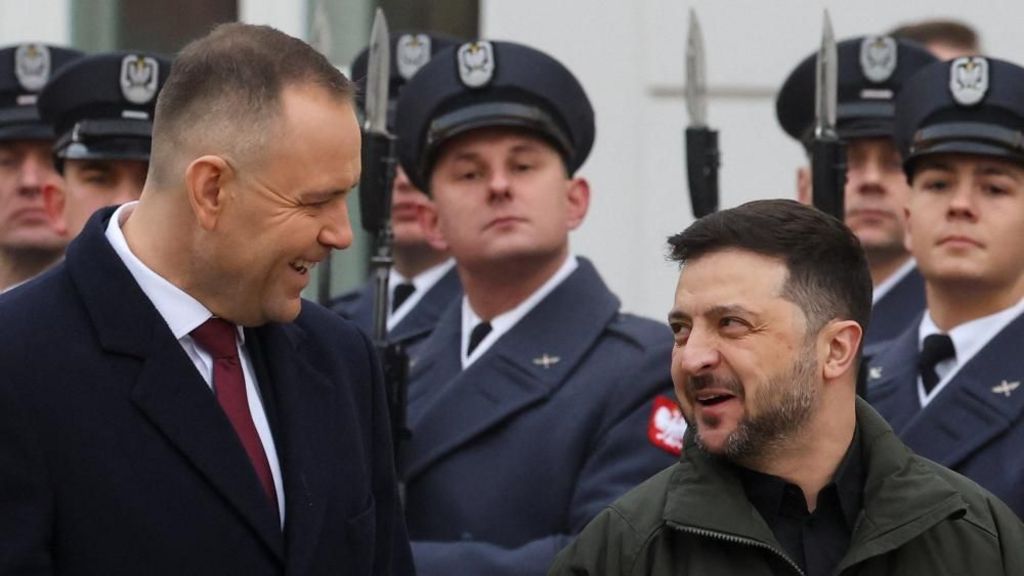
A deep diplomatic rift has opened between Ukraine and one of its most critical European allies, Poland, after a presidential decree from Volodymyr Zelensky honoring a mid-20th century Ukrainian nationalist military group reignited long-simmering historical tensions that now threaten to upend bilateral cooperation.
The conflict traces back to a late-May decree from Zelensky that renamed a Ukrainian Special Operations Forces unit after the Ukrainian Insurgent Army (UPA), a partisan group that operated across Eastern Europe between the 1940s and 1950s. For many Ukrainians, the UPA is enshrined as a symbol of national resistance, celebrated for fighting against three occupying forces: Nazi Germany, the Soviet Red Army, and interwar Polish governing authorities. Naming the elite military unit “Heroes of the Ukrainian Insurgent Army” was framed by Zelensky as an effort to honor the legacy of Ukrainian independence struggle, a tradition that remains resonant for frontline Ukrainian troops who today display the UPA’s red-and-black flag in combat against Russia’s 2022 full-scale invasion.
But the move triggered immediate and widespread outrage across Poland’s entire political spectrum. Warsaw accuses the UPA of perpetrating a targeted genocide of ethnic Polish civilians in the Volhynia region between 1943 and 1945, a massacre that historians estimate killed roughly 100,000 Poles. Polish President Karol Nawrocki condemned the decree as an unacceptable glorification of “bandits and killers,” a view echoed even by pro-Ukrainian politicians including Prime Minister Donald Tusk. Many Poles have framed the decision as a deep act of ingratitude, pointing to Poland’s unprecedented support for Ukraine since Russia’s invasion: Poland was the first neighbor to open its borders to more than 4 million Ukrainian refugees, and currently hosts nearly 1 million displaced Ukrainians, while also serving as a key hub for Western military aid to Kyiv.
The anger has escalated to the highest levels of state honors, with Nawrocki confirming he is actively considering revoking the Order of the White Eagle – Poland’s highest state decoration, awarded to Zelensky by then-President Andrzej Duda in 2023. The Polish president told reporters he has already held consultations with the Order’s governing council, and will announce a final decision “in due course.” Under Polish regulations, the honor can be revoked if a recipient is found to have committed an act that renders them unworthy of the distinction, though commentators note any formal revocation would require backing from Prime Minister Tusk, who has sought to de-escalate the standoff.
Hardline political factions in Poland have pushed for far more aggressive action against Kyiv. Opposition Law and Justice party MPs have called for a full sweeping reassessment of bilateral relations, while far-right Confederation leader Krzysztof Bosak has demanded Poland cut funding for the Starlink satellite internet services critical to Ukraine’s military operations, and block Ukraine’s EU accession process until Kyiv reverses the unit naming decree. Nawrocki himself went further, stating that Zelensky’s decision proves “Ukraine is not ready to join the European family.”
Kyiv has so far declined to issue a formal official response to the criticism, though Ukraine’s foreign ministry has stressed it never intended to cause offense to Poland. In a last-ditch effort to ease tensions, Zelensky’s chief of staff Kyrylo Budanov traveled to Warsaw over the weekend to meet with Polish officials ahead of the Order of the White Eagle council meeting. However, the diplomatic outreach failed to produce a breakthrough: following Budanov’s visit, Nawrocki moved forward with convening the honorary council to discuss revoking Zelensky’s award, and Tusk later acknowledged openly that “diplomacy has yielded no results.”
The growing rift has already produced visible ripple effects: Zelensky, who regularly departs for foreign trips from Poland’s Rzeszów Airport, chose this week to fly to the United Kingdom via Moldova instead. Tusk has clarified the airport remains open to the Ukrainian leader, saying “I am not going to tell him where and how to fly,” but the shift underscores the growing chill in relations.
Analysts warn that a formal revocation of Zelensky’s honor could trigger a full diplomatic rupture between the two neighbors, with serious consequences for both nations and the broader Western coalition supporting Ukraine against Russia. The growing discontent in Poland already threatens to overshadow a major upcoming conference on Ukraine’s post-war reconstruction, scheduled for later this month in Gdansk, with Polish foreign ministry officials indicating Zelensky may choose to skip the event entirely. Observers also note rising tensions could benefit right-wing Polish parties that have grown increasingly critical of continued military and refugee support for Ukraine, a shift that aligns with the strategic goals of the Kremlin.
Tusk has repeatedly pushed for de-escalation, urging both leaders to hold direct, honest negotiations to resolve the dispute before tensions spiral out of control. “Co-operation serves the interest of both our states and nations, while conflict serves Moscow’s interests,” he emphasized in a recent statement, framing continued bilateral unity as a critical national and continental security priority.