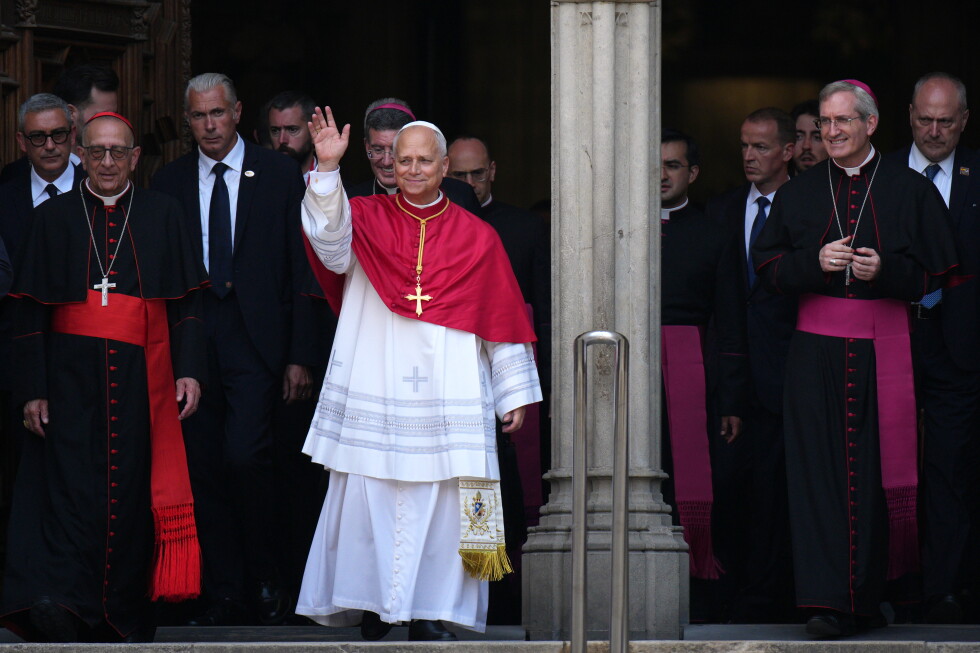
On Tuesday, U.S.-born Pope Leo XIV touched down in Barcelona for the second leg of his week-long visit to Spain, stepping straight into two of the nation’s most long-running and divisive cultural flashpoints. Days before his arrival, the pontiff had already sparked anger among FC Barcelona’s loyal fanbase with an unapologetic reveal: his soccer allegiance lies not with their beloved local club, but with their bitter historic rival, Real Madrid.
Aboard the papal flight bound for Spain, when asked about his sporting preferences, Pope Leo clarified: “The pope is for all teams, but Prevost is for Real Madrid” — a reference to his birth name Robert F. Prevost. Real Madrid’s official social media channels quickly shared the clip of the exchange, with fans joking online that the club is “the team of God.” Popular Spanish sports commentator Tomás Roncero of leading daily AS doubled down on the partisan tone in a viral video, claiming “the pope can’t be for Barça because it is a sinful club … in his heart he is of a pure and clean club like Madrid.”
Prior to arriving in Catalonia, the pope’s schedule in Madrid further cemented his public connection to the capital’s iconic club. He toured Real Madrid’s trophy-laden museum alongside club president Florentino Pérez, who gifted him a custom team jersey emblazoned with his full name. Thousands of Catholic worshippers also gathered at Real Madrid’s home stadium for a papal rally, where performers clad in the Holy See’s white and yellow colors juggled soccer balls for the crowd. In remarks at the event, Pope Leo declared, “Today the Church in Madrid has scored a great goal to always be remembered!”
For many Catalans and fans of non-Madrid clubs across Spain’s regionally diverse country, Real Madrid is far more than just a soccer team. It is widely viewed as a symbol of conservative central Spanish power, long tied to the national government and the Catholic Church as one of the core institutional pillars of the unified Spanish state — a framing that stings particularly in regions like Catalonia with strong separatist sentiment and distinct local identities.
That context made the pope’s soccer loyalty a sore point even before he arrived in Barcelona. Standing outside the iconic Sagrada Familia basilica — where Pope Leo will lead a major public Mass on Wednesday, the centerpiece of his Catalan stop — local office worker and lifelong Barça fan Eduard Modroño expressed disappointment. “A figure as important as he is shouldn’t take sides. Now that he has said that he supports Real Madrid, well, I am sorry, he has messed it up,” Modroño told reporters.
The second, far more politically charged controversy revolves around language use. Catalan, a tongue spoken by roughly 10 million people mostly in northeastern Spain, was brutally suppressed under Francisco Franco’s 20th-century fascist dictatorship. Decades after Franco’s death, Catalans remain fiercely protective of their language, and the fight to preserve its public status has been a core driver of the region’s independence movement, which reached a peak with a failed 2017 secession bid that remains a raw national wound.
Many Catalan activists and residents had publicly called on the pope to prioritize Catalan over Spanish during his public remarks in Barcelona, ahead of his onward journey to the Canary Islands. In a small but symbolic gesture to defuse tensions ahead of his visit, Pope Leo opened his first public address at Barcelona’s cathedral with introductory remarks in Catalan, alternating between the language and Spanish throughout his homily.
“Beloved brothers and sisters, it is with great pleasure that I start my visit holding the midday prayer at this cathedral,” he said in Catalan. Previous popes including John Paul II and Benedict XVI made small nods to Catalan during their 1982 and 2010 visits to the city, and the Spanish king regularly uses the language when visiting the region — though it remains rare for non-Catalan national politicians from central Spain to do so.
Even so, the gesture of a few opening words in Catalan has failed to satisfy many local residents and separatist politicians. During a brief meeting with the pope at the Spanish parliament on Monday, Míriam Noqueras of the pro-independence party Junts told him in English: “Speaking the language of the land that welcomes you is a wonderful act of love and respect. I hope you enjoy your visit to Catalonia, my nation.”
Barcelona’s archbishop Juan José Omella has sought to play down expectations, explaining that the pope prepared his remarks with full awareness of Catalonia’s linguistic history, but has no illusions about his own limited fluency. “The pope knew beforehand that he is coming to a country (Catalonia) where people speak a very old language that has never been lost through the centuries,” Omella told reporters. “He knows this and has prepared his speeches and his homily, while keeping in mind that he can only do so much and doesn’t want to end up looking silly in a language he doesn’t speak.”
For many locals, the language question outweighs even the soccer controversy. Even Modroño, the Barça fan who criticized the pope’s Real Madrid allegiance, says the failure to speak more Catalan is a bigger grievance. “It is a lack of respect not to speak entirely in Catalan,” he said.