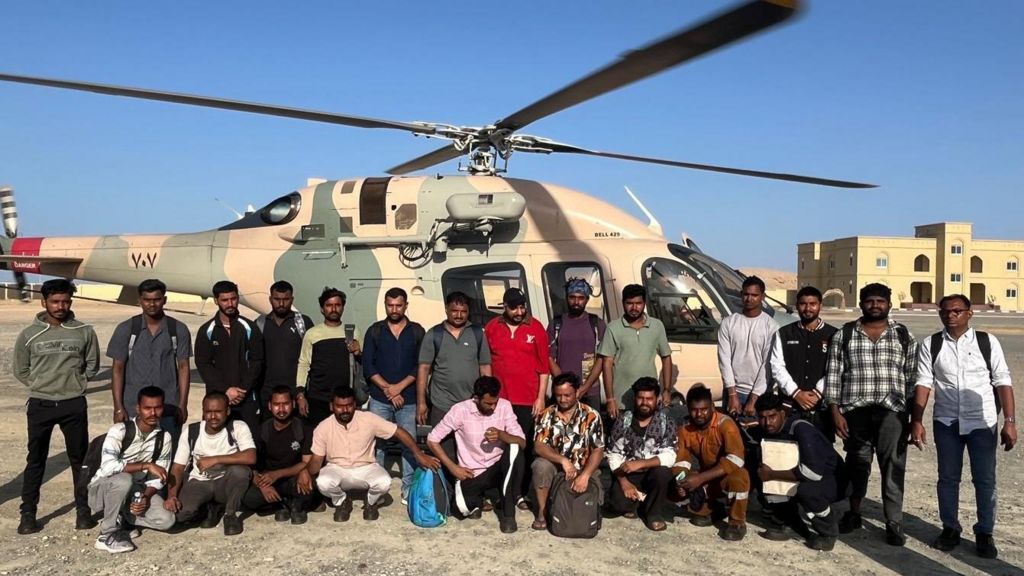
In an incident that underscores the escalating dangers to commercial maritime traffic in the Gulf region, all 24 Indian crew members aboard the stricken tanker MT Marivex have been successfully evacuated to safety following a strike by United States military forces off the coast of Oman. The event, which unfolded on Monday 8 June local time, is the latest in a growing string of disruptions to global shipping linked to rising geopolitical tensions between the U.S., Iran and Israel.
According to official confirmation from India’s Ministry of Ports, Shipping and Waterways spokesperson Opesh Kumar Sharma, the fire broke out on board the unladen Palau-flagged tanker at approximately 1:30 p.m. local time. Immediately after the blaze ignited, crew members transmitted urgent distress signals, reporting that the vessel was both on fire and at risk of sinking. Sharma confirmed that initial assessments confirmed all seafarers were unharmed, and Indian authorities had launched a cross-agency coordination effort to secure the crew’s safe return. The Indian government declined to offer immediate further details on the incident’s root cause at the time of the announcement.
Local Omani authorities led the evacuation operation, with helicopter crews extracting all 24 sailors from the burning tanker and transferring them to safety on Masirah Island, according to multiple Indian media reports. The Reuters news agency later confirmed that the MT Marivex had been previously targeted with U.S. sanctions over its alleged ties to Iranian oil networks.
U.S. Central Command later issued an official statement acknowledging the operation, saying that American military forces disabled the empty tanker after it violated the U.S.-led blockade on Iran by attempting to sail to an Iranian port. The statement detailed that an F/A-18 Super Hornet strike fighter launched from the USS Abraham Lincoln aircraft carrier fired a precision-guided munition at the tanker’s engineering and steering compartments after the crew refused to comply with U.S. military orders. The statement concluded that the vessel was no longer en route to Iran. The strike occurred south of the Strait of Hormuz, the critical global maritime chokepoint that carries approximately 20% of the world’s daily energy supplies during normal operations.
Two major Indian seafarers’ unions, the All India Seafarers Union and the Forward Seamen’s Union of India, monitored the incident from its onset. The All India Seafarers Union reported that it received the first distress alert from a crew member just moments after the fire started, and maintained constant communication with both the crew and responding authorities throughout the rescue. The Forward Seamen’s Union of India labeled the incident a “matter of serious concern,” calling for rapid action to protect the crew, provide support to their families back in India, and prioritize the safety of all commercial seafarers operating in the high-risk region. Both unions ultimately confirmed the safe evacuation of all 24 crew members.
The incident comes amid a months-long period of heightened risk for commercial shipping in Gulf waters, where rising geopolitical friction linked to the ongoing Iran conflict and U.S.-led enforcement actions have drastically increased security hazards for civilian vessels. Tensions between the U.S., Iran and Israel have already disrupted key shipping routes and driven a sharp increase in military activity across the Gulf of Oman and the surrounding Strait of Hormuz, leaving civilian seafarers caught in the crossfire of geopolitical competition.