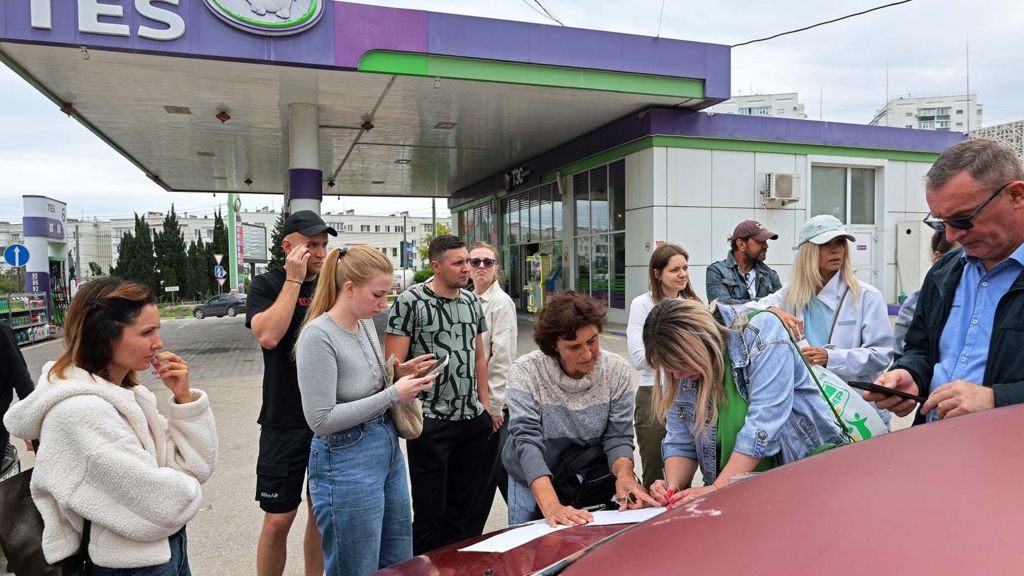
A severe fuel shortage has swept across Russian-occupied Crimea, with strict purchase caps imposed on consumers at most filling stations, after Ukraine’s sustained campaign of drone and long-range strikes shattered Russian supply routes into the peninsula. The crisis, which has hit both civilian populations and Russian military operations, traces its roots to two layers of Ukrainian targeting: months of long-range attacks on Russian oil refineries, and an intensifying recent push to disrupt overland logistics routes connecting Crimea to mainland Russia.
Russia illegally annexed Crimea from Ukraine in 2014, and the peninsula holds outsized strategic importance for Moscow: it serves as a key launchpad for Russian drone and missile strikes against Ukrainian territory, and is a top summer tourist destination for Russian travelers. Today, however, it is grappling with a logistical collapse that has left residents and tourists stranded, with fuel often unavailable even for those willing to pay inflated prices.
The most critical disruption stems from Ukrainian strikes on the main overland artery linking the southern Russian city of Rostov to Crimea via occupied Mariupol. Analysts describe this motorway as the central backbone of Russia’s occupation infrastructure in southern Ukraine. Clément Molin, an analyst with French think tank Atum Mundi, reports that since the start of May, Ukrainian forces have carried out more than 300 drone strikes on supply trucks traveling this route, including 30 fuel tankers, with the pace of attacks accelerating sharply in June. A June 7 strike further damaged a key bridge in northern Crimea’s Chonhar region, a critical crossing for Russian military and civilian traffic along the R-280 motorway, forcing a full suspension of traffic.
The impact of these strikes is immediately visible across Crimea. Videos shared on social media show multi-kilometer queues stretching outside petrol stations, with residents reporting wait times of up to 10 hours to access limited fuel supplies. At most filling stations, local residents are now restricted to a maximum purchase of 20 liters of fuel per person, available only via prepaid vouchers when stocks last. Russian tourists who traveled to Crimea before the crisis erupted are now trapped, unable to secure enough fuel to drive back to mainland Russia. Local occupation authorities have been forced to launch a dedicated emergency hotline to assist stranded visitors, while prices for petrol and diesel have skyrocketed amid tight supplies.
Sergei Aksyonov, the Kremlin-appointed head of Crimea’s occupation administration, acknowledged the severity of the crisis in a June 5 statement, admitting that current supply levels cannot meet civilian demand and confirming that hundreds of public buses have been pulled from service due to lack of fuel. The situation leaves Russia with few viable alternatives to restock the peninsula. The Kerch Strait Bridge, the only direct fixed link between mainland Russia and Crimea, has been restricted after repeated Ukrainian attacks and threats of future strikes. Oil industry expert Craig Kennedy, an associate at Harvard University’s Davis Center, notes that few operators are willing to risk moving fuel-laden trucks across the bridge, given its high-profile status as a target. Sea routes are also unworkable, after Ukrainian strikes took multiple Crimean ferries out of operation. That leaves only the Mariupol overland route – which remains exposed to constant Ukrainian drone attacks along its entire length.
The fuel shortage is not limited to Crimea. Ukrainian drone strikes have also disrupted logistics in other occupied Ukrainian regions, including Luhansk and Kherson. Occupation authorities in Luhansk have already banned all bus traffic on two key motorways leading to Mariupol and Crimea, urging local residents to avoid the routes entirely for “security reasons.”
The crisis is the result of a deliberate shift in Ukraine’s targeting strategy, experts explain. After months of disabling large-scale Russian oil refining capacity – Ukrainian President Volodymyr Zelensky estimates that nearly 40% of Russia’s primary oil refining capacity was put out of action in May alone – Ukraine has now expanded its campaign to target regional distribution and logistics networks. “This is having a more focused or concentrated impact on local populations and the military in certain regions such as Crimea,” Kennedy explained.
Yevhen Karas, commander of the 413th separate “Raid” battalion of Ukraine’s Unmanned Systems Forces, confirmed that disrupting Russian military fuel logistics is a core priority for his unit, which has carried out many of the recent strikes. Karas told the BBC that his drones face minimal effective resistance from Russian air defenses during most missions, allowing his unit to strike targets across occupied territory freely. “The main dish is Russian storage, oil and fuel tanks, buildings and even small bunkers with Russian officers,” he said.
Russia has accused Ukraine of causing civilian casualties in recent strikes, including reported attacks on a passenger bus in Kherson and a commuter train in Crimea that killed one person and injured another in early June. Karas did not directly address these specific incidents, but acknowledged that civilian collateral damage is a risk in the active combat zone. “This is a very busy area, and it is obvious that heavy trucks and large transport vehicles are all at risk of being hit, because the Russians use them,” he said. “Mistakes can happen, but this is not a deliberate targeting of civilian vehicles.”
Pro-Kremlin military analysts admit that the fuel crisis has impacted both civilian and Russian military operations alike. “The strikes that empty fuel stations for civilians also affect supplies to troops in the south,” the popular pro-Russian military analysis Telegram channel Rybar posted recently. “The logistics crisis does not distinguish between military and civilian needs, it hits everything at once.”
Beyond eroding Russia’s military capabilities, the campaign aligns with Ukrainian President Volodymyr Zelensky’s stated goal of “bringing the war home” to Russian-controlled territory, turning the disruption of conflict back onto populations and occupation forces that have operated in relative security on occupied Ukrainian land.