For more than seven decades, China and North Korea have framed their bilateral ties as a “blood-forged” alliance, rooted in their shared struggle during the Korean War. Yet for Beijing, this geographically proximate neighbor has long occupied a complicated position: it is a strategic buffer against U.S. military presence in Northeast Asia that China cannot afford to lose, but its unpredictable nuclear ambitions and independent foreign policy put it far beyond China’s full control. Now, as North Korea draws increasingly close to Russia, Beijing is moving to reassert its influence over this critical, volatile partner, ahead of an expected visit by Chinese leader Xi Jinping to Pyongyang this week.
Diplomatic observers widely frame Xi’s upcoming trip as less a celebration of historic friendship and more a calculated push to reinforce China’s leverage. For years, strains of mistrust have eroded the once-closer relationship between Beijing and Pyongyang, a shift that became starkly visible in 2024. The 75th anniversary of bilateral diplomatic relations passed with muted public messaging and little fanfare; China’s ambassador skipped North Korea’s national founding celebrations earlier that year, and no senior-level diplomatic exchanges took place across the entire year. This inactivity stood in sharp contrast to the rapidly warming public ties between Pyongyang and Moscow, a development that has quietly unsettled Chinese leaders.
Western diplomatic sources familiar with regional dynamics confirm that Beijing has grown increasingly concerned over the deepening partnership between North Korea and Russia. Following North Korea’s 2022 invasion of Ukraine, Pyongyang has dramatically expanded military cooperation with the Kremlin, culminating in a sweeping mutual defense pact signed during Russian President Vladimir Putin’s visit to Pyongyang in 2024. A BBC investigation estimates that roughly 2,300 North Korean troops have been killed fighting alongside Russian forces in Ukraine, and Pyongyang has been widely accused of supplying large volumes of ammunition to Russia’s war effort in exchange for Russian oil and economic aid. While this arrangement has sparked public alarm from Washington and its regional allies, it has also caused quiet anxiety in Beijing.
“China wants to ensure that its interests vis-a-vis North Korea are protected at a time of rapid convergence between Moscow and Pyongyang,” explains Ankit Panda, a nuclear policy specialist at the Carnegie Endowment for International Peace. China holds only one formal mutual defense treaty globally, and it is with North Korea. For Beijing, a scenario where Russia becomes the dominant external power in Pyongyang is far from ideal: a more confident, less economically dependent Kim Jong Un would almost certainly erode China’s historical leverage over the Korean Peninsula.
Scholars note that Beijing holds mixed views of the Pyongyang-Moscow rapprochement. On one hand, the closer alignment distracts U.S. attention and complicates American strategic planning across multiple global regions, a shift that indirectly benefits Chinese interests. On the other hand, expanding military ties between North Korea and Russia could trigger a far more robust military response from the U.S.-Japan-South Korea trilateral alliance, a development that would greatly increase security pressure on Beijing. This balancing act shapes China’s approach to North Korea’s nuclear program: Beijing has not publicly endorsed Pyongyang’s nuclear ambitions, recognizing that open support would draw deeper U.S. military involvement into the region, but it has also refused to confront North Korea head on. In 2022, China joined Russia in vetoing a U.S.-led United Nations resolution that would have imposed new sanctions on North Korea over its repeated missile tests. As Victor Cha, head of foreign policy at the Center for Strategic and International Studies, puts it: a hardline Chinese stance against Pyongyang’s nuclear program would only push North Korea deeper into Russia’s orbit.
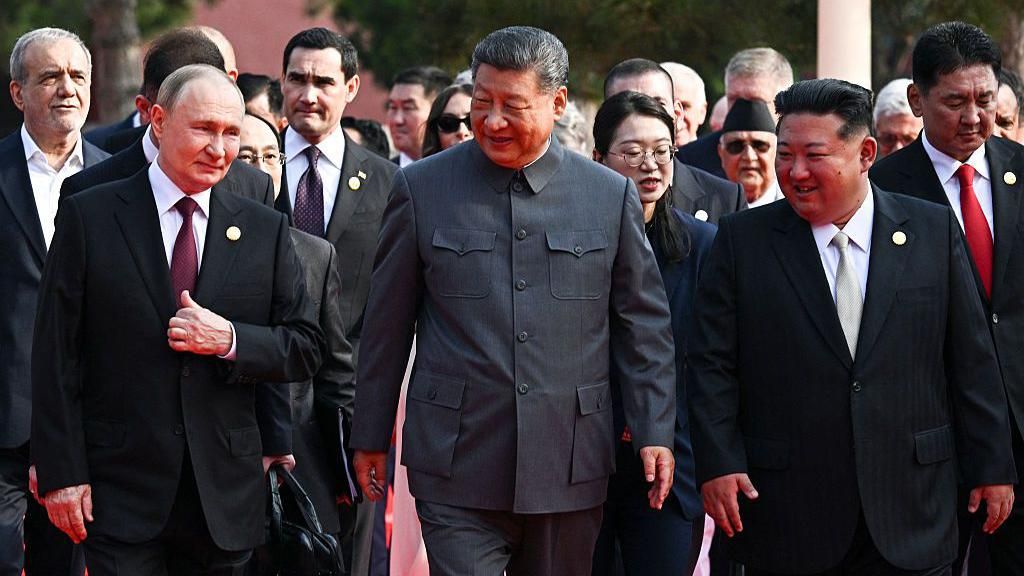
To pull Pyongyang back into its sphere of influence, Beijing has already taken incremental, calculated steps. Late last year, Xi invited Kim Jong Un to attend a military parade in Beijing, where he was placed prominently alongside Putin, marking the two leaders’ first formal summit in six years. During the meeting, Xi described the two countries as “good neighbours, good friends and good comrades bound by a shared destiny” and called for expanded strategic coordination, with no public mention of North Korea’s controversial nuclear arsenal. Trade ties have also deepened: Chinese exports to North Korea surged to roughly $2.3 billion (£1.7 billion) in 2025, the highest level recorded in six years, and cross-border passenger rail services between Beijing and Pyongyang restarted earlier this year following a six-year suspension. All these moves, analysts say, are designed to rebuild Beijing’s sway.
For Kim Jong Un, maintaining positive ties with China is also a pragmatic strategic choice. Kim cannot afford to alienate his largest historical source of economic aid, and there is long-term uncertainty in his alignment with Moscow: if the war in Ukraine ends, Russia’s need for North Korean military support could diminish significantly. Unlike an increasingly isolated Putin, Xi continues to host high-profile global diplomatic engagements in Beijing, giving China far more strategic leverage on the global stage than a war-weakened Russia. For Kim, balancing ties between the two major powers reduces the risk of being left reliant on a single, weakened partner.
This current push for rapprochement comes after decades of growing tension between the two neighbors. When Kim Jong Un inherited power from his father Kim Jong Il, he quickly shifted priorities away from the close alignment with Beijing his father had maintained. Instead, he accelerated North Korea’s nuclear and ballistic missile programs, conducting roughly 90 missile tests and four nuclear detonations in his first six years in office — more than both his father and grandfather combined. The rift deepened following the 2013 execution of Jang Song Thaek, Kim’s uncle, who was widely viewed in Beijing as a pro-China stabilizing force in Pyongyang. Xi responded with a rare public snub, visiting South Korea for the first time in 2014 before ever meeting Kim, a move that prompted Pyongyang to publicly label China a “turncoat and our enemy.” It was not until 2018, when international sanctions over North Korea’s nuclear program began to severely damage the country’s economy, that Kim made his first known foreign trip as leader, traveling by armoured train to Beijing to reset ties. After that summit, Kim always consulted Beijing ahead of any high-profile meetings with U.S. and South Korean leaders, sending a clear signal that Pyongyang would not negotiate over its future without China’s backing.
Today, the dynamic remains unchanged at its core: North Korea acts as both a strategic buffer and a persistent policy burden for China. It keeps U.S. military forces at a distance from China’s northeastern border, but its regular weapons tests consistently destabilize the regional security environment. For Kim, the relationship is equally transactional: he wants Chinese economic and diplomatic protection, but refuses to submit to full Chinese control. Neither side holds full trust in the other, but both recognize that continued engagement serves their core strategic interests for the foreseeable future, keeping the door open for dialogue despite underlying tensions.