Twelve months have passed since an Air India passenger jet bound for London slammed into the BJ Medical College hostel complex in Ahmedabad, leaving 260 people dead – 241 onboard the aircraft and 19 on the ground. For the local community that bore the brunt of the disaster, time has not erased the raw pain of loss, nor has it removed the mangled, burned wreckage that stands as a permanent reminder of that fateful June day.
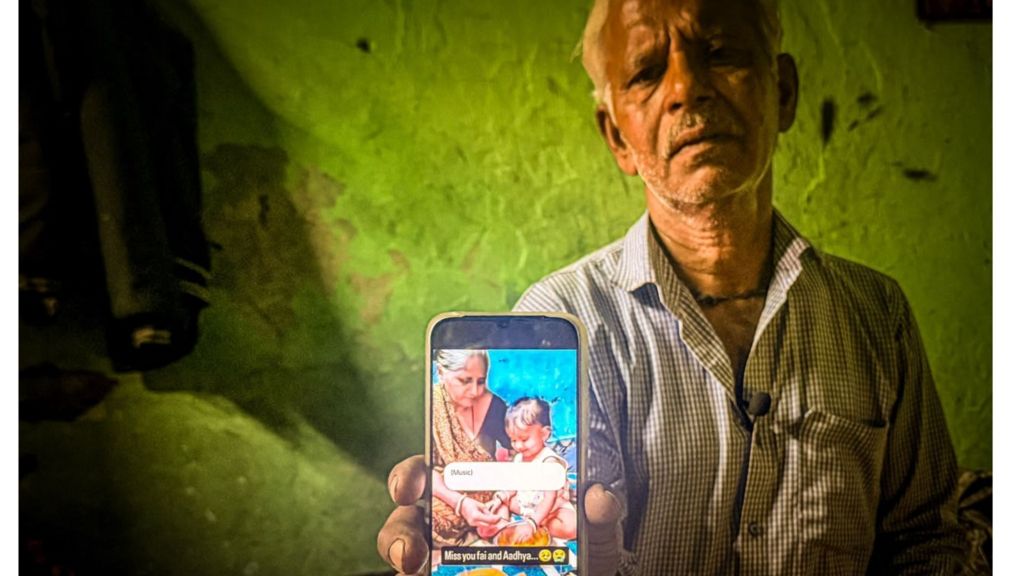
The first thing Prahlod Thakur sees every morning when he opens his eyes are the framed photographs of his wife Sarlaben and two-year-old granddaughter Aadhya, hanging on the flaking bright green walls of his small home, tucked between religious symbols, tarnished brass cookware, and decades-old fading family portraits. Both were at the college on the day of the crash: for 15 years, Thakur’s family ran a popular tiffin meal service for trainee doctors and staff at the adjacent hospitals, and Sarlaben was working the lunch shift at the hostel mess when the plane hit. When Aadhya, who rarely left her grandmother’s side, needed to use the restroom, the pair climbed the stairs together. Seconds later, the aircraft crashed through the building’s roof.
Thakur, working in another part of the campus that day, dropped everything and ran toward the thick black smoke rising from the wreckage. All he can recall now are fragmented, terrifying memories: the deafening explosion, searing heat, gas cylinders scattered across the destroyed kitchen, and his desperate, frantic search, calling Sarlaben’s name over and over through the rubble. For six days, Thakur and his family combed through every hospital, morgue, and relief camp across Ahmedabad, chasing unconfirmed leads and clinging to faint hope. It was only on the sixth day that they recovered the bodies of Sarlaben and Aadhya from a city mortuary.
Today, the loss feels as sharp as it did the day after the crash. “I just miss them,” Thakur says softly. “I see the photos and feel like crying.” Whenever a plane passes overhead – a daily occurrence so close to Ahmedabad’s airport, once just a familiar part of the city’s background hum – the old pain rushes back. “Whenever a plane passes by, we feel the same pain. We don’t even look at the sky,” he says. The 72-year-old now copes by replaying a short video on his phone, recorded just one day before the crash: in it, a tiny Aadhya carefully lifts a morsel of food to feed her smiling grandmother. Outside his window, another jet crosses the pale Ahmedabad sky. Thakur does not look up.
Unlike most disaster sites, where rubble is cleared and scars are smoothed over within months, the wrecked BJ Medical College hostel still stands, an open wound less than two kilometers from Ahmedabad’s airport. Its upper floors are ripped open to the sky, jagged slabs of exposed concrete hang loose, a smoke-blackened staircase vanishes into inky darkness, and soot streaks every concrete wall. Buried under the dust, broken concrete, and twisted steel beams, personal belongings – suitcases, textbooks, clothing – still remain, left untouched since the crash. Local officials have approved plans to raze the damaged structure and build a new hostel, but as the first anniversary approaches, the ruins still stand.
For the trainee doctors who study and walk past the wreckage daily, the crash left psychological scars that have yet to fade. Arman Khan Pathan, a second-year student, had just sat down for lunch when the crash struck. A collapsing section of wall pinned his legs under a heavy table, and as secondary gas explosions filled the room with dust and smoke, rescuers were pushed back to safety. Trapped, suffocating in total darkness, Arman managed to break a window with his bare fist, buying himself enough oxygen to stay alive until rescue workers pulled him out.
His best friend Aditya Dayal had been running late for lunch that day, and arrived at the scene just as Arman was freed. Aditya helped carry his injured friend out of the wreckage on a borrowed mattress to a waiting ambulance, but the images he saw that day have never left him. As trainee doctors, both young men had seen death before, but nothing prepared them for the scale of destruction they encountered that afternoon. Many victims were so badly burned they could not be identified, and the acrid smell of charred flesh and jet fuel still lingers in Aditya’s memory, sometimes rising unbidden a full year later. “It made me want to throw up,” he says. They still grieve for classmates who never made it out – young people who spent years working toward a medical career, their futures erased in seconds.
Other survivors carry physical scars that will alter their lives permanently. Brijesh, another student who was riding his scooter to the mess when the plane came down, still undergoes regular physiotherapy for severe burn injuries. Even through Ahmedabad’s sweltering summer heat, he must wear constant pressure garments to manage his healing, and struggles with simple daily tasks like turning the pages of his medical textbooks. When asked about the crash, he simply shrugs: “It happened. What can be done?” Like many students who pass the ruined hostel on their way to class, he has fallen into the habit of looking away, as if ignoring the wreckage can make the pain of what happened there disappear.
For local residents who live within meters of the campus, there is no choice but to live alongside the memory of the disaster. Vijay, who lives just 200 meters from the hostel, was at home when he heard the explosion. He jumped on his motorbike and rushed to the scene, joining hundreds of local residents who pulled survivors from the rubble, brought blankets and water to the injured, and assisted emergency services in the chaotic first hours after the crash. The images he saw that day still haunt his sleep. “Wherever I look, there is fire,” he says. “Someone’s head, someone’s hands.”
In the weeks after the crash, media attention faded, ambulances and news crews departed, and the hard, quiet work of rebuilding began. Meenakshi Parikh, the college’s dean, bore the weight of keeping the institution running while the entire community grappled with overwhelming grief. She describes the aftermath as not one tragedy, but dozens layered into one: distraught parents searching for missing children, injured students recovering from physical and psychological trauma, overworked staff, and families waiting days for DNA identification results to claim their loved ones. One memory that has stayed with her is of a father who lost his son, daughter-in-law, and granddaughter, who refused to leave the morgue without seeing his family. When officials explained DNA testing was required to confirm identities, he told them, “My eyes are the DNA test.” Parikh says she understood exactly what he meant.
Slowly, the rhythms of campus life returned: classes resumed, exams were held, and a new cohort of first-year students arrived. As the first anniversary of the June 12 crash approaches, the college has planned a quiet commemoration: a prayer service for the lost, a community blood donation drive, and the planting of memorial trees on campus. But Parikh is clear that moving forward with daily life is not the same as moving on from the disaster. “There wasn’t one moment when I felt I had processed it,” she says. “It was a gradual process of settling back into life.”
Investigators are expected to release their final official report on the cause of the crash in the coming weeks. For the past year, public attention has focused largely on the passengers of the London-bound flight and the unanswered questions about the plane’s final moments. But in Ahmedabad, a quieter, more persistent question lingers: how do communities live with catastrophe when the wreckage stays, and the grief remains an unspoken part of daily life?