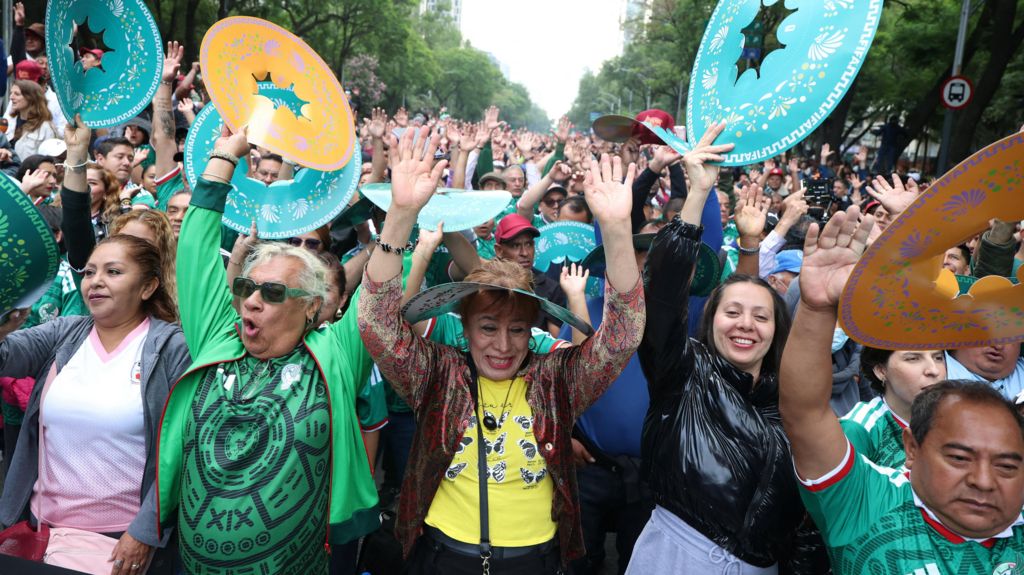
Forty years after the stadium spectator wave cemented its global reputation under the name ‘Mexican wave’ during the 1986 FIFA World Cup hosted in Mexico, Mexico City is stepping forward to claim a new world record for the largest collective wave in history.
The current Guinness World Record for the biggest wave has stood for nearly 18 years: it was set at a NASCAR racing event in Tennessee, United States, in 2008, when 157,574 spectators joined together to create the sweeping, rippling crowd movement that has become a staple at sporting events worldwide. To beat that mark, Mexico City organizers picked an unconventional non-stadium venue that would allow the wave to spread continuously across thousands of participants: Paseo de la Reforma, the city’s world-famous tree-lined arterial boulevard modeled after European grand thoroughfares.
On Saturday, thousands of enthusiastic participants lined both sides of the iconic avenue. Dressed in the Mexican national men’s football team’s signature bright green jerseys in many cases, the crowd went through multiple practice rounds before making their official record attempt. Chants of “Mexico! Mexico!” rang out across the avenue as thousands raised their arms in unison to carry the ripple down the length of the road. For now, official adjudicators from Guinness World Records are still reviewing data from the attempt to confirm whether Mexico City has successfully taken the crown from the 2008 NASCAR record.
Beyond the record attempt, the event reignites a long-running conversation about the origins of the beloved crowd tradition. While the global name ‘Mexican wave’ ties the phenomenon closely to Mexico thanks to its 1986 World Cup breakthrough, many credit American entertainer George Henderson, widely known as Krazy George, with creating and directing the first full stadium wave. Henderson says he first launched the movement during a 1981 Major League Baseball game between the Oakland Athletics and New York Yankees in California.
Recalling the moment, Henderson explained that the Athletics had dropped two straight away games, and by the third inning he was eager to try something completely new to energize the crowd. He worked with fans across three sections of the stadium to explain the concept. The first two attempts fell flat, but the third successfully rolled all the way around the stadium, and the fourth produced a steady, continuous ripple. ‘The place was going crazy,’ Henderson recalled. The game was broadcast nationally, so the concept quickly spread to fans of other sports across North America. It was not until the 1986 World Cup in Mexico, however, that the wave was broadcast to a massive global audience, turning it into an international staple of spectator culture – and earning it the widespread ‘Mexican wave’ name outside North America.
The uniquely collective nature of the wave has even drawn the attention of scientific researchers curious about crowd behavior. In 2002, a team of physicists from the Hungarian Academy of Sciences’ statistical and biological physics group decided to map the mechanics of the stadium wave, publishing their findings in the leading academic journal *Nature*. Lead researcher Illes Farkas told NPR the team was drawn to the project because crowd behavior in a wave offers a clear parallel to particle movement in physical systems.
The team’s analysis uncovered clear, consistent patterns: most spontaneous human waves travel clockwise around stadiums at a speed of roughly 12 meters, equal to about 20 spectator seats, per second. Shockingly, they also found that a self-sustaining wave only needs between 25 and 35 initiating participants to get rolling in a large stadium. The mathematical model the team used to explain the wave’s spread was not newly developed for the research – it was the same framework already used to describe how forest fires spread and how electrical signals propagate through heart tissue.
Beyond the physics, sports writer Chris Hunt, author of *World Cup Stories*, told the BBC that the wave also carries varied cultural meanings depending on context. While it is most commonly seen as a symbol of collective joy and excitement among spectators, it can also signal boredom when a match is slow or uneventful. ‘When a match drags and nothing interesting is happening on the pitch, fans feel it’s a way to make the most of the money they paid for their tickets,’ Hunt explained. Context also dictates whether a wave is likely to appear at all: a tense goalless draw in the final minutes of a World Cup final will almost never see a wave, while a lopsided friendly match with the home team leading handily is far more likely to spark the familiar ripple.