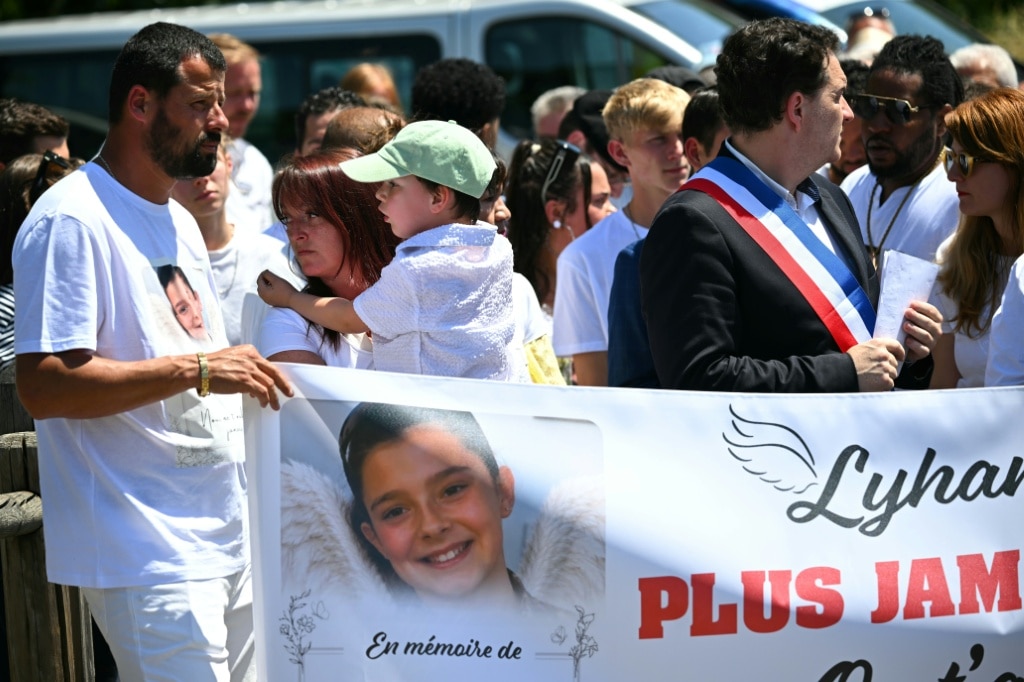
On a scorching Sunday afternoon in the small southwestern French town of Fleurance, a sea of 6,000 people dressed in white filled the streets, gathering for a silent march to honor the life of 11-year-old Lyhanna, whose suspected murder at the hands of a repeat accused child abuser has sparked nationwide outrage over systemic failures in France’s justice system.
Lyhanna disappeared near Fleurance on May 29, and her body was recovered by investigators just last week. She was last seen climbing into a car driven by the prime suspect in the case, 41-year-old Jerome B. — the father of one of Lyhanna’s classmates, a man who had previously worked at local schools and faced four separate prior allegations of child rape and sexual abuse, none of which resulted in a conviction. Jerome B. was arrested and charged with abduction before Lyhanna’s body was found, and he remains in custody as investigations continue.
The grieving family of the young victim led the procession through Fleurance, with Lyhanna’s father and local community members carrying a lead banner emblazoned with the words “Lyhanna. Never again! We love you, we miss you.” Lyhanna’s mother followed a few steps behind, accompanied by her son, while the crowd fell completely silent, many holding white flowers to honor the victim. Per the family’s explicit request, no national political figures participated in the march, though local elected representatives joined the gathering. The public anger over the case has already reached the highest levels of the French government: President Emmanuel Macron last week publicly condemned the “unacceptable” lapses that allowed Jerome B. to remain free despite multiple child abuse allegations, while Justice Minister Gerald Darmanin took the unusual step of issuing a formal apology to Lyhanna’s family, saying he was “furious” at the systemic failures in how the justice system handled prior complaints against the suspect.
For many marchers, the tragedy hit close to home, and many shared that they joined to push for long-overdue changes to how France handles child sexual abuse cases. Karine Camus, a 41-year-old marcher who was a victim of sexual violence for a decade, said “It could have happened to my family, to my son, to my daughter,” adding that young victims must be encouraged to speak out about their abuse. Manola Martin, a pensioner who was raped when she was 17, said she attended the march to stand up for her daughters and granddaughters, echoing a widely shared sentiment when she said “Unfortunately, the justice system does nothing for these people.”
Anger over the case spilled over outside the march as well: at the entrance to the nearby village of Montestruc-sur-Gers, where Jerome B. lived with his family, the village entry sign was covered Sunday with a white sheet marked with the slogan “death penalty for paedophiles.” The case has sent a deep shockwave through the tight-knit community of 6,000 residents, sparking renewed national calls for reform of how French authorities handle and investigate allegations of child sexual abuse.