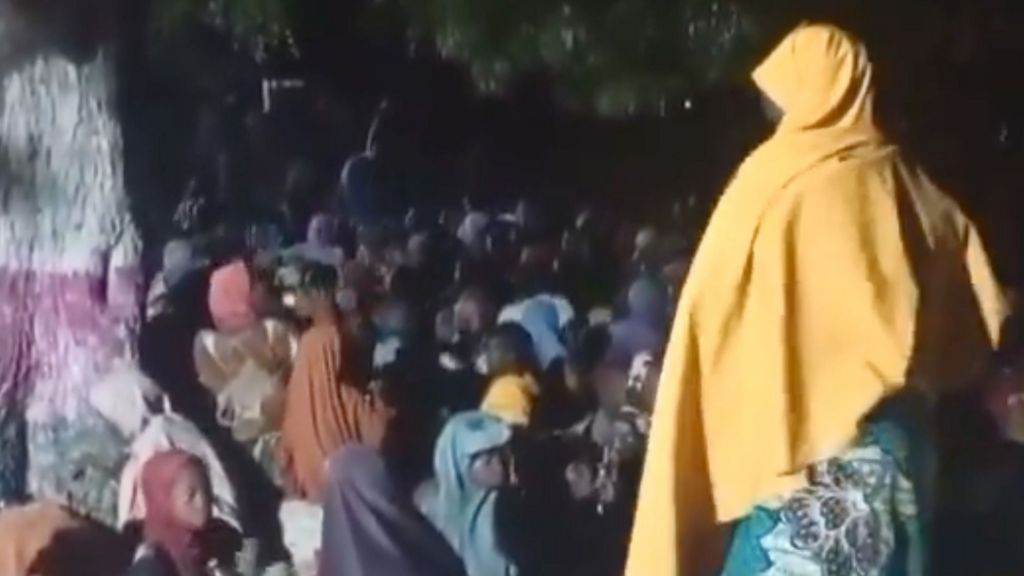
A large group of captives held by Boko Haram jihadists in Nigeria’s northeastern Borno State has been freed from a remote mountain stronghold, ending months of harsh captivity, though conflicting accounts have emerged over who is responsible for the operation.
The hostages, most residents of the majority-Muslim Ngoshe community near the Cameroon border, were abducted in early March as locals gathered to break their daily Ramadan fast. The Nigerian military confirms at least 360 people were rescued, while a local youth organization, the Borno South Youth Initiative, puts the total number of freed captives at 416.
In an official statement, military spokesperson Lieutenant-Colonel Haruna M Sani framed the operation as one of the most ambitious hostage rescues the Nigerian armed forces have carried out in the northeast. The weeks-long mission, built on detailed intelligence, struck the Boko Haram hideout in the Mandara Mountains under cover of darkness, catching the insurgents off guard. Facing the rapid, overwhelming force of advancing troops, Sani said many fighters fled into the surrounding rugged terrain and others surrendered without resistance.
However, local community groups have pushed back against the military’s account. Samaila Kaigama, president of the Borno South Youth Alliance (Bosaya), said his organization spent weeks negotiating with Boko Haram to secure an unconditional release, and accused government forces of trying to take credit for work led by local mediators. In a public Facebook video, Kaigama criticized “government boys” for claiming glory for the community-led effort.
According to Nigerian authorities, all freed hostages have received initial medical screenings, and are receiving ongoing care after their ordeal. Tragically, two young infants did not survive the harsh conditions of their prolonged captivity, dying from exhaustion exacerbated by the mountainous terrain, Daniel Bwala, special adviser to Nigerian President Bola Tinubu, confirmed in a post on X.
The release comes at a time when the Tinubu administration faces growing public backlash over soaring insecurity across the country. The presidency has publicly commended the military for the operation, and local officials have stated that work is underway to secure the Ngoshe area so that the freed captives can return to their homes and farms. Officials also noted that a small number of abductees are believed to have escaped into Cameroon during the operation, and cross-border efforts are ongoing to bring them home safely. On Sunday, the Nigerian military released photos and videos showing the freed hostages resting under trees overnight following their rescue, matching images posted to the official Nigerian Army social media channel.
Mass kidnapping has become an endemic tactic for armed groups across Nigeria in recent years, with criminal and insurgent factions targeting soft, high-vulnerability locations including remote villages, schools, churches and mosques to generate revenue through ransom payments. While Nigerian law bans the payment of ransoms to abductors, analysts confirm that payments from desperate hostage families, intermediaries, and in some cases state officials have continued, directly fueling the cycle of abductions across the country.
The 2014 kidnapping of 276 schoolgirls from the northeastern village of Chibok remains one of Boko Haram’s most notorious attacks, with roughly 90 girls still missing after more than a decade. During the group’s insurgency, captives were often forced into sexual slavery, domestic servitude, or coerced into serving as suicide bombers.
Boko Haram first launched its armed campaign to establish an Islamic state across northern Nigeria in 2009. While the group no longer controls the large swathes of territory it held at the height of its power in the early 2010s, it and its splinter factions (including the Islamic State West Africa Province) retain the capability to carry out regular attacks and kidnappings across the country’s northeast.
Nigeria has received international support to counter ongoing insurgency and kidnapping threats. Earlier in 2024, a small contingent of U.S. military personnel deployed to the country to train local armed forces and provide intelligence support. Just last month, Nigerian and U.S. forces announced they had carried out a joint operation that killed a senior Islamic State leader in the region. Nigeria’s security challenges remain multifaceted, overlapping threats that include Islamist insurgency, criminal kidnapping gangs, intercommunal land clashes, and separatist unrest in the country’s south.