As vote counting continues across California’s 2026 statewide primary elections, the days-long wait for final results has sparked familiar political friction, with former President Donald Trump amplifying baseless claims of electoral fraud to criticize the state’s widely used vote-by-mail system. Here is a breakdown of why results are taking longer to finalize, and what the current state of key races looks like.
California, the most populous U.S. state, has more than 23 million registered voters, and state law automatically sends a mail-in ballot to every registered voter ahead of any election. Currently, around 80% of all ballots cast in the state are submitted by mail, requiring a multi-step, labor-intensive process to sort, verify signature matches against official voter records, and count each ballot. Under state rules, any mail-in ballot postmarked by Election Day (June 2, 2026, this year) and received by county election offices no later than June 9 is considered valid, regardless of when it arrives. Additionally, provisional ballots and ballots with mismatched or missing signatures require extra follow-up: voters are notified of issues and given until two days before certification to correct any errors.
State law grants California’s 58 counties up to 30 days after Election Day to complete counting, with final results required to be submitted to Secretary of State Shirley N. Weber by July 3, and official certification scheduled for July 10. Most county results are expected to be finalized by June 15, nearly two weeks after polls closed.
Weber emphasized in an election night statement that the delayed outcome is entirely standard, urging Californians to remain patient. “California elections officials prioritise the right to vote and election security over rushing the vote count. We have a process that by law ensures both voting rights and the integrity of elections,” she said.
But Trump has seized on the delay to spread unsubstantiated claims of widespread Democratic electoral misconduct, repeating false assertions he first promoted after his 2020 loss to Joe Biden. “Democrats are stealing” the California election, Trump claimed Thursday, repeating his longstanding criticism of universal mail-in voting. He has also pushed baseless claims that federal prosecutors in Los Angeles are investigating voter fraud; California Governor Gavin Newsom’s office refuted the claim on social media as another lie about the state, while a spokesperson for the U.S. Attorney’s Office in Los Angeles declined to comment on Trump’s remarks to the BBC. Trump has also called on Congress to pass his proposed Save America Act, which would mandate proof of U.S. citizenship for voter registration, and previously issued an executive order to restrict mail-in voting by creating federal voter eligibility lists, a move experts and critics say exceeds presidential authority.
Newsom’s office has pushed back against the misinformation, reposting an official explainer of the vote counting process on social media, noting that state officials also wish results could be finalized more quickly.
As of Thursday, the Associated Press reports that roughly 56% of all ballots have been counted. In the high-profile race for California governor, where Newsom is term-limited and dozens of candidates are vying to advance to the November general election, early partial results show Republican Steve Hilton, a British-American former television host, holding a narrow lead with 27.6% of the vote (1.42 million votes counted). Trailing closely behind are Democratic candidates Xavier Becerra, a former Biden cabinet secretary, with 25.6% (1.32 million votes), and billionaire climate activist Tom Steyer with 19.8% (1.02 million votes). Under California’s jungle primary system, the top two vote-getters advance to the general election in November, regardless of partisan affiliation. Trump publicly congratulated Hilton on his early lead Wednesday on social media. Political analysts stress that Hilton’s lead could shift dramatically as millions of remaining outstanding ballots are counted in the coming days.
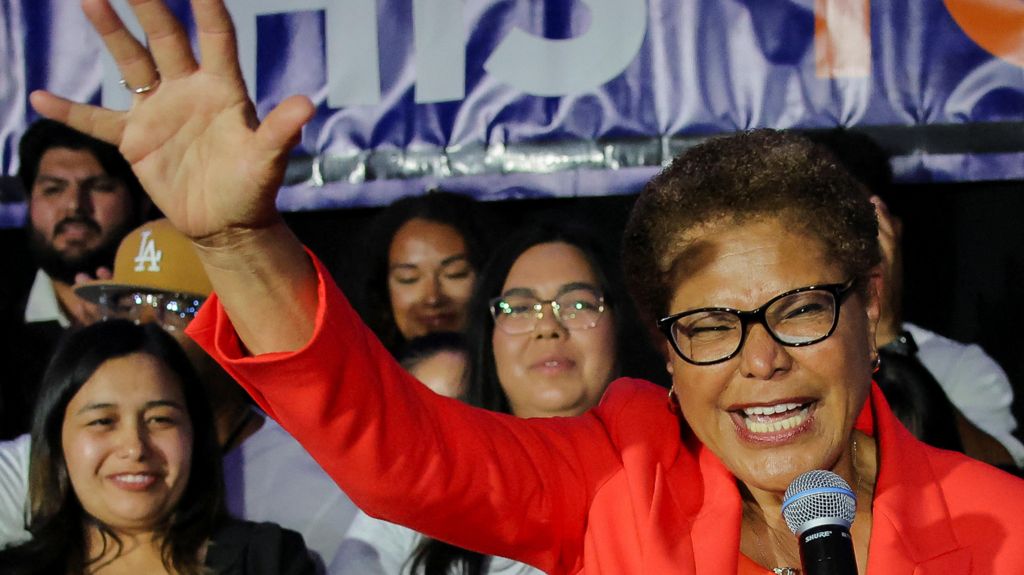
In the Los Angeles mayoral primary, incumbent Mayor Karen Bass has secured a spot in the November runoff, but made history as the first sitting mayor in more than two decades to fail to reach the 50% vote threshold needed to avoid a runoff. As of Thursday’s count, Bass holds 35% of the vote. The race for the second runoff spot remains too close to call: reality TV star Spencer Pratt holds 29.9% of the vote, while Democratic city council member Nithya Raman trails close behind at 22.8%.
The sheer scale of Los Angeles County contributes heavily to the extended counting timeline: the county is home to nearly 6 million registered voters, a larger voting population than 41 U.S. states, and the city of Los Angeles itself is the second most populous city in the country. Despite the delays, election officials note that the slower timeline is a deliberate feature of California’s election system, designed to protect ballot access and ensure every valid vote is counted.