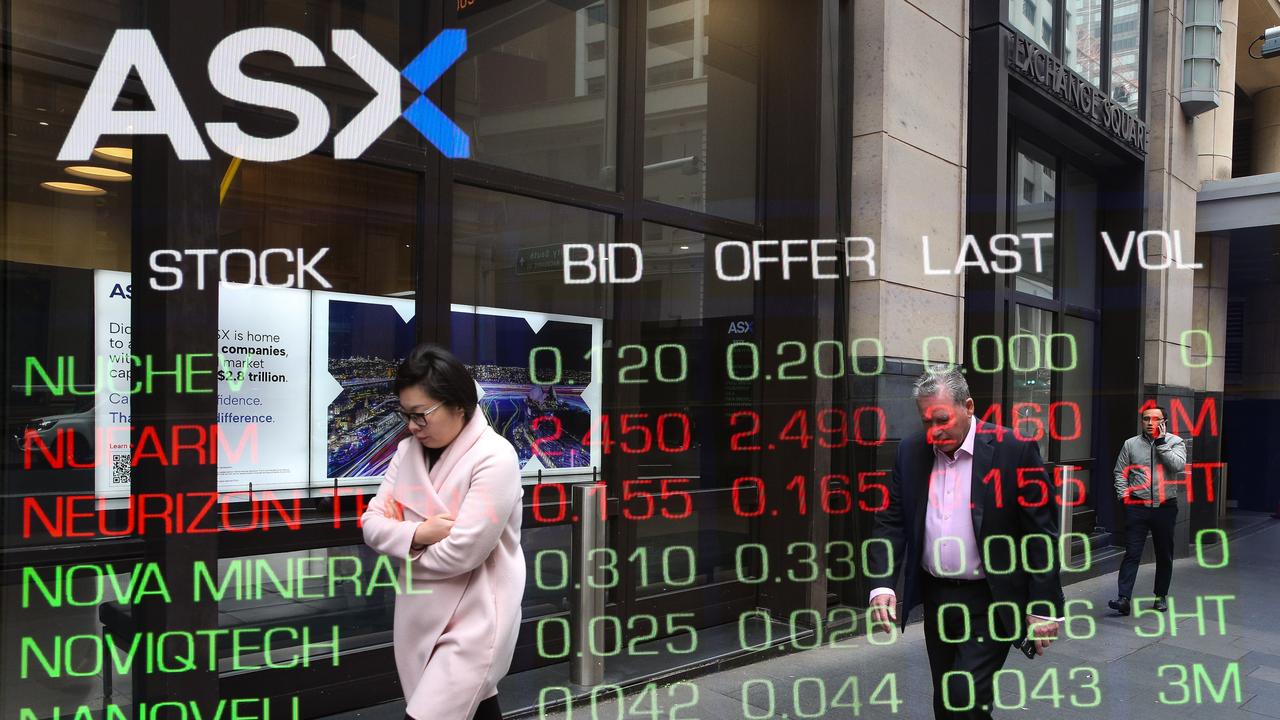
Just 24 hours after Australia’s benchmark share index notched an all-time record high, a wave of volatility spurred by developments in the Middle East and a sector-wide pullback for mining stocks erased all recent gains, leaving the country’s major markets in negative territory on Thursday trading.
The benchmark S&P/ASX 200 finished the session down 99.60 points, a 1.13% drop that closed the index at 8686.10. The broader All Ordinaries index followed a similar trajectory, falling 100.30 points or 1.11% to end at 8916.90. The Australian dollar also weakened slightly against its U.S. counterpart, slipping 0.12% to settle at 71.25 U.S. cents. Of the 11 market sectors tracked by the ASX, six closed in negative territory, with the steepest losses concentrated in mining, telecommunications and technology stocks.
Among the hardest hit were Australia’s two largest mining giants, BHP and Rio Tinto, which fell more than 3% each to close at $62.80 and $188.08 respectively. The drop came just one day after the firms’ stocks hit record highs. Fortescue Metals extended recent losses to fall a further 4.11% to $21.02, while gold miners Northern Star Resources and Evolution Mining dropped 6.08% and 3.04% to close at $20.39 and $12.10 respectively.
Cameron Curko, chief investment officer at wealth management firm Pitcher Partners, noted that shifting iron ore supply dynamics also weighed heavily on investor sentiment for the sector. Expanded production at the large Simandou iron ore deposit in the Republic of Guinea is accelerating, he explained, sparking fears of an oversupplied global iron ore market in the near term. “It also follows a period of extreme exuberance for the sector, so some pullback is not surprising,” Curko added.
Outside of mining, major listed companies also posted steep losses: Telecommunications leader Telstra fell 2.93% to $4.97, while top technology firms including accounting software provider Xero dropped 4.19% to $80.40, logistics software firm WiseTech Global fell 2.93% to $40.14, and health technology firm Life360 tumbled 4.03% to $21.66.
Much of the day’s market movement was driven by breaking news from the Middle East. Earlier in the day, an Iranian missile attack damaged Kuwait’s international airport, and U.S. military forces carried out targeted strikes near the Strait of Hormuz—one of the world’s busiest and most critical global oil chokepoints—raising fears of disrupted energy supplies that initially sent oil prices surging. That upward momentum faded quickly after Israel and Hezbollah announced a ceasefire along the Israel-Lebanon border, and Brent Crude Oil futures ultimately fell 1.1% to settle at $US96.78 per barrel by market close.
Justin Lin, an investment strategist for Global X ETFs, explained that repeated false starts for peace negotiations in the Middle East have left markets cautious of reacting to headline news, prompting a broad flight to safe assets during Thursday’s session. “The distinct mood across markets today was a retreat to safety, with consumer staples and utilities leading the way while materials and information technology lagged,” Lin said. “This came despite oil prices moving lower on news of a ceasefire between Israel and Lebanon, a development that has historically supported the Australian market and more risk sensitive exposures.”
Not all stocks closed in negative territory on Thursday. Treasury Wine Estates was a standout gainer, soaring 13.11% to close at $4.66 after the winemaker reaffirmed its full-year projected earnings guidance of between $480 million and $490 million alongside plans to cut up to a dozen low-performing wine brands from its portfolio. On the other hand, medical imaging technology firm Pro Medicus slipped just 0.25% to $159.23 after announcing a new five-year, $16 million contract with Ohio State University Wexner Medical Center.