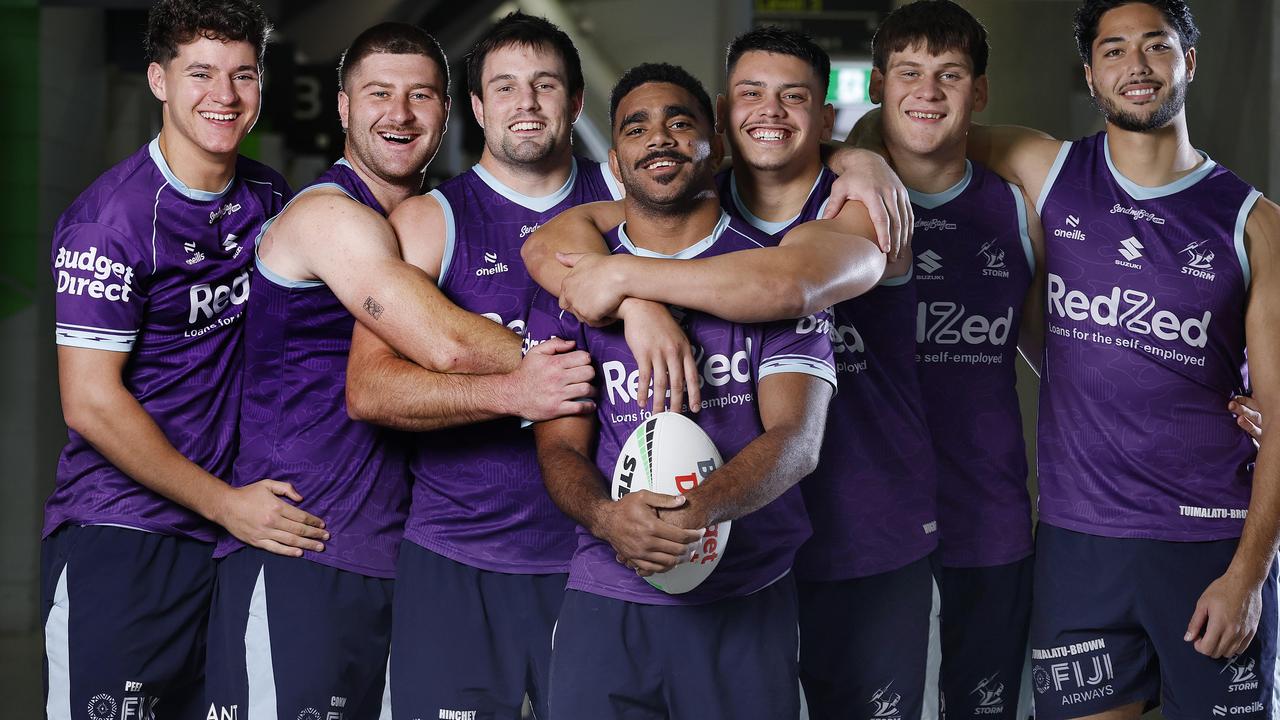
For years, the Melbourne Storm has focused on one strategic mission: unearthing homegrown rugby league talent across Victoria and nurturing it locally, rather than watching promising young athletes leave the state for opportunities elsewhere. Now, the club’s years of investment in grassroots development are beginning to deliver a new golden generation of players that could reshape the club’s future for decades to come.
Before the club launched its groundbreaking “Road to AAMI Park” initiative, Melbourne Storm leadership faced a persistent problem: top junior prospects were forced to leave Victoria because there was no clear, supported route to the National Rugby League (NRL) first grade. Only a small handful of local juniors had ever successfully made the jump to the top competition, a gap the club was determined to close. Today, the program’s impact is already clear, with fullback Sua Fa’alogo – a local Victorian product – emerging as one of Melbourne’s standout performers so far this season. Fa’alogo has become the public face of the club’s youth development success, and club leaders say he is just the first of many promising young athletes to rise through the new system.
Seven players from Melbourne Storm’s 2024 (corrected from 2025 per context) Jersey Flegg under-21 premiership-winning squad have already earned their first NRL call-ups this season, capitalizing on an injury crisis that opened up unexpected first-team opportunities at the club. Hugo Peel, Siulagi Tuimalatu-Brown, Gabriel Satrick, Preston Conn, Angus Hinchey, Cooper Clarke and Stanley Huen all helped defeat Penrith in last year’s under-21 grand final, and all made their NRL debuts in 2025. The long-term goal of the program is to see dozens more local juniors follow this path into the top-tier NRL system.
Melbourne Storm chief executive Justin Rodski explained the strategy was developed in partnership with the NRL specifically to grow rugby league’s footprint and build a robust development pipeline in Victoria. “There was a rich nursery of young talent across rugby codes in this state, so our priority was to build a genuine pathway with quality coaching and development opportunities that let young players stay close to home in Victoria, rather than forcing them to leave,” Rodski told NewsWire. “Seeing seven of these players, who came through the system together, make their debuts this season has been incredibly rewarding. Even though the opportunity came because of our injury crisis, it has let these young players step up together, which is exactly what we hoped for.”
Rodski pointed to a proven pattern across the most successful NRL teams of the past 20 years: championship-winning squads are almost always built around a core of players who grew up and developed together from a young age. “We’re really hopeful that this group is that next core for us,” he said. “These young talent coming through the system, play together, develop together, and ultimately become first-grade NRL players together. Get that right, and you have a group that can carry the club into its next golden generation.”
Among the seven debutants, 20-year-old forward Cooper Clarke has already emerged as the biggest early success story. Early impressions from his first NRL season suggest the young middle forward is on track for a long and impactful top-flight career, and he has already re-signed with the club through to 2029. Clarke says he is proud to have watched his former junior teammates earn their own opportunities alongside him. “It’s really special that the club prioritizes local juniors coming through, and that we can be the example for the next group coming up,” Clarke said. “It proves that if you put in the work, it doesn’t matter where you start – you can be playing NRL in just a year’s time, or in the lower pathways. It might take longer for some, but seeing us do this can inspire the kids coming after us. It’s been an absolute honor to be here with all these guys and watch each of them get their chance.”
Gabriel Satrick’s journey to the NRL is arguably the most inspiring of the group. The young dummy-half made his debut against the Canterbury Bulldogs last month, and the entire small communities he comes from turned out to celebrate his milestone. Satrick’s maternal family hails from Hope Vale, while his father is from Yam Island in the Torres Strait, which has a total population of just 275 people. He grew up in Yarrabah, a small Queensland community of around 2500 people, and nearly the whole town turned out to watch his debut: more than 50 locals traveled to Melbourne to cheer him on, while hundreds more gathered in the local park with popcorn and a projector to watch the game live.”
“Everyone in Yarrabah was so proud and excited,” Satrick said. “It was a big deal, everyone knew about it, and everyone turned out to the park to watch. It was really emotional for me, because it’s been such a long journey to get here. I left home when I was young to move to Ipswich, and I’ve been away from my family and community for six years. To see it all pay off like this is just incredible. Satrick added that he has learned a huge amount from Melbourne’s star hooker Harry Grant in his first weeks in the top squad.
For the Melbourne Storm, this wave of homegrown debutants is more than just a short-term solution to an injury crisis: it is proof that a years-long bet on local youth development is working, and the foundation for a dominant new era of NRL competition.