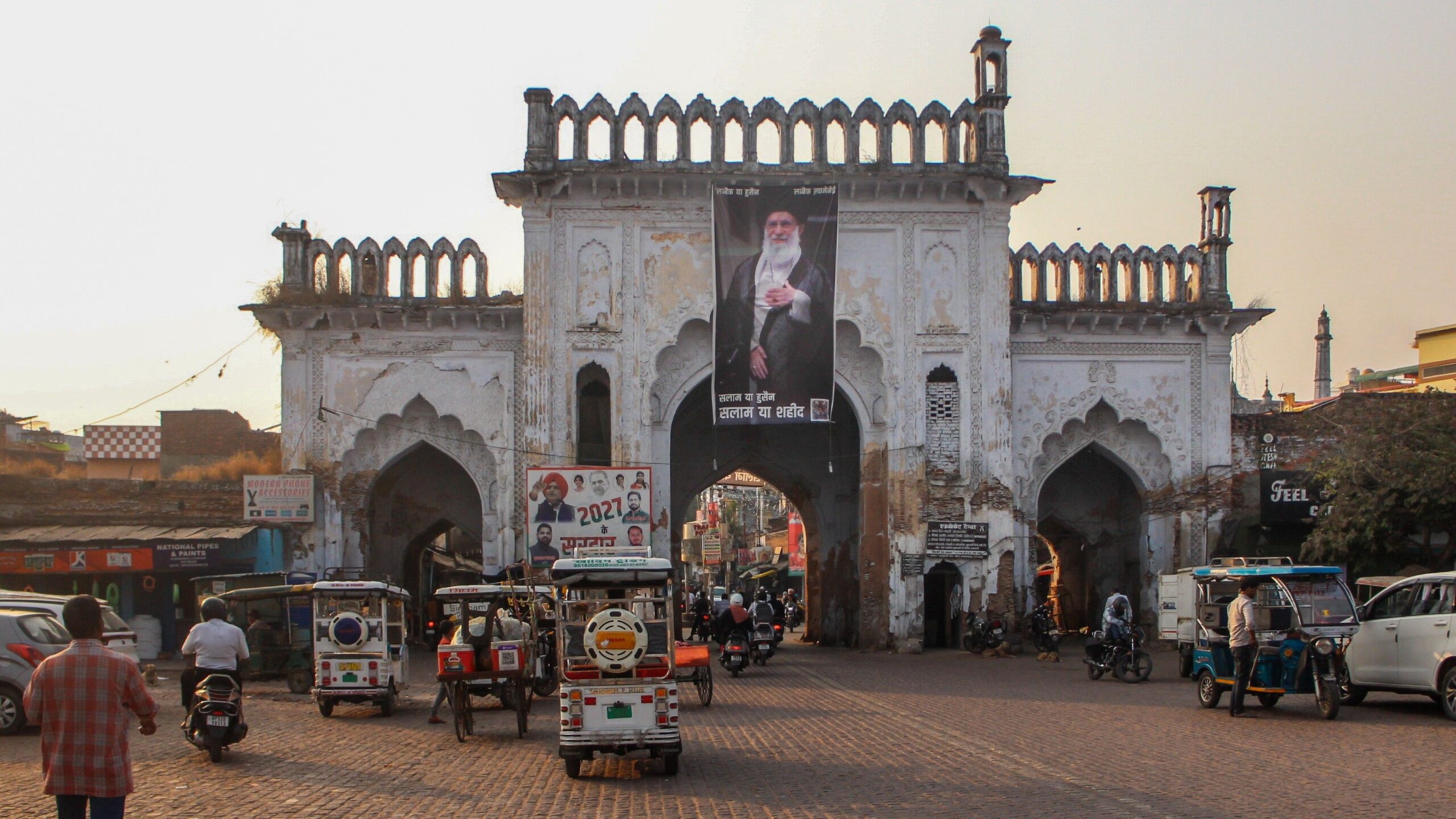
Beneath the scorching dry-season winds that cut through the narrow lanes of Lucknow’s historic old city, an unmistakable display of solidarity with Iran fills every public space. At Hussainabad Chowk, the city’s bustling central open plaza, towering posters of the recently assassinated Iranian supreme leader Ali Khamenei billow, one bearing a Hindi inscription that reads: “Heartfelt and tearful homage to the great leader and guide of world peace and humanity, Martyr Ayatollah Sajjad Ali Husaini Khamenei Sahib.” Another poster positions Mojtaba Khamenei, Iran’s new supreme leader, standing protectively behind his slain father, hands resting gently on his shoulders.
Further into the warren of old city alleyways, reverence for Iran’s ayatollahs appears everywhere: hand-painted graffiti, framed portraits, and street-side murals line every wall. In a stark act of protest, Israeli and American flags are painted directly onto the dusty paving stones, alongside portraits of Israeli Prime Minister Benjamin Netanyahu, U.S. President Donald Trump, and Saudi Arabia’s de facto leader Mohammed bin Salman, placed deliberately to be stepped on by passing pedestrians. Netanyahu’s image is the most heavily worn, reduced to faint fragments against the tattered blue-and-white backdrop of the Israeli flag, while Trump’s portrait remains partially intact—a vivid visual marker of the relative intensity of public anger toward each figure, shaped by their role in the strikes that killed Khamenei.
This grassroots activism is not a new outburst: soon after the October 7, 2023 attacks on Israel, local shopkeepers in old Lucknow launched a grassroots boycott of American and Israeli-linked goods, pouring thousands of bottles of Coca-Cola down open drains. Today, the only cola stocked on store shelves is Campa Cola, a popular Indian-made alternative. What makes this display of anti-Israel protest particularly striking is its location: it unfolds in the country of Prime Minister Narendra Modi, one of Israel’s closest global allies.
Lucknow, the capital of India’s most populous state Uttar Pradesh, carries centuries of deep cultural and religious ties to Iran. Once ruled by the Nawabs of Lucknow, a Persian-origin dynasty that governed the Awadh region through the 18th and 19th centuries, the city grew into one of South Asia’s preeminent centers of Indo-Islamic culture, with its art, cuisine, music, and architecture all bearing enduring West Asian influences. Today, it is home to India’s largest Shia Muslim community, concentrated heavily in the old city’s winding neighborhoods.
When news broke on February 28 of the joint U.S.-Israeli strike that killed Khamenei, spontaneous protests erupted across old Lucknow within hours. Chants of “America Murdabad” and “Israel Murdabad”—translated as “Death to America” and “Death to Israel”—echoed off the Chowk’s historic sandstone walls. By sunset, thousands of mourners gathered at Bada Imambara, Lucknow’s iconic 18th-century Shia religious site and top tourist attraction, to light candles in honor of Khamenei, whom many now honor as a martyr.
A historic slogan tied to the core of Shia identity was quickly reworked to reflect the moment: the centuries-old cry “Hussaini maaroge, har ghar Hussaini Niklega” (“If you kill one Hussaini, a hundred more will rise from every home”), rooted in the 680 CE martyrdom of Imam Hussain at the Battle of Karbala, became “Tum kitne Khamenei maaroge, har ghar se Khamenei niklega” (“If you kill one Khamenei, thousands more will emerge from every household”). The adaptation sent a clear message: the Shia community of Lucknow views itself as an integral part of the global Shia resistance movement.
“Lucknow’s historical relationship with Iran is such that it was once called the Shiraz of the East,” explains Akbar Mehdi, a young Shia cleric originally from a small town east of Lucknow who now resides in the Iranian holy city of Qom. Mehdi returned to India for the holy month of Ramadan shortly before the strike and has been unable to return to Iran amid the ongoing conflict. “In dining customs, in everyday conversation, an Iranian imprint is clearly visible across our culture here,” he said.
While connections between Lucknow and Iran predate the 1979 Islamic Revolution, the depth of ideological alignment grew dramatically in the decades that followed, according to Ziyaullah Siddiqui, co-editor of the Urdu-language news portal Qasidnama. His co-editor Shibli Beg explains that Ayatollah Ruhollah Khomeini’s introduction of the concept of Wilayat-e-Faqih—rule by Islamic jurists as a temporary guardianship before the messianic return of the Mehdi—shifted the entire orientation of Lucknow’s Shia community. After 1979, the community’s center of gravity moved from local religious affairs to an increasingly Iran-centric global outlook, with hundreds of young Lucknow Shias traveling to Iran for religious education, and nearly all of the city’s most prominent senior clerics completing their studies in Iranian seminaries.
The ancestral ties binding the two regions run even deeper than the revolution: just a short drive from Lucknow, the small village of Kintoor sits amid the lush, fertile paddy fields of the Gangetic Plains, and it is the ancestral birthplace of Khomeini himself. Khomeini’s grandfather, Syed Ahmad Musavi Hindi, was born in Kintoor in 1790 before migrating to the Iranian village of Khomein at age 40.
In the neighboring village of Rasulpur, Middle East Eye met Rehan Kazmi, a local doctor, descendant of Khomeini, and distant cousin of Iran’s first revolutionary supreme leader, who also founded the Imam Khomeini Foundation to preserve the family’s ancestral connection to the region. “The Kazmi family of Rasulpur and the Kazmi-Musavi family of Kintoor share the same bloodline,” Kazmi explained during an interview in his clinic, where four framed images hang on the wall: a local Sufi saint Haji Waris Ali Shah, a piece of embroidered Islamic calligraphy, Ali Khamenei, and Ruhollah Khomeini. “Around 900 years ago, our ancestors moved to this land from Nishapur in Iran and settled here. We have been Indians ever since,” he said, recalling that even during his childhood in the village, Farsi was so commonly spoken that “even the chickens understood Farsi commands.”
Kazmi recalled that within hours of news of Khamenei’s assassination breaking on February 28, villagers across the region took to the streets to condemn the strike and express solidarity with Iran. They marched carrying portraits of Khomeini and Khamenei, all local shops closed their doors, and the village observed three days of official mourning.
While Lucknow is home to India’s largest Shia community, the city’s overall population is majority Hindu, and Uttar Pradesh is governed by Chief Minister Yogi Adityanath, a controversial Hindu nationalist priest-politician infamous for his anti-Muslim rhetoric and repeated actions that stoke inter-religious communal tension. He once claimed “Muslims did no favour to India by staying here.” Yet despite this tense political context, local journalist Siddiqui noted that aside from a tiny number of isolated provocations early on, the widespread pro-Iran protests have seen remarkably little communal pushback. “Lucknow is a city where Hindu-Muslim riots have never taken root. During the 1947 Partition of India and Pakistan, the city was largely spared the bloodshed that tore apart other parts of the subcontinent. People here are sensible. This is a city of tehzeeb—of civilisation,” he said.
By mid-March, the nature of the solidarity movement shifted: large, public street protests gave way to coordinated humanitarian fundraising for Iranian civilians affected by the ongoing war. Even the poorest members of the community contributed what they could, Kazmi said. “Even very poor daily wage labourers gave whatever small change they had. It shows how deeply people here care about this cause.” One young donor, who himself relied on casual work to support his family and clearly had little to spare, told organizers: “Such is my love for Iran, I could not give less.”
The gap between this widespread grassroots solidarity and India’s official foreign policy could not be wider. Modi’s ruling Bharatiya Janata Party (BJP) government in New Delhi maintains extremely close ties to Israel: India is the world’s largest buyer of Israeli military equipment, and just three days before the joint U.S.-Israeli strike on Iran began, Modi completed a high-profile state visit to Israel. Standing alongside Netanyahu on February 25, Modi declared: “Israel is the Fatherland, India is the Motherland,” and even noted that his birthday falls on the same date that India first formally recognized Israel, framing the alliance as a personally fated bond. Just two days after that visit, the war on Iran began.
The conflict has already delivered tangible economic harm to India, which relies almost entirely on energy shipments passing through the Strait of Hormuz. Nine out of 10 Indian households rely on liquefied petroleum gas (LPG) cylinders for cooking, and roughly 60% of India’s total LPG imports pass through the strategic waterway. From the first day of the war, Indian households faced sharp price hikes and long waiting lines for refills, and widespread public panic has gripped the country ever since. When negotiations between the U.S. and Iran collapsed in mid-May, Modi publicly called on Indian citizens to cut energy use by using public transport and working from home wherever possible.
“Both the ordinary people of India and Iran are unhappy with India aligning so closely with Israel,” cleric Akbar Mehdi said. “People here can tell truth from falsehood. Iran, Lebanon, Yemen, Palestine—this is the path of truth, the path of Karbala, the path of Islam.”
Today, India presents a picture of two competing national narratives existing side by side. On one side is the BJP government, which has refused to condemn Israel’s military campaign, even as its own supporters grow increasingly anxious about the economic fallout of the conflict. On the other side is the grassroots pro-Iran solidarity movement, whose leaders are hesitant to openly challenge the central government: after 12 years of BJP rule, India’s Muslim community as a whole, and Shia Muslims in particular, are a marginalized minority with very little representation in national politics, and face widespread systemic pressure. “We cannot speak openly against the government, because of the fear and the constant pressure we live under,” Mehdi explained.
Once a leading global voice for Palestinian statehood and the first large country to cut diplomatic ties with apartheid South Africa, India now maintains a deliberate silence on the violation of Iran’s sovereignty, though it has also walked back its early overtly pro-Israel rhetoric in the face of growing domestic and regional discontent. Many critics in Lucknow argue that the BJP’s current foreign policy is unmoored and weak, leaving India increasingly isolated across West Asia as anti-Western and pro-resistance sentiment spreads across Asia.
For Rehan Kazmi, the shift in India’s longstanding principles is the core of the problem. “The leaders who built independent India experienced oppression themselves, they stood with the victims of colonialism. They understood what was happening in Palestine, because they had fought the same fight. Our ancestors sacrificed everything to free this country. Today, the soul of India is under attack. If the soul is gone, the body has no meaning.”