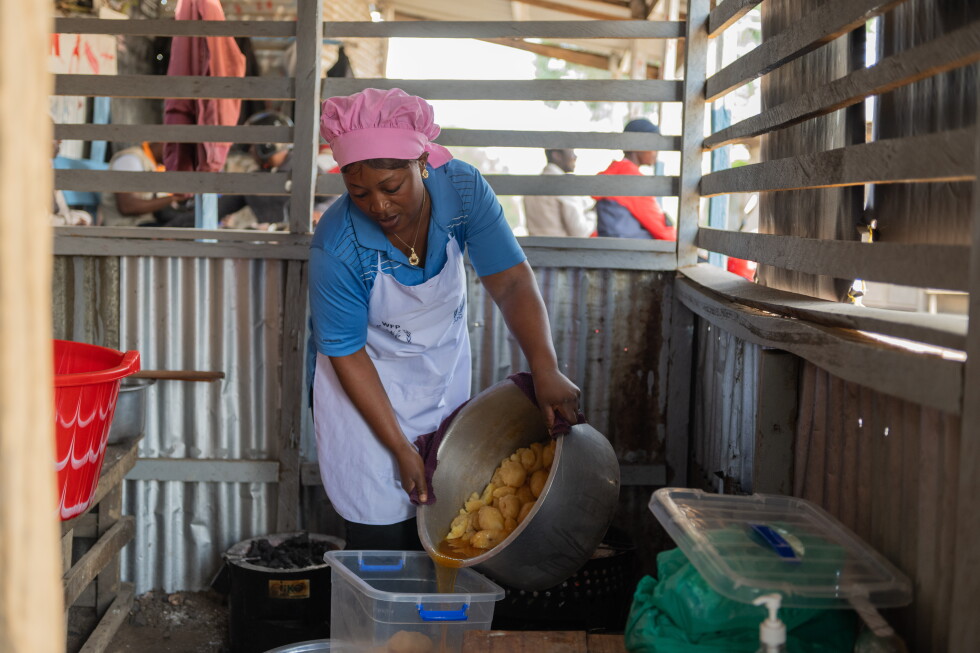
In the sweltering heat of Bunia, the epicenter of the Democratic Republic of Congo’s latest Ebola outbreak, one quiet act of service forms an unexpected backbone of the regional response effort. Arlette Basekawike, a volunteer with the United Nations World Food Programme (WFP), spends nearly every waking hour in a cramped open-air shed outside a local health facility, stirring large pots of food and planning menus for patients on the frontline of this public health crisis.
Clad in a protective pink bonnet covering her hair, Basekawike starts each day early, preparing porridge, fluffy omelets, and fresh bread for patients admitted to the Evangelical Medical Center. For afternoon and evening meals, she serves up seasoned fresh fish paired with fufu — the region’s beloved starchy staple made from mashed plantains — followed by ripe seasonal fruit. On a recent Monday, as she diced vegetables, potatoes and goat meat for a large batch of stew, she explained the quiet purpose that drives her work.
“Even though patients carry this terrible disease, a warm, good meal still lifts their spirits and helps them feel stronger,” Basekawike told the Associated Press. “And for the doctors and nurses working endless shifts, this food gives them the energy they need to treat patients and administer care. I’m here for them like a parent would be — I just want to make them feel as comfortable as possible through this.”
On paper, Basekawike’s work may look like a simple, unremarkable task. But public health officials say her contributions, and the work of the entire WFP nutrition team here, have emerged as critical support for a region grappling with the fast-moving spread of Bundibugyo virus — the rare Ebola species confirmed in eastern Congo back in May.
As of this week, the World Health Organization (WHO) has confirmed 321 total cases of Ebola disease across three eastern Congolese provinces: Ituri, North Kivu, and South Kivu, with 48 recorded deaths. Neighboring Uganda has detected nine cases and one fatality, prompting authorities to close the entire shared border between the two countries to slow transmission.
Long before this outbreak was declared, this already beleaguered region was grappling with one of the world’s most severe food insecurity crises. Years of ongoing armed conflict between government forces and rebel groups have displaced millions of people, leaving vast communities without reliable access to consistent, nutritious food. The emergence of Ebola has layered a new, deadly crisis on top of pre-existing fragility, creating a devastating cascade that the United Nations warns complicates every effort to contain the outbreak among a population already deeply strained by hardship.
“We operate in a region where huge portions of the population already face acute food insecurity tied directly to war and displacement,” explained Olivier Nkakudulu, head of WFP’s Ituri province operations. “These needs already existed — Ebola is just an additional crisis stacked on top of a crisis.”
Compounding these challenges, the already resource-strapped WFP now faces severe operational disruptions driven by major aid cuts from the United States and other key global donor partners. With global partners pulling back or reducing their funding pledges, the overall effort to contain the outbreak — which WHO has already classified as a Public Health Emergency of International Concern — has been severely hampered by the funding shortfall.
On top of funding gaps, responders also face persistent threats: attacks on health care workers by local residents suspicious of the outbreak response, and constant delays to aid delivery caused by ongoing fighting in the region have both worked together to slow efforts to curb transmission.
Even against these stacked obstacles, WFP and local health teams confirm they have managed to meet the basic nutritional needs of Ebola patients and frontline workers so far. Still, as case counts climb, that balance is becoming harder to maintain.
“Today we need to increase the volume of food we provide, because the number of patients has gone up,” said Esther Bao, a nurse and volunteer on the response team. She added that many patients, weakened by the progression of Ebola, require specialized, tailored meals that cannot follow a one-size-fits-all menu.
Unlike some more common Ebola species, the Bundibugyo virus has no approved vaccine or targeted treatment currently available. Care teams can only treat symptoms as they appear, but even that supportive care has yielded small victories: five patients have successfully recovered from the virus to date.
The scope of the outbreak continues to expand at an alarming rate. According to Congo’s Ministry of Health, what began with transmission limited to just three initial health zones has now spread to 22 affected zones as of last weekend.
To date, WFP has served 120 meals across four treatment facilities in a single recent Sunday, bringing the total number of meals provided since the nutrition program launched on May 28 to 404, according to Nkakudulu. But he stressed that the financial situation remains extremely precarious.
“Without additional emergency funding, we won’t be able to prioritize every suspected case for nutritional support,” Nkakudulu said. “We might be forced to only provide for some patients, and leave others with no food to help them through their treatment.”
This report was compiled by AP correspondents, with additional contribution from Adetayo reporting from Lagos, Nigeria.