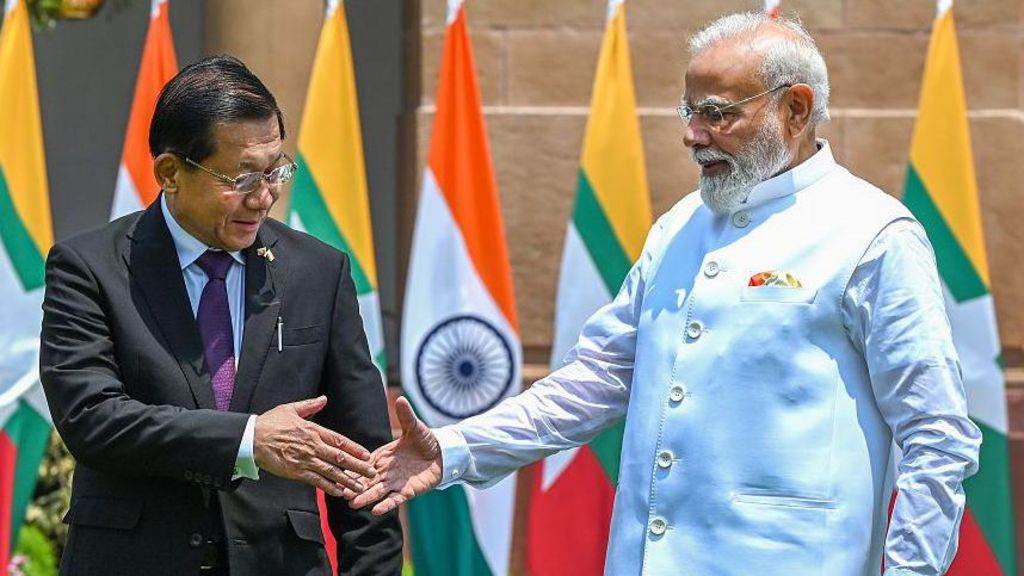
In a high-stakes diplomatic meeting that has drawn widespread international attention, Myanmar President Min Aung Hlaing held official talks with Indian Prime Minister Narendra Modi in New Delhi on Monday, kicking off a five-day official visit focused on advancing bilateral cooperation across critical sectors ranging from trade and cross-border connectivity to border security and defense cooperation. This meeting marks a historic milestone: it is Min Aung Hlaing’s first foreign trip since he was sworn in as president in April 2026, following a military-backed election that sparked global criticism, and comes five years after the 2021 military coup that plunged Myanmar into a protracted civil conflict. Regional and global powers are closely watching the visit to gauge how key regional players will engage with Myanmar’s military-led administration amid ongoing domestic unrest.
Geography has long bound the fates of India and Myanmar together: the two neighbors share a 1,643-kilometer land border, and political and security developments in Myanmar have direct and immediate impacts on India, particularly its vulnerable northeastern states, where local security, cross-border migration and informal trade are deeply interconnected with events across the border. The current crisis in Myanmar traces back to February 2021, when Min Aung Hlaing, then serving as commander-in-chief of the Myanmar Armed Forces, ousted the democratically elected government of Aung San Suu Kyi, just weeks after her National League for Democracy secured a landslide victory in general elections. The military takeover triggered mass nationwide pro-democracy protests that quickly escalated into an organized armed resistance movement, igniting a civil conflict that has killed more than 10,000 people, displaced millions more, and left large swathes of Myanmar outside the control of the military government. The violence has spilled across the border into India, with thousands of refugees, most from Myanmar’s persecuted Chin ethnic minority, fleeing to the Indian states of Mizoram and Manipur to escape the fighting.
Between December 2025 and January 2026, the military-backed government held a national election, which resulted in an overwhelming victory for pro-military parties. The vote was heavily criticized by the international community, as major opposition parties were barred from running, and millions of voters in conflict-affected regions were unable to cast ballots. Following the election, a military-dominated parliament elected Min Aung Hlaing to the presidency in April 2026. Myanmar’s authorities frame the election as a critical step toward a return to civilian rule, but opposition groups, Western governments and independent international observers have rejected the vote as unfair, arguing it does nothing to loosen the military’s stranglehold on power. Despite this, Min Aung Hlaing has maintained that the election was free and transparent. Before this post-inauguration visit to India, Min Aung Hlaing had traveled to China and Russia for diplomatic meetings in the period between the 2021 coup and his presidential election. The last official visit by an Indian prime minister to Myanmar took place in 2017.
In a press briefing following the meeting, Indian Foreign Secretary Vikram Misri confirmed that the talks between Modi and Min Aung Hlaing covered the full scope of Myanmar’s domestic political situation, alongside bilateral priorities. Misri noted that Prime Minister Modi raised broad concerns about democratic progress in Myanmar, and the two leaders also discussed the case of Aung San Suu Kyi, who remains under strict house arrest five years after the coup. Misri reaffirmed India’s long-standing position: Delhi remains committed to supporting lasting peace and an inclusive political dialogue that brings all of Myanmar’s stakeholders to the table, arguing that sustained diplomatic engagement, rather than international disengagement, is the only viable path to meaningful progress.
A joint statement published by Myanmar’s state-run *Global New Light of Myanmar* newspaper outlined that both sides emphasized the urgent need to prevent the misuse of border territory for activities that threaten either nation’s security interests. Min Aung Hlaing reaffirmed Myanmar’s formal assurance that it would not allow its territory to be used to launch operations against India, while Modi reaffirmed India’s unwavering support for Myanmar’s sovereignty and territorial integrity.
The Myanmar leader arrived in India on May 30, and kicked off his visit with a trip to the sacred Buddhist site of Bodh Gaya, where he offered prayers at the Mahabodhi Temple, the site revered as the place where Buddha attained enlightenment. After the official talks in New Delhi, Min Aung Hlaing traveled to Mumbai to meet with Indian business leaders, with the goal of attracting new foreign investment and expanding bilateral trade between the two nations.
Regional analysts widely view the visit as a landmark moment for Myanmar’s military leadership, which has sought to expand its diplomatic engagement after years of international isolation and criticism following the 2021 coup. Rajiv Bhatia, a former Indian ambassador to Myanmar, told reporters that the meeting represents a major diplomatic win for Nay Pyi Taw, as it grants formal validation to Min Aung Hlaing’s presidency from the world’s largest democracy. Gautam Mukhopadhaya, another former Indian ambassador to Myanmar, added that the visit is part of Min Aung Hlaing’s broader strategy to build greater regional and international legitimacy as a newly elected head of state.
For India, the meeting underscores a long-standing strategic calculation: India’s core national interests in Myanmar outweigh any concerns about the character of the country’s military-led government. Analysts outline that India has three primary strategic priorities in its relationship with Myanmar: maintaining stability along its sensitive northeastern border, advancing its Act East Policy aimed at deepening economic and security ties with Southeast Asia, and balancing the growing influence of China in the country. Myanmar holds a unique place in India’s regional strategy: it is the only member of the Association of Southeast Asian Nations (ASEAN) that shares a land border with India, making it a critical gateway for Indian engagement with the bloc. Bhatia notes that the visit could have a positive ripple effect across ASEAN, as member states work to develop a unified approach to the ongoing Myanmar crisis.
The talks also come amid intensifying great power competition between India and China in the Indo-Pacific, with Myanmar emerging as a key strategic battleground. Myanmar provides China with direct access to the Bay of Bengal, allowing Beijing to reduce its reliance on the Strait of Malacca for critical trade and energy supplies. Mukhopadhaya notes that since 2017, China has steadily expanded its influence in Myanmar and has become increasingly open about its support for the country’s military leadership, in pursuit of its own strategic and economic goals.
Min Aung Hlaing’s visit to India also takes place against a shifting backdrop of Myanmar’s relations with Western nations. After the 2021 coup, the United States and many of its allies imposed sweeping economic sanctions on Myanmar’s military leadership. But according to Mukhopadhaya, the second Trump administration has shown little interest in engaging with Myanmar, and has suspended most foreign assistance to the country, including funding for Myanmar refugees and pro-democracy opposition groups. Bhatia added that the Quad security grouping — made up of the United States, India, Japan and Australia — shares a common goal of restoring stability to Myanmar, creating an opening for engagement with the country’s new leadership.
The ongoing civil conflict has already reshaped the security dynamic along the India-Myanmar border. In recent months, the Myanmar military has regained ground from resistance forces in the country’s eastern and northern regions, and has increasingly focused its attention on securing its western border with India. Mukhopadhaya argues that it is highly likely the Myanmar government will seek greater security cooperation with India to crack down on anti-military resistance groups operating near the border. Ultimately, Bhatia noted, India’s core goal is to see a stable, unified Myanmar emerge from the conflict, and a Myanmar that maintains its strategic independence amid great power competition. “Clearly, a more independent Myanmar is what India is looking for,” Bhatia added.