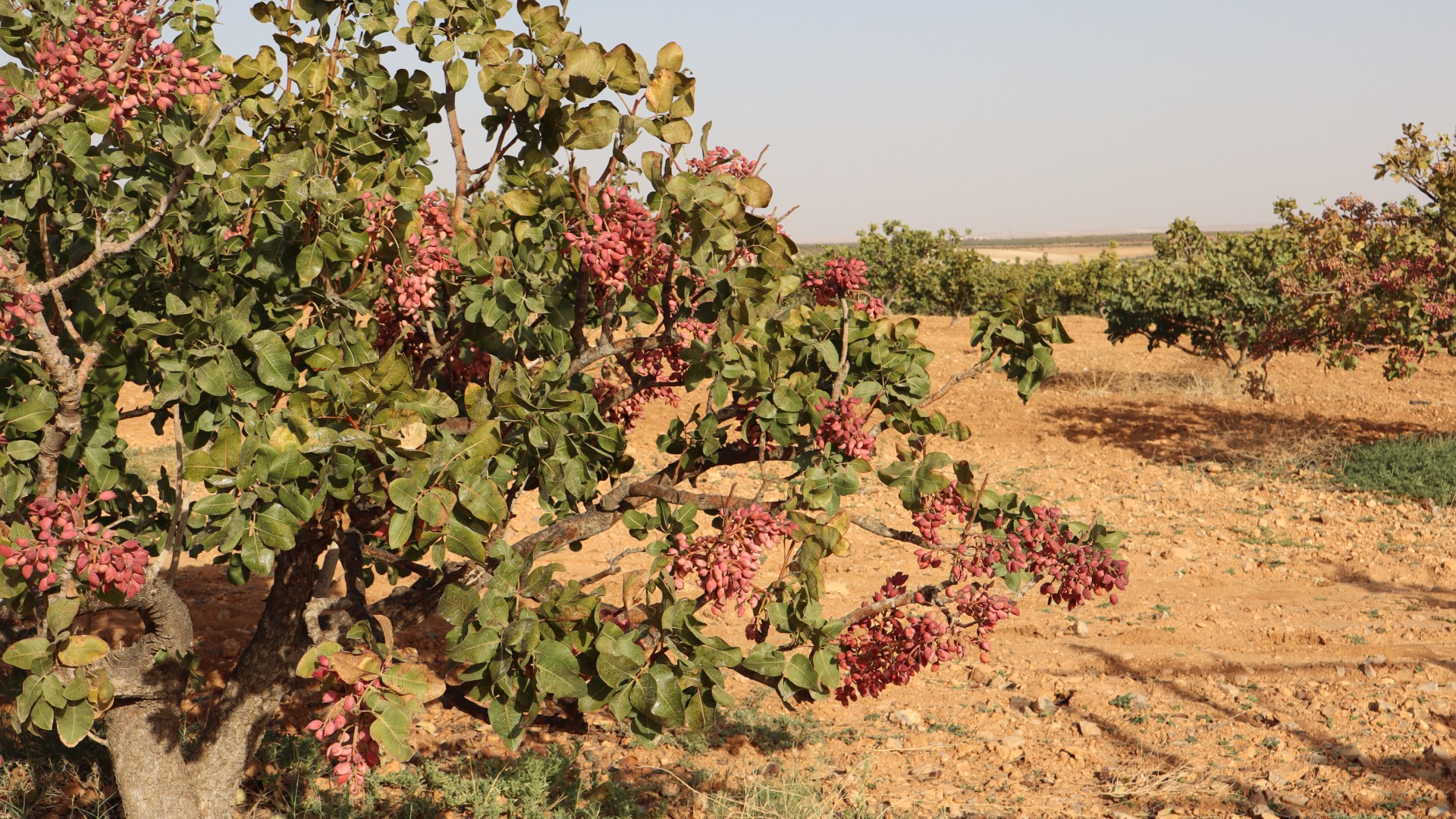
In the wake of the December 2024 lightning rebel offensive that toppled 50 years of Assad family rule in Syria, a quiet crisis over land ownership is unfolding in northern Hama, the historic core of Syria’s once world-leading pistachio industry, threatening to derail fragile efforts to build intercommunal peace.
The conflict traces back more than a decade to the earliest days of Syria’s civil war, when northern Hama’s pistachio-growing hills became a brutal frontline between regime forces and opposition factions. What were once scenic, multi-sectarian villages descended into sectarian bloodshed between majority Sunni communities, which made up most of the anti-Assad rebellion, and Alawis, the Shia offshoot sect to which Bashar al-Assad belonged. By the end of Assad’s rule, thousands of Sunni landowners had been displaced from their properties, while Alawi landholders fled en masse after the regime’s collapse, fearing retaliatory violence from returning rebels.
For Ahmed Ali, a former Syrian civil servant who lost his government job in 2019 for refusing mandatory military service on principle, the collapse of the Assad regime should have cleared the way for him to return to his 15-hectare family pistachio farm, a plot that has been in his family for more than half a century. Instead, Ali has become one of hundreds of landowners trapped in the messy new system of property administration implemented by the new Syrian government, led by former HTS leader Ahmed al-Sharaa.
Ali’s story is familiar to many displaced landowners. When he returned to his property after Assad’s ouster, he found his former Alawi neighbor Karim al-Khattib occupying his home, after Khattib’s own property was destroyed in the fighting. Ali initially agreed to let Khattib stay in exchange for a share of the annual pistachio harvest, only to discover that the state-owned agricultural investment firm Iktifaa had seized control of his land, branding him an Assad-aligned “shabih” without providing evidence of any crime.
Khattib, who has signed a new contract with Iktifaa to farm Ali’s land for 2026, says he will vacate the property once he earns enough to replant his own destroyed pistachio orchard. Last year, a weak harvest worsened by Syria’s worst drought in decades yielded around $4,000, 60% of which went to Khattib, with the remaining 40% going to Iktifaa. Ali estimates his losses from 2025 alone top $50,000, and he has been blocked from even selling the land he has owned for decades.
Founded in 2021 through a merger of two Idlib-based agricultural firms active in former opposition-held territory, Iktifaa is now the central body managing “absentee lands” across most of Syria, under the oversight of the newly created Illicit Gains Committee. The committee, an extrajudicial body independent of Syria’s court system, is tasked with investigating ties to the former Assad regime and seizing assets from those linked to the old government. It is overseen by Abraham Succarieh, a Lebanese-Australian national who remains under Western sanctions over allegations of terrorism financing, and all revenue from seized assets flows to the Syrian state’s sovereign wealth fund.
During the war, Iktifaa and its predecessor firms managed lands owned by displaced Druze and Christian minorities in HTS-held Idlib. While those properties were returned between 2020 and 2023 as HTS sought to improve its standing with minority communities, many landowners reported they never received compensation for years of use of their property, with all revenue going to the former Syrian Salvation Government, HTS’s pre-2024 governing body. Today, Iktifaa applies the same model to lands abandoned by displaced Alawis who fled after Assad’s fall.
Monzer Khattab, head of Iktifaa’s Hama and Homs branch, defends the firm’s approach, arguing that state oversight was necessary to prevent widespread land grabbing and chaos in the immediate aftermath of the regime’s collapse. He acknowledged that 2025 was a chaotic year, with much of the harvest in Hama and Homs stolen due to the firm’s limited capacity, but confirmed Iktifaa still earned between $1.5 million and $2 million in profits from the region last year, 90% of it from absentee lands. This year, the firm will deploy additional staff across all producing regions to monitor the upcoming June mid-harvest, he said.
But for displaced Alawi landowners who have already been cleared of any ties to the Assad regime, the system still leaves them locked out of their livelihoods. Ammar al-Aassad, an Alawi farmer from the northern Hama village of Maraiwid, received official clearance for his 29 dunam pistachio and olive orchard last month, but has still been unable to access his land. After a Bedouin faction occupied his property and Iktifaa signed a cultivation contract with the group, Aassad lost his entire 2025 harvest, with estimated losses of $40,000. He has yet to receive any compensation, and fears to return to his village even with official clearance: three days after Assad’s ouster, one of his Alawi neighbors who tried to return was killed by unknown assailants, and no other displaced Alawi residents have dared come back since.
“There should be evidence – the previous regime was oppressive, we don’t want oppression again,” Ali says of the current system.
Syrian provincial authorities in Hama acknowledge the growing tensions and say they are working to resolve the crisis. Hama Deputy Governor Hassan al-Hassan says the national presidency has issued formal directives supporting the return of displaced Alawis to their lands, and that new appeal offices linked to the Illicit Gains Committee will open in every province within weeks to allow landowners to challenge seizures. To resolve the immediate housing crisis that has displaced Sunnis and Alawis alike, the provincial council is planning to build temporary caravan housing for displaced Sunni farmers who returned to destroyed homes and now occupy abandoned Alawi properties.
“Our goal is to restore civil peace, and our thinking is that of a state and its institutions, not that of an armed faction. The state’s vision is that people return to their regions,” Hassan said, adding that priority must first go to Sunni farmers who returned after years of displacement to find their homes destroyed and trees uprooted. He gave no clear timeline for when full property returns would be completed.
Local intercommunal reconciliation committees, made up of both Sunni and Alawi community leaders, are already working to resolve disputes at the village level. Alaa Ibrahim, an Alawi landowner from Maan village who serves on one such committee, says his 138 dunam family property remains under Iktifaa control because his brother worked at an army-owned shoe factory, placing him under suspicion. With the 2026 harvest approaching, the Illicit Gains Committee has not issued a ruling on his case, and Ibrahim warns that if Alawi landowners are locked out of another harvest, the economic impact will be catastrophic for already vulnerable families, pushing many to sell their land at rock-bottom prices.
Ibrahim and other committee members are negotiating direct sharecropping contracts between Alawi landowners and their Sunni neighbors, while working to resolve long-running intercommunal violent disputes. If successful, he says, the agreements could pave the way for the safe return of displaced Alawis and ease sectarian tensions. If not, he warns, growing resentment will undermine the entire project of building post-war civil peace in Syria’s once-prosperous pistachio heartland.