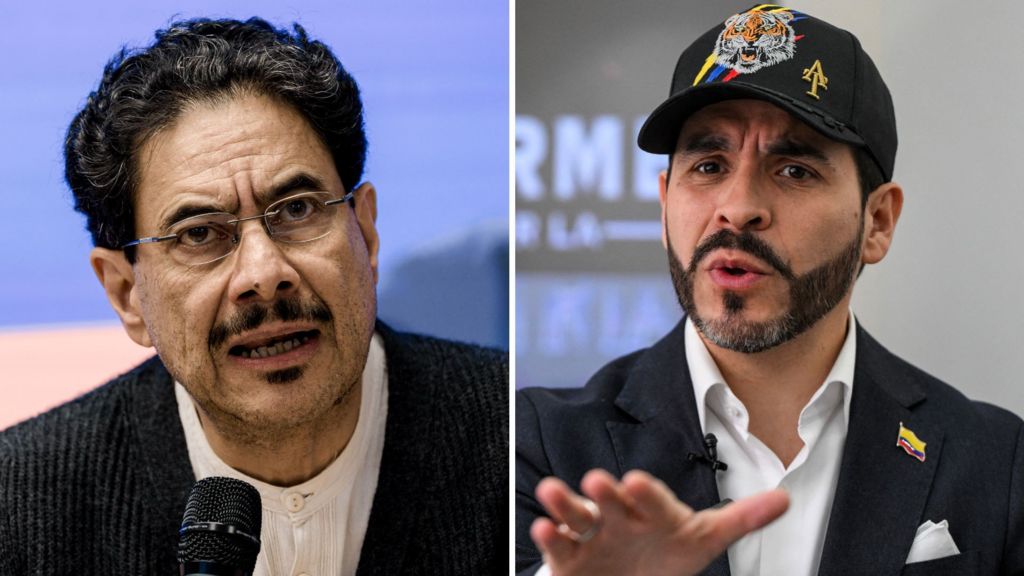
After a tightly contested first round of voting Sunday that left no candidate crossing the 50% threshold for an outright win, Colombia is set for a high-stakes June 21 presidential runoff that pitches a far-left ideological ally of the current administration against a hard-right, Trump-aligned outsider. When nearly all ballots were counted, right-wing contender Abelardo de la Espriella – a lawyer and businessman who styles himself “El Tigre” – secured first place with 43.7% of the vote, edging out left-wing senator Iván Cepeda Castro, who earned 41% of support. The result upended pre-election polling that had widely predicted Cepeda would finish ahead of his conservative challenger.
At its core, the runoff election will offer Colombian voters two starkly opposing visions for addressing the country’s decades-long internal armed conflict, which has reemerged with rising violence in recent years. Cepeda, a key ally of incumbent President Gustavo Petro, Colombia’s first left-wing head of state, brings deep firsthand experience in peace negotiations: he was a central figure in the 2016 historic peace deal between the Colombian government and the FARC guerrilla movement that led to the disarmament of thousands of rebel fighters. Today, he is widely recognized as the architect of Petro’s flagship “total peace” strategy, which prioritizes ceasefire talks and negotiated settlements with armed groups over large-scale military intervention.
The Petro administration’s approach to peace and security has become a central flashpoint of the campaign. During Petro’s term, cocaine production has reached an all-time record high, armed group membership has expanded, and border violence has spiked to its worst level in decades, displacing tens of thousands of Colombians. Critics and security analysts widely dismiss “total peace” as a failed policy, though Petro has pushed back, noting his government has seized more illegal narcotics than any prior administration. On the economic front, Colombia has seen modest growth under Petro, and the president delivered a significant increase to the national minimum wage, yet roughly one in three Colombians still lives below the poverty line. If elected, Cepeda has pledged to advance progressive economic reforms, including expanding social welfare programs and advancing land redistribution for victims of the country’s long-running internal conflict.
De la Espriella, by contrast, has built his campaign on a full-throated rejection of Petro’s peace strategy, calling instead for a harsh military crackdown on organized crime and armed groups. A self-described admirer of former U.S. President Donald Trump, he has proposed deepening security cooperation with the United States, including carrying out targeted bombings of cartel strongholds with U.S. backing, expanding the military’s domestic policing powers, and holding mass trials for alleged organized crime members. Echoing the hardline approach of El Salvador’s President Nayib Bukele – whom de la Espriella has cited as a policy and even personal influence, with commentators noting the similarity of their facial hair – he has pledged to construct 10 new maximum-security mega-prisons in remote jungle regions. He has also promised to drastically cut the size of the Colombian national government.
The right-wing candidate has faced significant controversy over his professional background as a defense attorney. He previously represented high-profile clients including Alex Saab, a close associate of ousted Venezuelan leader Nicolás Maduro who currently faces U.S. money laundering charges, and David Murcia Guzmán, the mastermind of a multibillion-dollar pyramid scheme that defrauded thousands of Colombians. De la Espriella has framed his representation of these figures as a standard part of legal practice for defense counsel, but critics have accused him of profiting from his work for powerful criminals.
With moderate conservative senator Paloma Valencia finishing third in the first round, de la Espriella is widely seen as well-positioned to pick up the bulk of her right-leaning supporters in the runoff, putting him in a strong starting position for the second round of voting.
The election outcome will carry far-reaching implications for regional geopolitics, particularly for Colombia’s relationships with the United States and neighboring countries. In recent years, a wave of right-wing victories has swept across Latin America, with conservative candidates winning presidential elections in Ecuador, Chile, Argentina, Bolivia, Honduras and El Salvador. The Trump administration, which returned to power in 2025, has pursued an aggressive muscular foreign policy in the region: it has carried out a military raid that captured Nicolás Maduro, launched strikes on alleged drug trafficking vessels in the Caribbean and Eastern Pacific, imposed a full oil blockade on Cuba, and earlier this year established the “Shield of the Americas”, a security alliance of right-leaning regional leaders focused on combating cartel activity.
While Petro and Trump have a history of public clashes and verbal insults over drug policy and U.S. intervention in the region, relations between the two leaders warmed following a February meeting at the White House, and anti-narcotics cooperation between the two countries has continued largely uninterrupted. Cepeda shares Petro’s anti-interventionist stance, repeatedly arguing that Colombia should not act as a “vassal state” to the U.S., while de la Espriella has made clear he seeks to strengthen security alliances with Washington and aligns ideologically with Trump. To date, Trump has not issued a formal endorsement of either candidate, a departure from his public involvement in other recent regional elections.
The runoff will also shape relations between Colombia and neighboring Ecuador, which has faced a dramatic surge in violence driven by drug trafficking that largely transits through Ecuadorian territory after leaving Colombia, the world’s largest cocaine producer. Ecuador’s conservative President Daniel Noboa has already imposed tariffs on Colombian imports, accusing Petro’s government of failing to secure their shared border. Last month, Noboa confirmed he had reached an agreement with de la Espriella to drop the tariffs if the right-wing candidate wins, in exchange for cooperation on extraditing Ecuadorean criminals hiding in Colombia and a joint crackdown on narcoterrorism. Colombia’s foreign ministry quickly condemned Noboa’s move as “deliberate interference” in its sovereign election, and Noboa’s office has not yet issued a public response to the accusation.
The entire campaign season has been marred by pervasive political violence, including drone attacks on candidates, widespread kidnappings, multiple political homicides, and the assassination of a presidential candidate at a public rally last year. Security forces deployed heavily across the country on election Sunday, with armed guards posted at polling stations to protect voters and election officials.