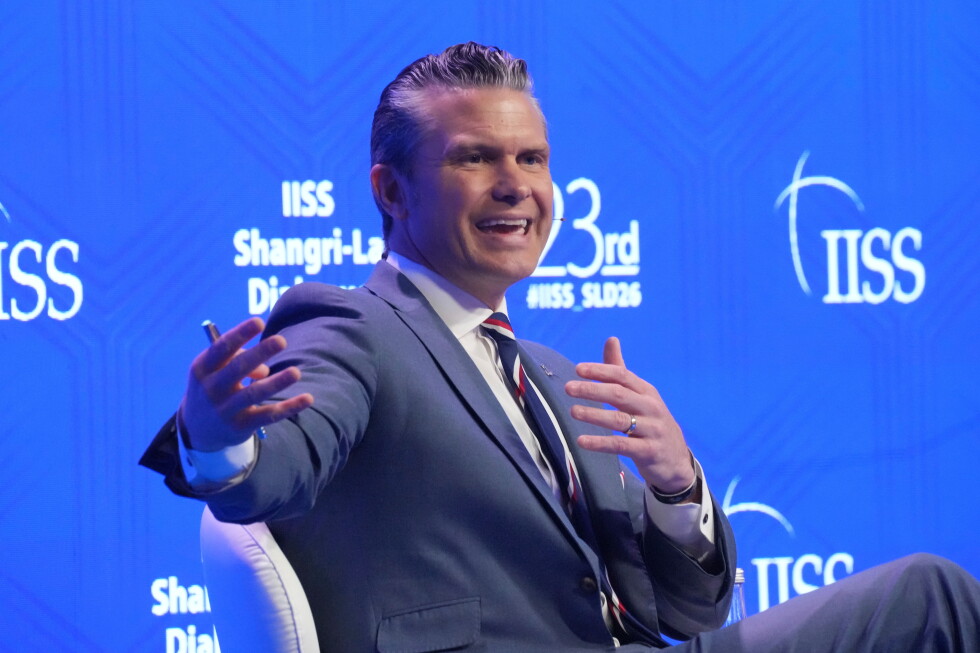
At the annual Shangri-La Dialogue, hosted by the International Institute for Strategic Studies in Singapore, senior defense officials from U.S. allied nations have converged to stress the urgent need for collective solidarity amid shifting transnational security threats and growing friction between Washington and its long-standing partners. The calls for unity came one day after U.S. Defense Secretary Pete Hegseth used the forum’s opening to renew the Trump administration’s sharp criticism of Western European allies for failing to meet defense spending commitments. Hegseth, echoing President Donald Trump’s longstanding harsh rhetoric against the North Atlantic Treaty Organization, went further Saturday, accusing European capitals of being distracted by hollow globalist discourse around the rules-based international order, weakening their own militaries, and opening borders without sufficient security safeguards. He argued that international rules hold no weight without credible hard power to enforce them.
While Japanese Defense Minister Shinjiro Koizumi publicly praised Hegseth for the U.S.’s continued commitment to Indo-Pacific security, he joined other allied leaders in underlining that robust global coalitions remain irreplaceable for countering modern threats. In a clear push against the risk of growing rifts between the U.S., Europe, and like-minded partner nations, Koizumi told attendees: “Division weakens deterrence, unity strengthens deterrence.” He warned that any fractures in the alliance bloc would be exploited by adversarial powers, arguing that now is the moment to deepen, rather than scale back, cooperative defense efforts.
Koizumi also addressed recent geopolitical friction between Tokyo and Beijing over Japan’s landmark shift in defense policy. Last month, the cabinet of Prime Minister Sanae Takaichi scrapped a decades-long ban on lethal weapons exports, the most significant break from Japan’s post-World War II pacifist framework to date. China has decried the move, with Foreign Ministry spokesperson Guo Jiakun vowing that Beijing would “resolutely resist Japan’s reckless moves toward a new type of militarism.” Rejecting this accusation outright, Koizumi framed it as deeply ironic in his English remarks at the conference. “Think about it, there is a country that has a huge arsenal of nuclear weapons and strategic bombers,” he said. “Japan has neither of such weapons, and yet Japan is labeled new militarism. Isn’t it strange?” The Japanese defense minister also called out China’s choice not to send its top defense official to the dialogue, noting that genuine transparency emerges only through open discussion and diplomatic engagement.
Other allied defense leaders echoed Koizumi’s emphasis on collective action, while largely aligning with Hegseth’s core argument that the rules-based international order requires hard military backing. Speaking to reporters on the conference sidelines Sunday, Australian Defense Minister Richard Marles agreed that rules must be underpinned by credible power, but added that a strong, shared rule of law is more vital today than at any point in recent history. For middle powers like Australia, and for smaller nations globally, Marles noted that a rules-based system is the only framework that guarantees sovereign agency. “This is a collective challenge and it demands a collective response, which is actually what the rules based order is all about,” Marles said, adding that cross-national alliances remain the bedrock of regional security.
Netherlands Defense Minister Dilan Yesilgöz-Zegerius expanded on this point, noting that contemporary conflicts no longer stay contained within regional borders. “A war in Europe involves drones from Iran, soldiers and ammunition from North Korea and various types of support from China,” she observed. “The lesson is clear: regional tensions are no longer regional. Our security is interconnected.” Yesilgöz-Zegerius warned that if middle and small powers fail to coordinate their action, they risk being sidelined from decisions that shape their own security, but unified coalitions allow them to uphold global stability. Even as international law faces widespread violations, she argued, the international community must not abandon shared norms. “The fact that international rules are being violated does not mean we should abandon them,” she said. “On the contrary, it means we must defend them more constantly and more courageously. International law may be imperfect, but history teaches us that the alternative is far worse.”