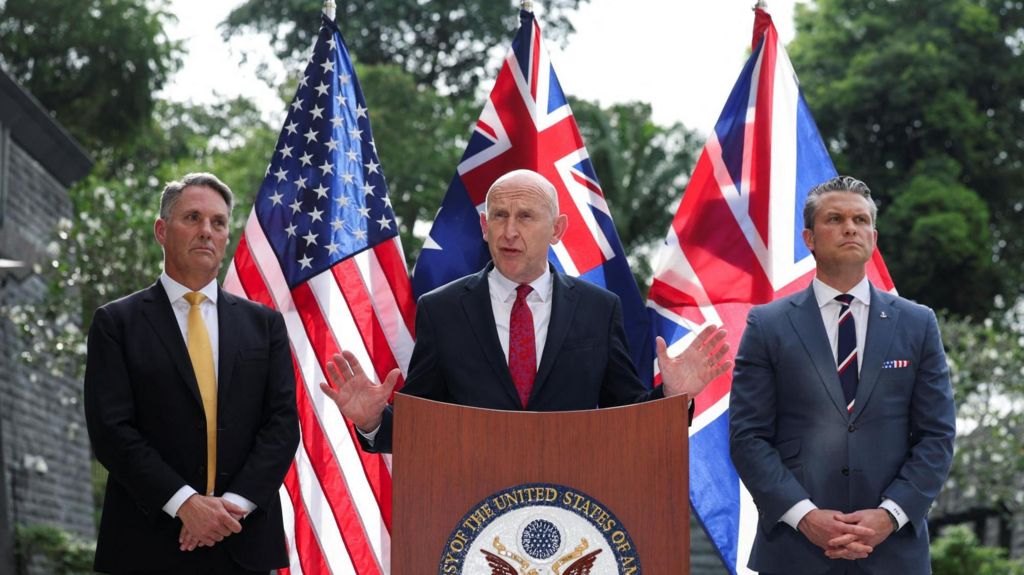
At the recent Shangri-La Dialogue security summit held in Singapore, defence leaders from the United States, the United Kingdom, and Australia made a landmark announcement for their AUKUS trilateral defence pact: the three nations will jointly develop next-generation uncrewed undersea vehicle (UUV) technology, a project designed to safeguard critical undersea infrastructure and expand collective military capabilities. Scheduled to deliver functional technology by 2027, the initiative marks the first flagship collaboration under AUKUS’s Pillar 2 framework, which focuses on advancing cutting-edge military technologies beyond the alliance’s nuclear submarine program.
UK Defence Secretary John Healey confirmed that London will commit £150 million ($201 million) to the UUV development effort, while the total overall cost of the project has not been publicly disclosed. The announcement comes amid widespread criticism that AUKUS has failed to deliver tangible progress on its commitments since the pact was first established in 2021. Addressing these concerns directly, Healey acknowledged that “for too long in Aukus, we talked too much and delivered too little”, but stressed that the current governments of all three nations have shifted the alliance into action.
Since its founding in 2021, AUKUS has centered on two core pillars. Pillar 1 focuses on developing nuclear-powered attack submarines for the Royal Australian Navy, a historic agreement that will see Australia become only the second nation after the UK to gain access to U.S. advanced nuclear propulsion technology. Pillar 2, meanwhile, is dedicated to collaborative development of advanced military capabilities, including long-range hypersonic missiles, artificial intelligence, and undersea robotics. The new UUV project is the first major program to launch under this second pillar.
According to a joint statement from the three defence ministries, the UUV program will develop cutting-edge payloads and supporting systems for autonomous underwater vehicles that can carry out multiple core missions: protecting critical seabed infrastructure such as undersea cables and pipelines, conducting intelligence surveillance and reconnaissance, supporting logistics operations, and even carrying out offensive strikes. Healey added that the project will also develop custom sensors and weapons systems for the drones, enabling rapid deployment of advanced battle technology to allied forces, while strengthening deterrence across the Pacific, Atlantic, and High North regions.
The push to protect undersea infrastructure comes amid growing concerns among Western nations over potential threats to subsea cables, which carry an estimated 99% of global intercontinental data traffic and underpin modern global communications and commerce. Just one month before the Singapore summit, Healey publicly accused Russia of conducting covert operations targeting undersea cables and pipelines in waters north of the UK – an allegation Moscow has repeatedly denied. In late 2024, the UK and Norway signed a dedicated agreement to coordinate monitoring and countering Russian submarine activity in the North Atlantic to protect these critical assets. British officials report that Russian naval presence in UK territorial waters has increased by 30% in recent years, with the UK connected to global communications via around 60 undersea cables.
Beyond Russian activity, Western officials have also raised concerns over Chinese-linked activity near undersea cables. Chinese vessels have been suspected of damaging cables in waters surrounding Taiwan and off the coast of Sweden, and multiple unexplained cable damage incidents have been recorded in the Baltic Sea in recent years. When asked by reporters at the summit whether the UUV project is specifically intended to counter undersea activity by Russia and China, the three defence ministers declined to comment. They also did not respond to repeated questions about whether AUKUS’s overall pace of progress is sufficient to address emerging security threats.
For the alliance’s flagship Pillar 1 nuclear submarine program, leaders also pushed back against growing criticism over long delivery timelines. The first purpose-built AUKUS nuclear submarines for Australia are not scheduled to enter service until the 2040s, leading to concerns that Australia will face a capability gap as its existing ageing conventional submarines retire before the new vessels are ready. Australian Defence Minister Richard Marles, speaking ahead of the summit, noted that there is no “plan B” for the program, and that the alliance remains committed to moving forward.
At the summit, U.S. Defence Secretary Pete Hegseth confirmed that the planned rotation of U.S. and UK nuclear submarines through Australian ports remains on schedule, with the first contingent of U.S. Navy personnel set to arrive in Australia by the end of 2025. Marles added that HMAS Stirling, the Royal Australian Navy base in Western Australia, will be fully upgraded to host the rotational submarine force by the end of 2027, and construction work on a dedicated submarine building yard in South Australia is progressing at the required pace to meet delivery targets for the locally built AUKUS submarines.