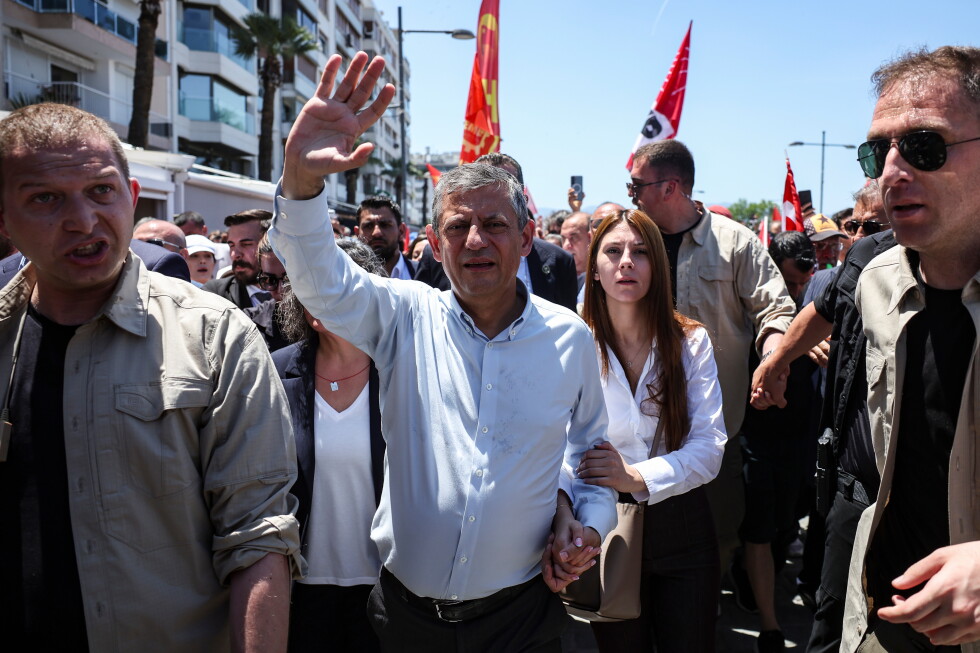
On a tense Saturday in Turkey’s capital Ankara, tens of thousands of supporters of the recently deposed leader of the country’s main opposition Republican People’s Party (CHP) took to the streets to protest a court ruling that removed him from office, escalating a political standoff that has already shaken the nation’s democratic landscape.
Ozgur Ozel, 51, who was formally elected to lead the CHP during a 2023 party congress, was ousted from his position via court order on May 21. The appellate ruling nullified the results of the 2023 congress vote, citing unproven allegations of procedural irregularities, and reinstalled Ozel’s 77-year-old predecessor Kemal Kilicdaroglu, who held the CHP leadership for 13 years of largely muted opposition to long-serving President Recep Tayyip Erdogan.
The demonstration began with a rally at Guven Park, located in central Ankara, where Ozel addressed the assembled crowd to condemn his ousting. He framed the court decision as nothing less than a deliberate power grab by the ruling government. “They are attempting to replace the CHP’s elected chairman and appoint a hand-picked trustee,” Ozel told his cheering supporters. “Today is the day to restart our march to power. I wish this were an internal party matter. This is not an internal matter for the CHP. This is a matter between Recep Tayyip Erdogan and the nation.”
Following the rally, Ozel led the crowd in an unplanned march to the mausoleum of Mustafa Kemal Ataturk, the founder of modern Turkey, a symbolic site widely tied to the nation’s secular and democratic founding principles.
Many political observers and opposition supporters widely view the court ruling as a politically motivated maneuver designed to weaken the CHP ahead of a potential early national election. Recent polling puts the CHP neck-and-neck with Erdogan’s ruling Justice and Development Party (AKP), and while the next scheduled general election is not set to take place until 2028, widespread speculation suggests Erdogan may call for a vote earlier to capitalize on current political momentum.
Ozel, who led the CHP to major gains in the 2024 municipal elections, solidified and expanded the party’s control of critical major cities including Istanbul and Ankara that the opposition first flipped in 2019, dealing a significant public rebuke to the AKP. The party’s most high-profile rising star, Istanbul mayor Ekrem Imamoglu, is widely seen as the strongest potential challenger to Erdogan, who has held Turkey’s presidency since 2003. However, Imamoglu has remained in prison since March 2024, facing a series of criminal charges that could result in decades of prison time if he is convicted. Supporters universally dismiss the charges as a fabricated political attack designed to remove Erdogan’s most formidable rival from the electoral landscape.
The ousting of Ozel is far from an isolated incident, Ozel argues: it is the latest in a sweeping pattern of legal pressure targeting the CHP and its members across the country. To date, hundreds of elected CHP officials and party activists have been detained, with most cases centered on unproven corruption allegations targeting municipalities run by the opposition. Last Sunday, just days before the mass march, Turkish police stormed CHP headquarters in Ankara to forcibly remove Ozel and his allies from the building.
In a striking parallel development on Saturday, Kilicdaroglu held a separate, rival gathering for his own supporters at the CHP headquarters, where he used the event to accuse the prior Ozel-led party administration of widespread corruption. Kilicdaroglu’s event drew a far smaller crowd than the mass march led by Ozel.
Turkish government officials have repeatedly pushed back against allegations of political interference in the judiciary, insisting that the country’s courts operate independently and free from political pressure. However, critics warn that the cumulative series of legal actions against opposition figures has eroded public trust in the impartiality of Turkey’s judicial system, deepening political polarization in the country ahead of what is already shaping up to be a contentious election cycle.
This political upheaval comes as the Turkish opposition holds unprecedented momentum after its strong showing in 2024 municipal elections, turning the conflict over the CHP leadership into a flashpoint for the broader struggle over the future of Turkish democracy.