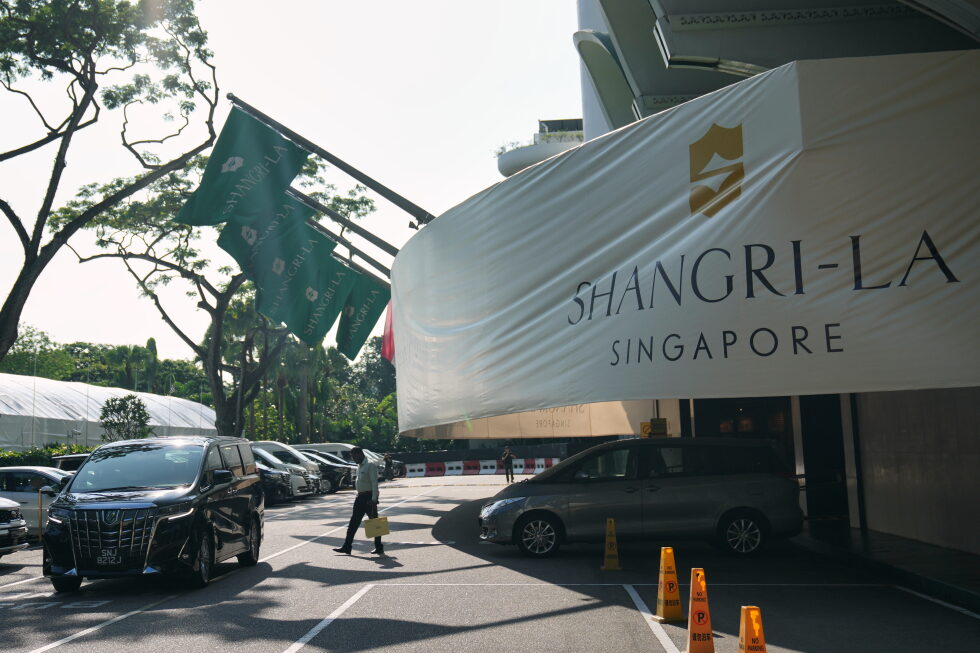
SINGAPORE — When defense leaders, top diplomats and senior security officials from across the globe gather this week for Asia’s most influential annual defense summit, two interconnected forces will dominate closed-door discussions and public agendas alike: China’s accelerating military modernization and increasingly assertive posture across the Indo-Pacific, and growing global uncertainty over long-term U.S. strategic priorities in the region.
Hosted by the International Institute for Strategic Studies, the 2025 Shangri-La Dialogue opens against a backdrop of spreading global instability that extends far beyond Asia’s borders. Just days ahead of the summit, new violent clashes have eroded the fragile ceasefire in the ongoing Iran war, pushing tensions in the Middle East to a new boiling point. Meanwhile, Russia has escalated its full-scale invasion of Ukraine, intensifying missile strikes and ground operations that have stretched Western military support for Kyiv to its limits.
The summit gets underway Friday with a landmark keynote address from Vietnamese leader To Lam, who has reshaped Vietnam’s political landscape this year by consolidating power into his hands, holding both the post of Communist Party general secretary and state president — a break from the Southeast Asian nation’s long-standing tradition of split collective leadership. For Vietnam, a strategically positioned nation that lies at the geographic and economic intersection of competing U.S. and Chinese interests, the balancing act it has perfected for decades is now under unprecedented scrutiny.
Like many Indo-Pacific coastal states, Vietnam maintains long-running overlapping maritime territorial claims with Beijing that have sparked multiple high-profile confrontations in recent years. At the same time, Hanoi remains deeply economically intertwined with China, which holds the position of Vietnam’s largest two-way trade partner. On the other side of the geopolitical divide, the United States is Vietnam’s top export market, and Washington has worked steadily over the past decade to deepen diplomatic ties and secure new defense contracts, aiming to shift Hanoi away from its decades-long traditional defense partnership with Russia.
Even after Hanoi and Washington elevated their bilateral relations to the highest diplomatic level in recent years, newly leaked official documents reveal that Vietnam’s military leadership remains deeply skeptical of U.S. intentions in the region. The documents show Hanoi has already taken concrete defensive planning steps to prepare for a potential future American “war of aggression” against the country, laying bare the deep mistrust that persists despite warming diplomatic ties. Against this complex backdrop, observers widely expect Lam to frame his opening address around a call for regional consensus-driven dispute management and collective cooperation to advance shared stability and development, avoiding overt alignment with either global power.
Following Lam’s opening, U.S. Defense Secretary Pete Hegseth will take the stage Saturday to outline the Trump administration’s updated Indo-Pacific strategy. This marks Hegseth’s second appearance at the summit; his 2024 address drew fierce condemnation from Beijing when he declared that “the threat China poses is real, and it could be imminent,” claiming China’s military was “rehearsing for the real deal.” At the time, Hegseth pledged that the U.S. would bolster its regional defensive posture to counter what the Pentagon frames as growing Chinese aggression, particularly against self-governing Taiwan.
This year’s speech comes just two weeks after President Donald Trump’s high-profile meeting with Chinese leader Xi Jinping in Beijing, a summit that injected new uncertainty into U.S. policy across the Taiwan Strait. During the meeting, Xi issued a stark warning that the two superpowers could face direct military conflict if the Taiwan issue is not managed in line with Beijing’s core interests. After the talks, Trump publicly praised Xi as a “great leader” and claimed the two nations would build a “fantastic future together.” The U.S. president also sparked widespread concern by openly questioning Washington’s long-standing commitment to Taiwan’s defense, calling a proposed $14 billion U.S. arms package for Taipei — which he has yet to approve — “a very good negotiating chip for us” with Beijing.
China claims the self-governing, democratic island of Taiwan as an integral part of its territory, and Beijing has repeatedly refused to rule out the use of military force to bring the island under its control. For decades, the U.S. has supplied Taiwan with advanced fighter jets, missiles and other defensive weaponry, while maintaining a long-standing policy of “strategic ambiguity” over whether it would intervene militarily if China launched an attack. Trump’s open ambivalence toward Taiwan’s security has far outpaced that of any of his predecessors, fueling growing global speculation that he could be willing to roll back long-standing U.S. support for Taipei in exchange for concessions from Beijing.
A Pentagon spokesperson said Hegseth’s Saturday address will outline the military’s “common-sense approach to safeguarding U.S. vital national interests in the Indo-Pacific.” Most analysts agree that coming so soon after Trump’s Beijing summit, Hegseth is unlikely to make any dramatic remarks that would contradict the president’s recent conciliatory comments toward Xi.
China is scheduled to present its official perspective on regional security during Sunday’s plenary sessions, but Chinese state media has confirmed that Beijing will send only a lower-level delegation to this year’s summit, and it has not yet confirmed which official will deliver China’s address. Chinese Defense Minister Dong Jun also skipped last year’s Shangri-La Dialogue, continuing a pattern of reduced high-level Chinese participation in the annual forum.
While the Shangri-La Dialogue has always centered primarily on Indo-Pacific security, two ongoing global conflicts will be impossible to avoid on the summit’s sidelines and in public debates: Russia’s 3-year full-scale war against Ukraine and the escalating Iran war that has effectively shut down the Strait of Hormuz, one of the world’s most critical energy chokepoints. In normal peacetime, roughly 20% of all globally traded oil passes through the strait; since its effective closure following the outbreak of hostilities, global oil prices have spiked sharply, triggering widespread economic disruption across energy import-dependent nations worldwide. Qatar’s defense minister is among the senior Middle Eastern officials scheduled to address the summit over the weekend.
Ahead of the conference, Ukrainian President Volodymyr Zelenskyy sent a formal letter to President Trump and the U.S. Congress requesting additional shipments of American-made air defense ammunition to help Ukraine fend off intensifying Russian ballistic missile attacks on Ukrainian civilian and energy infrastructure. While Zelenskyy made a surprise in-person appearance at the 2023 Shangri-La Dialogue, he is not expected to attend this year’s summit. But a roster of senior European defense officials from NATO frontline states including Lithuania and Poland are scheduled to speak, ensuring the war in Ukraine remains a core topic of discussion.