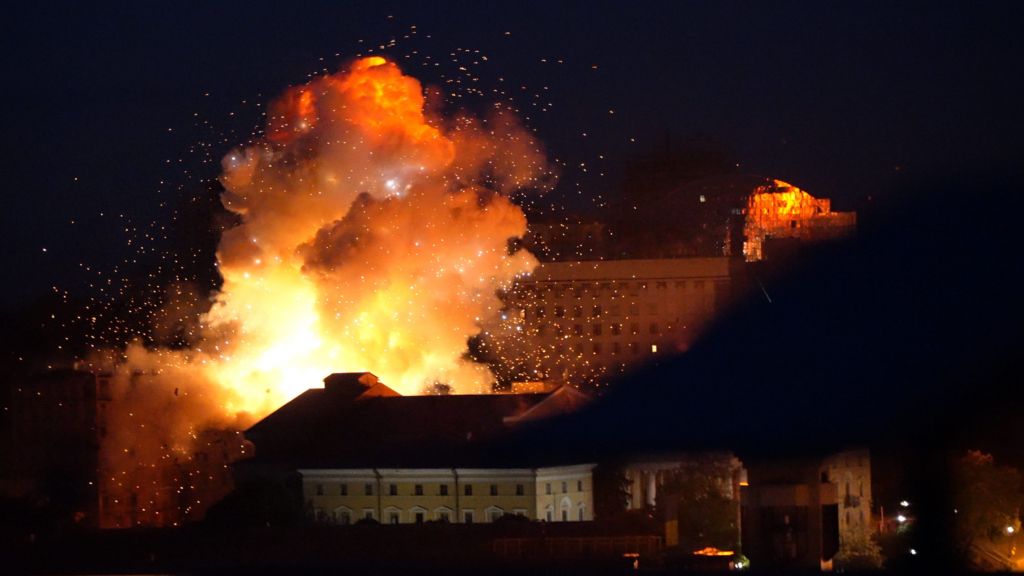
Over the weekend, the Russian military launched one of its largest recent bombardment campaigns against Ukraine’s capital Kyiv, following the attack with explicit new threats of consistent, systematic targeting of Ukrainian military infrastructure in the city. Alongside its warnings of intensified strikes, Moscow has urged foreign nationals and diplomatic personnel to evacuate Kyiv immediately, stoking fears of a dramatic escalation in the four-year full-scale invasion that has reshaped eastern Europe’s security landscape.
On the surface, these threats carry an ominous tone that has prompted global observers to question whether a new phase of open conflict is imminent. But as Ukrainian officials point out, the reality on the ground holds much that is familiar: for more than four years, Russian forces have targeted Ukrainian population centers and infrastructure on a weekly basis, and Kyiv has faced regular bombardments since the full-scale invasion began in February 2022. Ukraine’s foreign ministry has assessed that the overall level of security threat to Kyiv and other Ukrainian cities remains unchanged from what it has been over the past months and years.
What is new, however, is the explicit framing Moscow has given to its planned strikes, a shift tied directly to a recent incident in the Russian-occupied Luhansk region. Last week, Moscow accused Ukrainian forces of deliberately carrying out a lethal strike that killed 21 civilians in the town of Starobilsk, framing the attack as an intentional massacre of students. Ukraine has rejected that claim, asserting it only targeted a legitimate Russian military facility in the occupied territory. For the first time in recent months, the Kremlin is holding up the alleged civilian casualty event as formal justification for large-scale retaliation against Kyiv – a departure from its usual pattern of launching strikes without extensive public justification, and a contrast to its longstanding lack of public remorse for civilian casualties caused by its own military operations across Ukraine.
Analysts and Ukrainian officials have offered multiple interpretations of what is driving this new rhetorical escalation. Ivan Stupak, a military analyst and former Ukrainian intelligence officer, argues that the shift in messaging reflects growing problems with Russian domestic narrative control. “When you have problems with the economy and Russian society, then there’s pressure for revenge,” he explained.
Andrii Kovalenko, a member of Ukraine’s National Security and Defence Council, outlined three additional factors unrelated to the Starobilsk incident that he believes explain the new threats. First, he argues, the heightened rhetoric stems directly from Russia’s persistent lack of strategic progress on the front lines. With no major territorial gains to show for months of fighting, the Kremlin is turning to psychological pressure to break Ukrainian public morale. Second, the warning to foreign diplomats to leave Kyiv is a deliberate attempt to pressure Ukraine’s Western allies, whose continued political and military support Moscow has long identified as a core barrier to achieving its war aims. Third, Kovalenko says the threats serve as a deliberate distraction from Ukraine’s growing ability to carry out long-range strikes on Russian territory and its incremental progress reclaiming occupied Ukrainian land.
These assessments align with broader analysis from international defense and security research institutes. The Washington-based Institute for the Study of War has concluded that the trajectory of the war, now entering its fifth year, is currently shifting in favor of Ukrainian forces. Russia is losing far more soldiers than it is able to recruit each month, with casualty numbers outpacing monthly recruitment for five consecutive months, as Russian command continues to throw troops into costly offensives that yield minimal territorial gains.
Nigel Gould-Davies, a senior fellow at the International Institute of Strategic Studies, notes that these battlefield losses have left the Kremlin facing a fateful choice. As Russia confronts growing constraints on both its military industrial output and available manpower, it will soon have to decide whether to order a forced mobilization of the country’s economy and society to sustain the war effort. Forcing mass conscription and economic restructuring, Gould-Davies warns, would be deeply disruptive and extremely unpopular among the Russian public, carrying significant risks to the Kremlin’s domestic stability.
Despite these signs of growing Russian weakness, the immediate threat to Kyiv remains acute. The capital is still clearing damage from the large-scale weekend retaliatory strike that saw Russia launch nearly 600 drones and 90 missiles, the vast majority aimed at Kyiv. While Ukrainian air defenses intercepted most of the drones, 35 missiles successfully struck targets. In a notable display of new weapons deployment, Russia used at least one of its new Oreshnik hypersonic missiles, a system fitted with six independent warheads that is extremely difficult for conventional air defense systems to intercept. Stupak argues that the deployment of the new missile so far has been primarily for propaganda purposes, noting that Russian Oreshnik tests over Ukraine have so far used inert warheads and caused limited damage.
Still, Kyiv faces growing challenges in defending against repeated large-scale Russian strikes. Ukrainian officials have repeatedly warned that critical air defense interceptor missiles are in dangerously short supply, and US-made Patriot systems – the only weapon currently in Ukraine’s arsenal proven effective at intercepting Russian ballistic missiles – remain far less numerous than needed. Ukrainian President Volodymyr Zelensky has recently renewed urgent appeals to Western allies to deliver additional air defense systems and interceptor missiles to shore up Kyiv’s defenses.
While analysts agree that the Kremlin’s escalating threats stem in large part from growing desperation over the course of the war, that desperation does not make the threat to Ukraine any less severe. For Kyiv and its international backers, Russia’s worsening position on the battlefield may only make the coming months more dangerous.