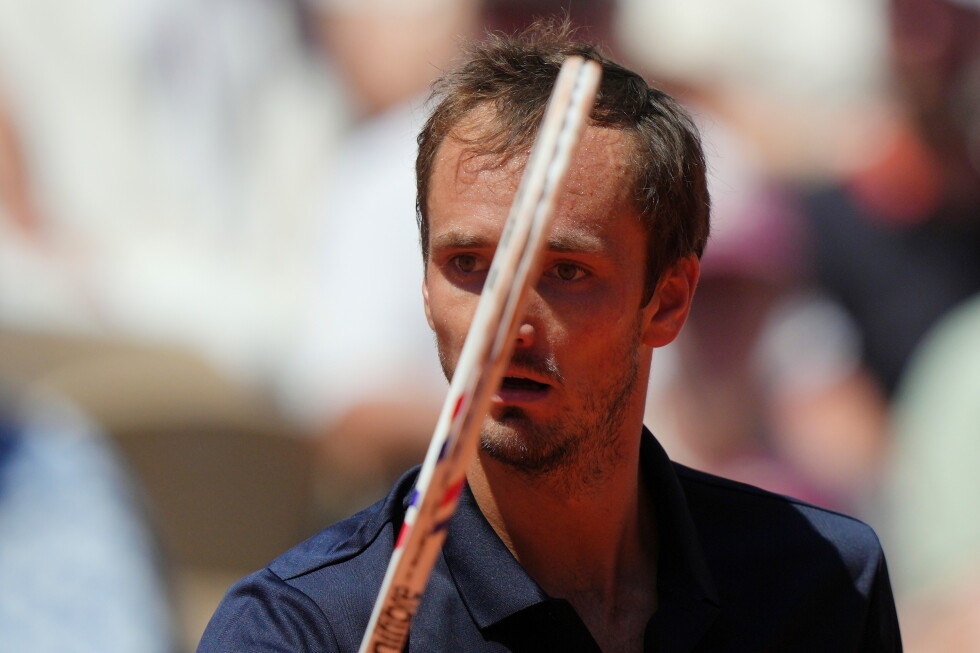
As the 2024 clay court swing reaches its peak with the French Open underway, a familiar, dramatic staple of professional tennis has returned to the spotlight: explosive on-court temper outbursts, most commonly marked by violent racket-smashing. For a sport universally recognized as one of the most psychologically demanding in the world, moments where even top-ranked competitors lose their composure in front of thousands of live spectators and millions of global viewers are far from a new phenomenon.
Recent weeks have already delivered multiple high-profile meltdowns across European clay tournaments. Former world No. 1 Daniil Medvedev suffered one of the most humbling defeats of his career earlier this season, dropping a 6-0 6-0 double-bagel loss to Matteo Berrettini at the Monte Carlo Masters. Midway through the lopsided defeat, the Russian star slammed his racket into the red clay seven consecutive times before tossing the completely mangled frame into a court-side trash can. Medvedev later acknowledged that even he did not plan the outburst, noting he had hoped the release of frustration might spark a comeback, though the effort failed to turn his game around.
Not long after, German competitor Daniel Altmaier saw his frustration boil over during a tournament in Hamburg, where he smashed his racket before kicking the broken frame into the spectator stands. No fans were injured in the incident, but it reignited conversations about the risks of unregulated on-court anger.
This trend stretches back decades. 1980s legend John McEnroe remains one of the most iconic examples of on-court temper, and even some of the sport’s most beloved and composed greats had their moments early in their careers. Roger Federer, widely hailed as one of the classiest players in tennis history, was known for frequent racket-smashing as a junior before reining in his emotions to build his legendary legacy. Other all-time greats have also had high-profile run-ins with officials over outbursts: Serena Williams was penalized for shouting at a line judge following a foot fault call at the 2009 U.S. Open, while Novak Djokovic was disqualified from the 2020 U.S. Open after accidentally striking a line judge in the throat with a hit ball, ending his 29-match winning streak in stunning fashion.
Current top players have opened up about the root of these outbursts, explaining that the pressure of tennis amplifies the same frustrations all people experience in daily life. Andrey Rublev, the world No. 13 and a player who has long been open about his own on-court anger, noted that the intensity of the sport can even leave him with cuts after punching racket strings or slamming his knees to release frustration. Rublev’s coach, legendary former player Marat Safin, once estimated he broke more than 1,000 rackets over the course of his own career.
“It’s not about tennis,” Rublev explained. “All people have this situation in life and you just lose it. What makes tennis different is that you’re completely alone out there, and everyone is watching. Some people handle those emotions better, but I’m one of the people who let them take over.”
World No. 1 Aryna Sabalenka, who has worked for years to manage her own temper, says that unchecked anger used to tank her performance. “My emotions were destroying my game and my level was dropping dramatically when I would start overreacting on everything,” she said. “Opponents would see that weakness, step up, and play even better. Learning to keep those emotions in check has been a huge improvement for my career, and it really helped me level up.”
Some players have adapted by channeling their frustration away from the public eye. After Coco Gauff’s off-court post-match meltdown was caught on camera at the Australian Open, it sparked broad debate about athlete privacy. World No. 5 Jessica Pegula says she intentionally reserves any racket-smashing for private spaces away from crowds. “I go find some place that’s maybe not near people and then I can break a racket,” she said, noting that on the court she is able to stay composed. “I’m not a super emotional person in general, so getting to that point takes a lot for me. But I do think it’s entertaining to watch – sometimes I wish I could wear my heart on my sleeve more, that’s just not who I am.”
Four-time Grand Slam champion Naomi Osaka similarly developed a private way to handle frustration, after her father corrected her poor on-court attitude when she was young. Now, Osaka releases her anger quietly enough that it rarely draws attention. “I actually do curse a lot on the court, I say it so softly you can’t hear it,” she explained. “I’m really glad about that, because I don’t want to get fined for it.”
36-year-old Sorana Cirstea, who recently became the oldest player to debut in the WTA top 20, summed up the prevailing perspective among players: professional tennis is a uniquely grueling mental test, and competitors are only human. “It’s such a mental sport,” Cirstea said. “To be able to sustain that mentality for three long hours with all the adrenaline and the pressure, sometimes you don’t handle it the best. We are human.”