A three-day consecutive gain for Australia’s domestic sharemarket came to an abrupt end on Tuesday, as renewed geopolitical tensions in the Middle East upended market forecasts and sent global crude oil prices surging by 2.3% in a single trading session. The sudden shift in sentiment followed conflicting developments in US-Iran diplomacy that left global investors scrambling to adjust their risk positioning.
The benchmark ASX 200 closed the session down 34.20 points, a 0.39% drop that pushed the index to 8657.80. The downturn began immediately after the opening bell, when news broke of new US military strikes targeting Iranian assets, injecting fresh uncertainty into a region already roiled by ongoing conflict. The broader All Ordinaries index followed a similar trajectory, falling 32.80 points, or 0.37%, to settle at 8882.60. Against this backdrop, the Australian dollar edged slightly higher against the US dollar, hitting 71.67 US cents by market close.
Oil emerged as the defining volatility driver of the session. Just hours before Australian markets opened, crude prices had fallen overnight after both US and Iranian officials announced a tentative, in-principle peace deal that would reopen the strategically critical Strait of Hormuz, a chokepoint through which roughly 20% of global oil supplies pass daily. That optimistic shift was completely erased, however, following reports of explosions near Bandar Abbas, Iran’s key coastal hub for access to the strait.
IG market analyst Tony Sycamore explained that the blasts shattered growing market confidence that a breakthrough in US-Iran tensions was finally at hand. “These doubts have emerged just as markets were growing increasingly confident that a breakthrough was imminent, seemingly ignoring the fact that five previous attempts had fallen apart at the eleventh hour,” he noted. By the close of trading, Brent Crude had jumped 2.3% to settle at $US98.34, equal to around $A137.21, erasing all prior losses from the overnight session.
Nearly all market sectors felt the downward pull of the uncertainty: 10 of the ASX’s 11 core sectors closed the session in negative territory, led by utilities, consumer staples, and Australia’s big four banks. Even the energy sector, which typically rises alongside crude prices, ended the day lower, dragged down by coal producers that reversed the strong gains they posted a day earlier, which had followed a deadly explosion at a major Chinese coal mine that disrupted global supply.
Utilities were hit particularly hard after the national regulator announced an upcoming cut to retail electricity prices. Origin Energy shares dropped 2.30% to $10.64, while competitor AGL fell 2.79% to $8.70. Among consumer staples, major supermarket chains Woolworths and Coles slipped 0.75% and 0.56% respectively, while Treasury Wine Estates saw shares plummet 3.90% to $4.43.
Australia’s four largest national banks all posted losses ahead of the release of key domestic inflation data scheduled for Wednesday. Economists forecast that headline annual inflation will rise to 4.4%, while the Reserve Bank of Australia’s preferred trimmed mean inflation measure is expected to come in at 3.4%. Current market pricing suggests slowing inflation growth, paired with last week’s unexpected jump in national unemployment, will give the RBA room to keep the official cash rate on hold at 4.35%. By close, Commonwealth Bank of Australia fell 0.18% to $164.30, Westpac dropped 0.44% to $36.61, National Australia Bank led the big four losses with a 0.76% drop to $37.99, and ANZ slipped 0.31% to $35.66.
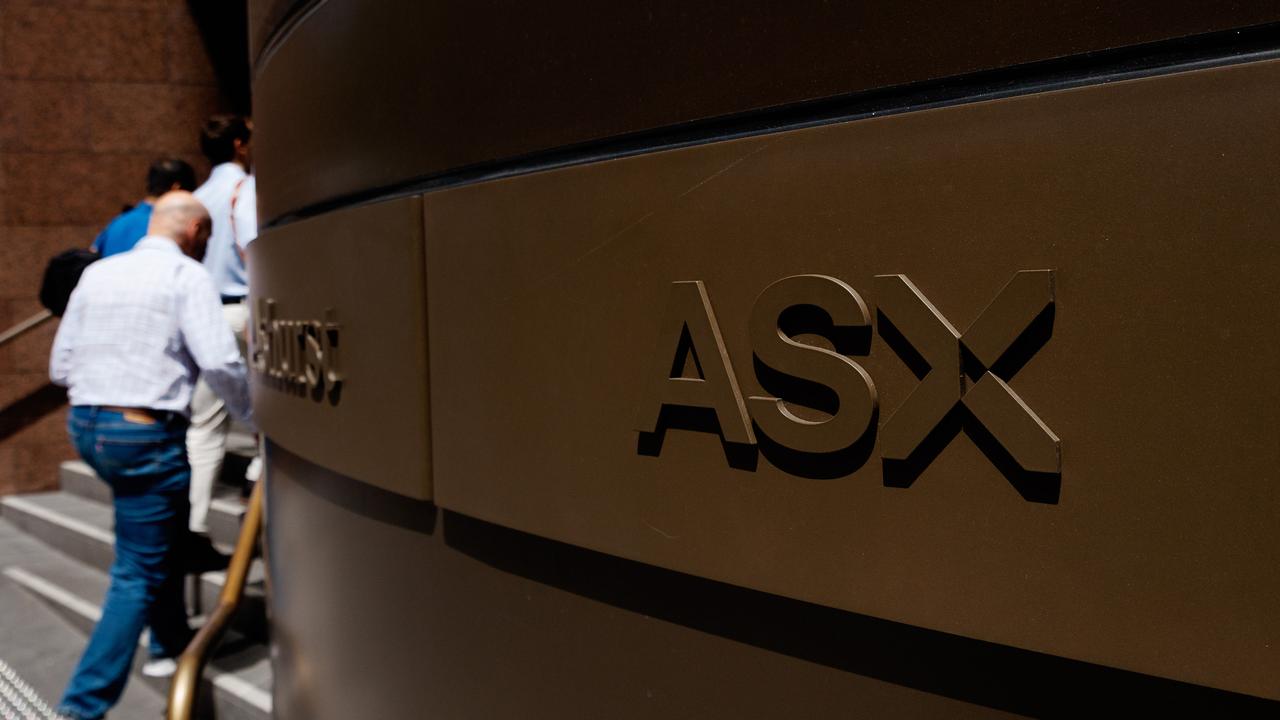
A handful of individual companies posted outsized moves on the day. Market operator ASX Ltd itself suffered its worst single-day performance since 2000, with shares plummeting 13% to an eight-week low of $51.03. Mexican fast food chain Guzman Y Gomez trimmed recent gains, falling 2.22% to $19.42, one day after the company confirmed it would fully exit the US market to focus on its domestic and Asian operations.
Against the broader market downturn, two companies delivered strong positive gains off the back of promising business updates. Online electronics retailer Kogan soared 18.60% to $4.08 after releasing a mid-financial year update showing gross sales grew 18.2% and total revenue jumped 18.1% over the first 10 months of the fiscal year. Medical device manufacturer Fisher & Paykel Healthcare also rallied sharply, with shares jumping 9.2% to $30.05 after reporting a 24% year-on-year rise in full-year net profits that outperformed market expectations.