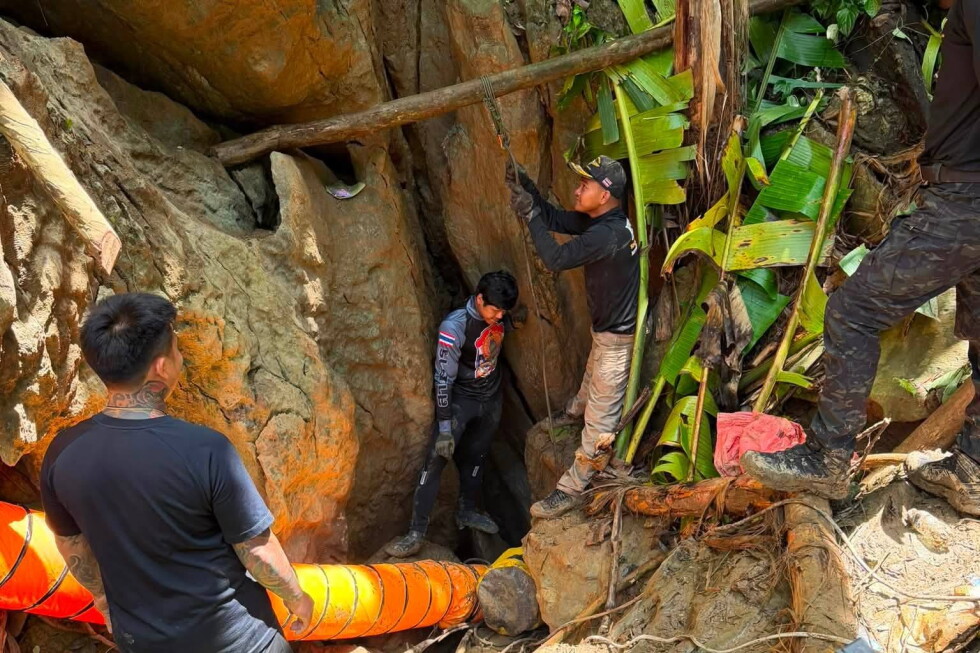
The multi-national search and rescue mission for seven local villagers trapped inside a flooded cave in central Laos has entered its seventh day on Tuesday, with rescuers battling harsh terrain and volatile weather to reach the stranded group whose current status remains unclear.
According to Lao and Thai rescue teams deployed to the operation, the seven entered the cave in Xaisomboun Province on May 19, only for an intense downpour to trigger sudden flash flooding that sealed off their only exit path.
The Lao non-profit Rescue Volunteer for People, which has been collaborating closely with local government authorities on the operation, announced its Tuesday operational priorities via a Facebook post: search teams planned to explore natural air shafts above the cave system to identify alternative access points and pinpoint the location of the trapped group. Rescue personnel from neighboring Thailand arrived at the remote site over the weekend to reinforce the effort.
Difficult conditions have consistently slowed progress from the start of the operation. To date, rescue divers have only managed to navigate roughly 100 meters into the narrow, waterlogged cave system, and estimates place the trapped group around 30 meters beyond the farthest point rescuers have currently reached. Crews are currently working around the clock to pump floodwater out of the cave to open new passage for search teams.
The cave is located in a remote, mountainous area of Longcheng district, Xaisomboun Province, approximately 120 kilometers north of the Lao capital Vientiane. Rescuers have documented on social media how steep terrain and ongoing heavy rainfall have severely hampered movement and operations. Footage shared by Thai rescue teams shows that reaching the cave entrance alone requires a 4-kilometer steep, arduous hike over uneven ground. The entrance itself is rocky, sharply sloped, and only wide enough to allow one person to climb through at a time. Once inside, teams must navigate mud-choked corridors, fully flooded chambers, and tight tunnels that force rescuers to crawl slowly forward.
While no official confirmation of the group’s purpose inside the cave has been released by authorities, participating rescuers confirmed the villagers entered the site to search for untapped gold deposits. Bounkham Luanglath, a representative of the Lao rescue organization, told the Associated Press that local residents had long visited the cave to prospect for gold, despite repeated official warnings about the site’s significant safety risks.
Laos has one of the lowest average per capita incomes in Southeast Asia, ranging between $2,000 and $2,500 annually, with rural, underdeveloped regions seeing even lower average earnings. Though the country is not classified as a major global gold producer, its mining sector makes up a substantial share of its developing national economy, driven by foreign direct investment primarily from neighboring China and Thailand. While copper remains the country’s top mineral export, mining for rare earth elements — critical components for nearly all modern electronics and clean energy technologies — has expanded rapidly across Laos in recent years. As of Tuesday, the Lao Foreign Ministry stated it had no official information to release to media outlets. The one-party communist state maintains strict controls over information sharing, with no formal organized opposition permitted.
The high-profile rescue operation has drawn major attention in neighboring Thailand, where it evokes sharp comparisons to the viral 2018 Tham Luang cave rescue, when 12 youth soccer players and their coach were trapped for more than two weeks before a daring international operation pulled them out alive. That mission claimed one life: a former Thai Navy SEAL diver who died during the search phase. Just earlier this month, another high-profile cave tragedy claimed six lives: five Italian divers who died after going missing during a cave dive in the Maldives, plus a Maldivian military diver who was killed during the high-risk body recovery operation.
Cave rescue experts note that trapped cave explorers face a cascade of life-threatening hazards even in the best conditions. Extended exposure to cold cave temperatures can quickly lead to hypothermia. While the human body can survive for multiple weeks without food, access to clean drinking water is critical to avoid fatal dehydration, and contaminated water can trigger diarrhea that accelerates fluid loss. Falling oxygen levels and carbon dioxide buildup also pose severe risks: low oxygen causes symptoms similar to altitude sickness that can damage lungs and other organs over time, while excess carbon dioxide buildup leads to fatigue and eventual unconsciousness. Constant darkness also disrupts the body’s circadian rhythms and sense of time, and can leave victims with extreme light sensitivity once they are extracted.
This report includes contributions from Associated Press journalists Grant Peck, Anton L. Delgado and Haruka Nuga.