As Colombians prepare to head to the polls this Sunday to elect their next head of state, three candidates from wildly different political backgrounds have emerged as the clear frontrunners, each offering a sharply contrasting vision for the country’s future. At the top of pre-election polling is Ivan Cepeda, a veteran leftist senator, human rights advocate and close ally of outgoing President Gustavo Petro, Colombia’s first ever left-wing head of state. Trailing closely behind him are right-wing political newcomer Abelardo “The Tiger” de la Espriella and conservative opposition senator Paloma Valencia, a protégé of hardline former president Alvaro Uribe.
Cepeda’s political journey has been defined by tragedy and resilience, shaped by decades of conflict in Colombia. He first stepped into the national spotlight in 1994, when at just 32 years old, he stood beside the bullet-riddled corpse of his father, a communist senator assassinated by far-right paramilitaries during a wave of political violence that killed more than 5,700 leftist leaders across the country. Speaking to reporters on that day, he demanded accountability, saying “Let this crime not go unpunished” — a moment broadcast live to millions of Colombians.
Now 63, Cepeda spent years in exile across Czechoslovakia, Bulgaria, Cuba and France before returning to his home country to advocate for victims of the decades-long internal armed conflict. He played a pivotal role in crafting the 2016 historic peace accord that brought about the full disarmament of the FARC, Colombia’s once-largest rebel guerrilla group, and later was the architect of Petro’s controversial “total peace” initiative, an effort to end all remaining insurgent and criminal violence that ultimately failed to meet its core goals.
A defining moment in his political rivalry with the right came when Cepeda led the investigation into Uribe’s alleged paramilitary ties, a case that led to Uribe becoming the first former Colombian president to be convicted of a criminal offense in 2024. Though the conviction was later overturned by a judge, the confrontation cemented Cepeda’s status as the left’s most prominent icon and Uribe’s greatest political foe. Known for rejecting neckties — which he calls a symbol of oligarchy — and often wearing a traditional Caribbean collared shirt, Cepeda has brushed off decades of attacks from opponents, noting during this campaign: “I have survived genocide, stigmatization and relentless persecution. And here I am, still standing.” His critics still attack him over his past, however, repeating accusations of hidden ties to the FARC and blaming him for the failures of Petro’s total peace plan.
In second place in the polls is 47-year-old de la Espriella, a millionaire lawyer and businessman who has branded himself “The Tiger” and is making his first run for public office after years living a lavish lifestyle abroad. A self-identified right-wing outsider, de la Espriella left Colombia to live in Florence, Italy, where he enjoyed opera, traveled via private jet and built his businesses in rum and wine. He returned to run for president, he says, to stop the left from “destroying” Colombia, and counts among his political idols former U.S. President Donald Trump, Argentina’s libertarian leader Javier Milei and El Salvador’s hardline president Nayib Bukele.
Over his decades-long legal career, de la Espriella has defended a wide range of high-profile Colombian figures, from top soccer stars to notorious drug traffickers. Now campaigning, he often wears a tailored suit and has recently taken to wearing a bulletproof vest to public events, a nod to his tough-on-crime platform. As the candidate of the hardline law-and-order movement, de la Espriella has proposed sweeping measures to tackle Colombia’s status as the world’s largest cocaine producer: he wants to create a military alliance with the United States and Israel to crack down on drug cartels, build a network of large mega-prisons, and expand legal access to firearms for civilians. “Any criminal who does not surrender will be taken down as the law allows,” he told AFP in a February interview.
The candidate has drawn widespread controversy for his inflammatory rhetoric: he once called for the Colombian left to be “gutted” before later softening his language, has made remarks widely condemned as homophobic and sexist, and often uses aggressive, vulgar language in campaign events. His hot temper and unapologetic style have become defining parts of his political brand, attracting a base of angry, anti-establishment right-wing voters.
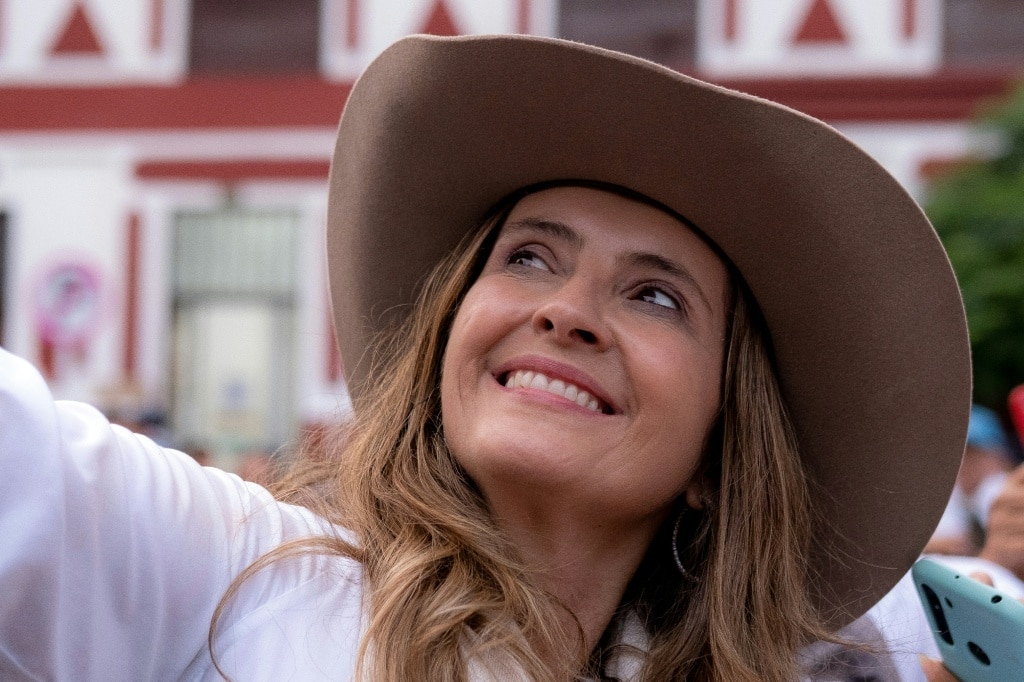
Third in pre-election surveys is 50-year-old Paloma Valencia, a conservative senator from one of Colombia’s most politically powerful elite families. She is the granddaughter of Guillermo León Valencia, who served as Colombia’s president from 1962 to 1966, a conservative leader who took a hard line against early guerrilla groups and aligned Colombia closely with U.S. anti-communist policy in Latin America. If elected, she would become Colombia’s first female president.
Valencia has long positioned herself as one of the most vocal critics of the Colombian left and guerrilla groups, and considers former president Uribe her political “father” and mentor, campaigning side-by-side with him across the country. Like Uribe, she opposed the 2016 FARC peace accord and supports the hardline militarized security strategy that defined his presidency. In a March campaign speech, she laid out her core policy contrast to Petro’s agenda: “We are going to put an end to ‘total peace’ in order to impose total security.”
On social issues, Valencia holds staunch conservative positions on LGBTQ rights, and she supports expanding fracking — a controversial method of oil and gas extraction widely criticized for its severe environmental harms. As the most established right-wing candidate in the race, she draws support from traditional conservative voters who align with Uribe’s long-standing political movement.
With just days to go before voting begins, polls show a tight three-way race that remains too close to call, leaving Colombians poised to choose between continuing the country’s left-wing shift or turning back to a hardline conservative security agenda.