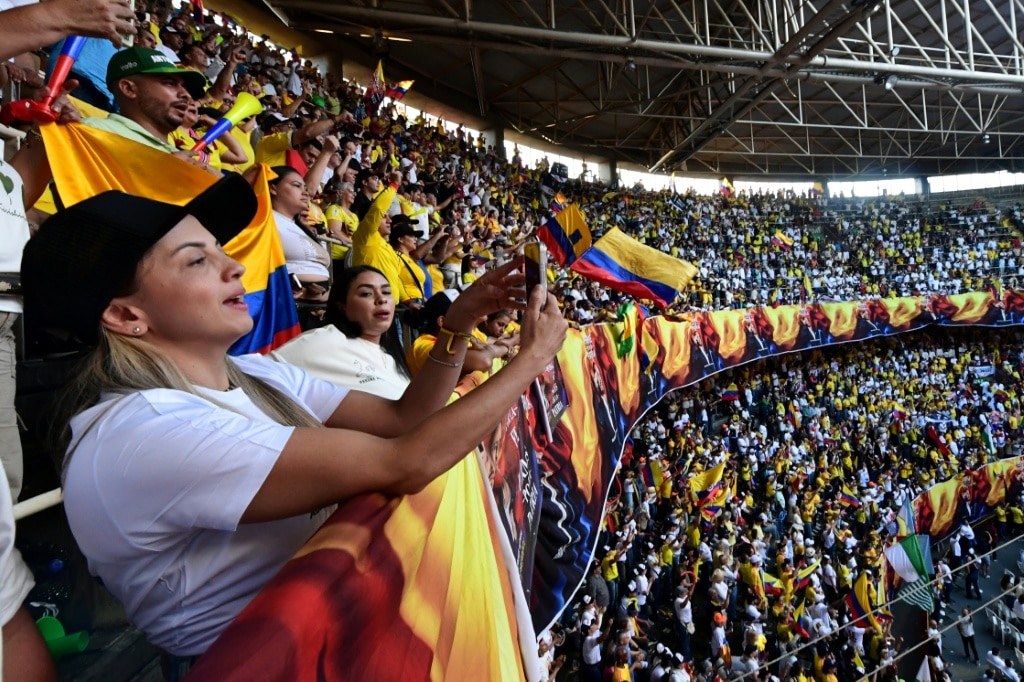
Colombians will cast their ballots this Sunday in one of the most divisive presidential elections in the country’s recent history, a contest that has been overshadowed by a dramatic spike in organized violence and forces voters to choose between extending four years of historic leftist governance or turning the country sharply to the right.
Outgoing President Gustavo Petro, Colombia’s first ever leftist head of state, is barred from seeking consecutive re-election, bringing a turbulent close to a term defined by rising insurgent violence, high-profile attacks including car bombings and drone strikes, and the assassination of a sitting presidential candidate. Still, Petro’s administration delivered tangible economic gains for working and low-income Colombians: the national unemployment rate has fallen steadily, driven in part by expanded public sector hiring, and the national minimum wage has been raised significantly.
That legacy has put Petro’s hand-picked successor, 63-year-old leftist Senator Ivan Cepeda, in the position of poll front-runner heading into election day. The son of a prominent senator murdered by paramilitary groups, Cepeda has campaigned on a promise to expand Petro’s flagship social welfare programs and continue the administration’s signature “total peace” policy of open negotiations with active armed groups, even though the talks have produced few tangible demobilization results to date. For many of Cepeda’s supporters, the Petro administration’s policies have delivered life-changing support. “I give him my vote because my life changed under this government,” explained 23-year-old Bogota design student Natalia Rojas, who benefited from the government’s subsidized higher education program. To avoid a June 21 runoff, Cepeda must win an outright majority of the popular vote, a result most pollsters see as unlikely.
Most forecasts currently predict Cepeda will advance to a second-round faceoff against 47-year-old right-wing candidate Abelardo de la Espriella, a wealthy lawyer nicknamed “the Tiger” who has never held elected office and run a deeply unorthodox campaign. Known for campaigning in a bulletproof vest, de la Espriella has built his platform on a hardline security agenda that echoes the crackdown implemented by popular Salvadoran President Nayib Bukele – a comparison the candidate has leaned into openly, from his pledge to build large Bukele-style mega-prisons to his similar facial hair style. If elected, de la Espriella has announced he will request direct military backing from the United States to launch a 90-day campaign of airstrikes and aerial crop fumigation targeting cocaine-trafficking armed groups. “What De la Espriella wants is to put the house in order,” said Wilmer Bolivar, a 47-year-old former Colombian soldier and supporter of the right-wing candidate. De la Espriella is locked in a tight battle for second place, however, against centrist opposition Senator Paloma Valencia, who is backed by influential former president and conservative power broker Alvaro Uribe.
The election has laid bare deep ideological and class divides that have defined Petro’s polarizing tenure. While poorer Colombians have rallied around the government’s expanded social investment and pro-labor policies, the country remains one of the most economically unequal in the Western Hemisphere. Political scientist Alvaro Forero framed the contest as fundamentally rooted in this class divide, telling Agence France-Presse that “this election is marked by class struggle, and that is Petro’s main electoral ammunition.”
Critics, meanwhile, argue Petro’s governance has been erratic, and that his total peace negotiation strategy allowed armed criminal and insurgent groups that survived the 2016 FARC peace accord to rebuild and expand their territory. Independent experts confirm many groups used the cover of peace talks to strengthen their smuggling and drug trafficking networks, contributing to the wave of violence that has swept the country. Colombia remains the world’s largest producer of cocaine, and the vast majority of current violence is tied to battles over drug trafficking routes between competing armed factions. Human Rights Watch’s Juanita Goebertus called 2025 “a very bad year” for security in the country, noting that kidnappings have more than doubled and internal displacement from violence has hit its highest level in nearly 20 years.
Every major candidate has faced credible assassination threats throughout the campaign, a reminder of the country’s unstable security environment. The 2024 killing of right-wing candidate Miguel Uribe left many voters anxious about a return to the widespread political violence that marked Colombia’s late 20th century. Rising drug trafficking activity has also badly strained relations between the Petro administration and U.S. President Donald Trump, with the dispute escalating into public mutual insults that nearly upended decades of bilateral security cooperation.
Regardless of Sunday’s outcome, the next president will inherit a raft of pressing national challenges. Beyond the intractable security crisis, Colombia is facing a ballooning fiscal deficit that has reached 7% of national GDP, driven by lagging tax collection that has not kept pace with Petro’s ambitious social spending programs that were launched to offset a weak post-pandemic economic recovery. As Forero put it, the core question of the election is clear: “What’s at stake is continuing Petro’s change agenda or rejecting it.”