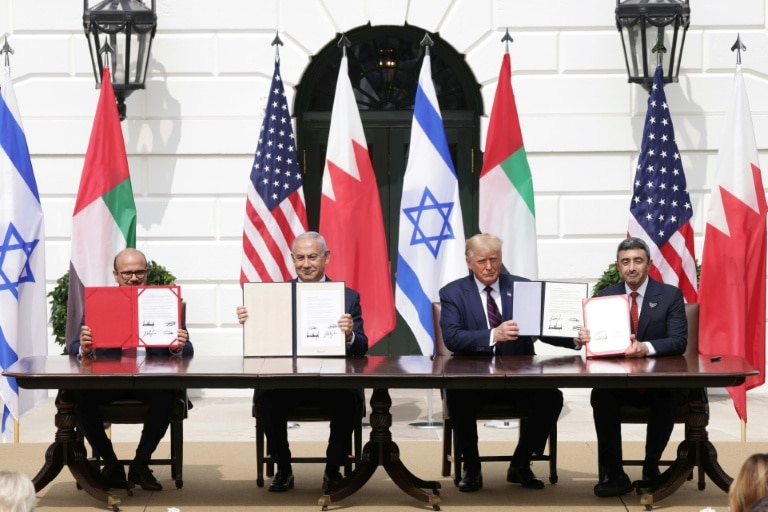
U.S. President Donald Trump has introduced a critical new condition for any finalized peace deal to end the ongoing war with Iran: widespread participation in the Abraham Accords, the 2020 U.S.-brokered agreements normalizing diplomatic ties between Israel and a number of historically hostile regional nations. In a lengthy post shared to his Truth Social platform on Monday, Trump outlined that broad, simultaneous sign-on to the accords should be a mandatory requirement for any Iran peace agreement, following a Saturday conference call with leaders from multiple regional and Muslim-majority nations.
Trump named the nations discussed on the call as Saudi Arabia, the United Arab Emirates (a 2020 signatory), Qatar, Pakistan, Turkiye, Egypt, Jordan, and Bahrain (another original 2020 signatory). He acknowledged that one or two nations could have valid reasons to opt out, but argued that broad participation would elevate any Iran deal to a far more historic milestone for regional stability. Calling for immediate action, Trump said Saudi Arabia and Qatar should lead the signing process, warning that nations that refuse to join would demonstrate bad faith and be excluded from the deal entirely.
In a surprising extension of his demand, Trump even suggested that Iran itself could join the accords if it finalizes an agreement with his administration, writing that it would be an honor to welcome Iran into what he called an unparalleled global coalition. The Abraham Accords, first negotiated during Trump’s first presidential term, have long been billed by his administration as one of its most consequential foreign policy achievements, breaking decades of regional precedent by establishing formal relations between Israel and several Arab states. While diplomats have praised the accords as a foundational step toward broader Middle East peace, they have faced widespread public backlash across much of the region, largely because they do not address the long-running Israeli-Palestinian conflict. Saudi Arabia, the most prominent regional power yet to join the accords, signaled as early as November 2025 that it was open to membership only if a clear path toward a two-state solution for Israelis and Palestinians is guaranteed.
Over the recent U.S. holiday weekend, Trump and his top diplomat Marco Rubio offered conflicting timelines for an Iran deal, at various points suggesting a final agreement was imminent. In his Monday post, however, Trump struck a more measured but optimistic tone, writing that negotiations with the Islamic Republic of Iran were proceeding nicely. While Trump has framed the deal as either being a robust, meaningful agreement or no agreement at all, Iranian officials struck a more cautious note on Monday, confirming that some progress had been made but adding that a final agreement was not yet close at hand. Following up on the ongoing diplomatic process, Iran’s top negotiator Mohammad Bagher Ghalibaf arrived in Qatar on Monday for further talks, according to Iranian state media.