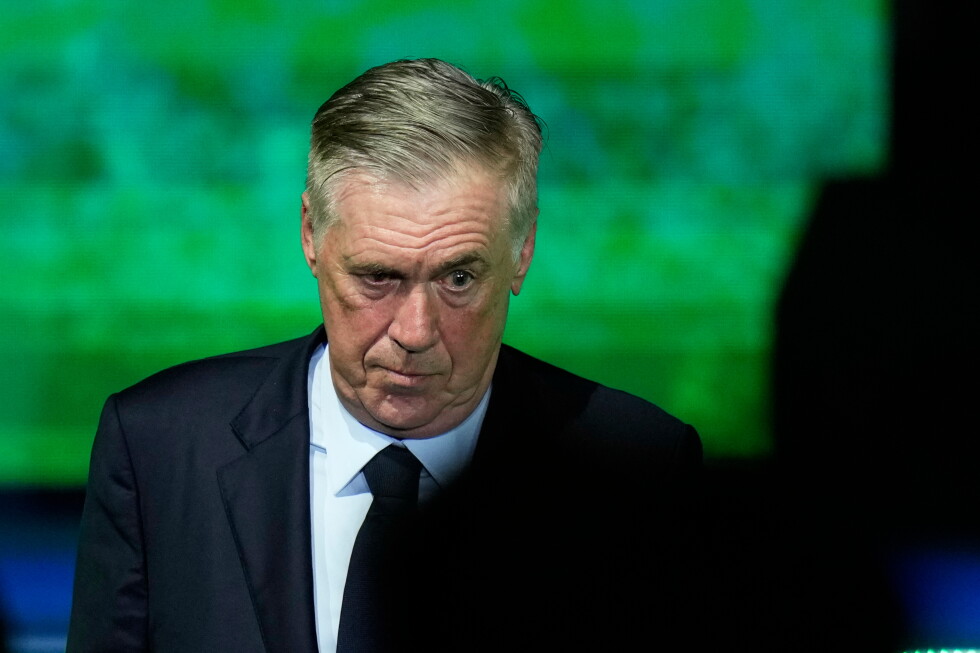
For a nation as soccer-obsessed as Brazil, 24 years without a FIFA World Cup trophy has felt like an eternity. The five-time world champions, creators of some of the most iconic players the sport has ever seen—from Pelé to Ronaldo to Ronaldinho—have not lifted football’s most coveted prize since their 2002 triumph, and this year, the country’s hopes for ending that dry spell do not rest on a lethal striker, crafty playmaker or dynamic dribbler. Instead, Brazilians are pinning their dreams of a sixth title on a 66-year-old Italian sitting on the sidelines: legendary manager Carlo Ancelotti.
Ancelotti, one of the most decorated club coaches of his generation, departed Real Madrid last year to take the helm of the Brazilian men’s national team, a highly unusual move for a program that has almost exclusively been led by domestic managers. Though his early results in charge have been uneven, posting a mixed record of five wins, three defeats and two draws across his first matches, widespread optimism persists that he can lift a current squad widely viewed as less star-studded than Brazil’s legendary historic sides—even with elite global talents such as Neymar and Vinicius Júnior on the roster.
Brazil’s decades-long title drought has been punctuated by repeated heartbreaking disappointment. Since 2002, the Seleção have only advanced past the World Cup quarterfinals once, when they hosted the tournament in 2014. That run ended in infamous humiliation, with a crushing 7-1 semi-final defeat to eventual champion Germany that remains a raw memory for Brazilian fans. Compounding the nation’s lack of confidence in recent years has been the sustained success of archrival Argentina, which claimed the 2022 World Cup title and has won back-to-back Copa America championships, feeding a growing undercurrent of self-doubt within Brazil’s soccer community.
In response to this uncertainty, Ancelotti has struck a balanced yet encouraging tone. “It is allowed to believe,” the manager stated in a recent World Cup-themed advertising campaign, acknowledging the quiet uncertainty that has lingered among fans. For the 2026 expanded 48-team World Cup, Brazil will kick off their campaign at New Jersey’s MetLife Stadium on June 13 against 2022 World Cup semi-finalist Morocco, with Haiti and Scotland rounding out their Group C fixtures. While advancing past the group stage is widely treated as an expectation in Brazil—failure to do so would be considered a catastrophic outcome—the question of how far the side can progress against elite competition in the knockout round remains open. Ancelotti, for his part, has expressed confidence in his squad’s potential: “I am aware and reliant that this team can compete against the best in the world. Can we win the World Cup and reach the final? Yes, we can reach the final. But I don’t know if that is enough, it is best for us to get there and win the final.”
One of the biggest selection calls Ancelotti has made already is the inclusion of 34-year-old star Neymar, who has been plagued by a string of serious knee injuries in recent years. After transferring to Saudi Arabia’s big-spending Pro League in 2023, Neymar barely featured due to fitness issues, and a subsequent return to his boyhood club Santos in Brazil was also cut short by recurring injuries. Despite widespread concerns over his match fitness, Ancelotti named Neymar to the final World Cup squad, calling him a critical piece of the team. Barcelona winger Raphinha echoed that sentiment, recently describing Neymar as “the man of our sixth World Cup title.”
Unlike the free-flowing, attacking style that made Brazilian football famous around the globe, Ancelotti—renowned as one of the sport’s sharpest tactical minds—has implemented a more structured, counter-attacking system for the Seleção. He often deploys a compact 4-4-2 formation that can quickly shift to an aggressive 4-2-4 when turning defense into attack, prioritizing defensive solidity over the constant ball dominance that defined past Brazil sides.
Overall, Ancelotti retains broad support among Brazilian fans and football figures, even with his uneven early results. During World Cup qualifying, Brazil claimed two wins, one draw and one loss under Ancelotti, finishing fifth in the South American standings behind Argentina, Ecuador, Colombia and Uruguay. In recent friendly matches, the side secured a meaningful win over Croatia—who knocked Brazil out of the 2022 World Cup on penalties—before falling to 2022 runner-up France. Former Brazil left-back Filipe Luís, who recently launched his own coaching career, called Ancelotti “the best thing that happened” to the national team back in April. “It is not a sure thing we will win anything,” he noted. “But we needed someone big, with enough support to make decisions. A man people respect, who knows Brazil has gone through many years in doubt for not winning the World Cup.”
Ancelotti took charge of Brazil after a period of extreme instability for the national program. The Seleção struggled through 2026 qualifying, dropping two matches to Argentina, and were knocked out by Uruguay in the 2024 Copa America quarterfinals. Three different managers occupied the role in quick succession—interim coaches Ramon Menezes and Fernando Diniz, plus full-time boss Dorival Júnior—all departing after poor results and widespread fan criticism. While that was unfolding, the Brazilian Football Confederation actively pursued Ancelotti, whose second tenure at Real Madrid was drawing to a close even after the club claimed both the 2024 Champions League and La Liga titles. So convinced are Brazilian officials that they have made the right hire that they already extended Ancelotti’s contract through the 2030 World Cup. “We have a beast taking care of our national team, a man who is respected by everyone,” Luís said. “This World Cup is for us to build on that.”