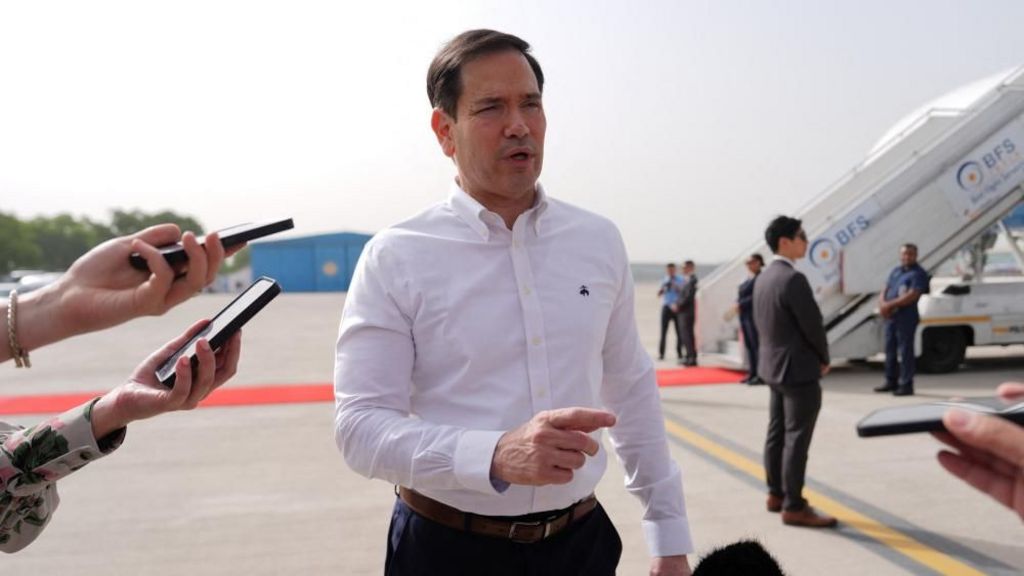
During a press briefing while on an official visit to New Delhi, India, U.S. Secretary of State Marco Rubio has confirmed that negotiators from the United States and Iran have put forward a substantive draft framework for a preliminary agreement, with a possible announcement as early as Monday.
Rubio emphasized that the agreement remains an unfinished work, telling reporters that while a solid proposal outlining the reopening of the Strait of Hormuz is already on the table, Washington is still awaiting a formal response from Tehran. “I wouldn’t read too much into it, it takes a little while to hear back from Iran,” Rubio noted.
The reported tentative deal centers on three core components: a 60-day extension of the existing ceasefire, the full reopening of the strategic Strait of Hormuz, and a structured roadmap for future negotiations on the long-standing dispute over Iran’s nuclear program. The Strait of Hormuz, a chokepoint through which roughly 20% of the world’s daily oil and liquefied natural gas supplies transit, has been effectively blocked by Iran since the outbreak of the latest conflict in the region, sending global energy markets into volatility.
The update comes just days after U.S. President Donald Trump contradicted earlier hints of an imminent deal by publicly instructing his negotiating team to avoid rushing into an agreement. Behind the scenes, the talks have been delayed by a major communication barrier, according to reporting from CBS News, the BBC’s U.S. news partner. U.S. intelligence assessments indicate that Iran’s Supreme Leader Mojtaba Khamenei, who took power after his father and predecessor was killed in an Israeli strike on the first day of the war, has been hiding in an undisclosed location after sustaining injuries in the same attack. This isolation has slowed decision-making and communication between Khamenei and his negotiating envoys, a factor that has extended the timeline of talks.
Iranian foreign ministry spokesperson Esmail Baghaei struck a measured tone over the weekend, acknowledging that the two sides are simultaneously “very close and very far” from sealing an agreement. Crucially, the proposed deal is not a final comprehensive resolution, but instead a confidence-building stepping stone that pushes the most intractable issues to subsequent negotiations. These thorny outstanding questions include the scope and timeline for lifting U.S. economic sanctions on Iran, the release of billions of dollars in frozen Iranian assets held overseas, and Washington’s core demand that Iran permanently curb its nuclear enrichment activities.
The prospect of the deal has already created a deep schism within Trump’s own Republican party, with several high-profile senators coming out publicly against the framework, arguing it is far too lenient toward Tehran. Senator Ted Cruz has called the potential agreement “a disastrous mistake”, while Senate Armed Services Committee Chair Roger Wicker claimed that a 60-day ceasefire would erase all gains from the U.S.-Israeli military campaign Operation Epic Fury, saying “everything accomplished by Operation Epic Fury would be for naught!” Even Lindsey Graham, a long-time close ally of Trump, has criticized any deal that would leave Iran perceived as a dominant regional power, asking “It makes one wonder why the war started to begin with.”
Trump pushed back hard against his intra-party critics on his Truth Social platform, dismissing them as “losers, who are critical about something they know nothing about”. The president insisted that any deal he finalizes with Iran will be a strong, positive agreement for the United States, writing “If I make a deal with Iran, it will be a good and proper one.” He also reaffirmed his red line that Iran cannot be permitted to develop a nuclear weapon, a demand that Tehran has repeatedly pushed back on, with Iranian officials consistently maintaining that their nuclear program is exclusively for peaceful civilian energy and medical purposes.
Some unconfirmed U.S. media reports suggest that the draft deal includes a provision for Iran to eventually transfer its stockpile of highly enriched uranium to third-party oversight. At the outbreak of the war in late February, U.S. estimates placed Iran’s stockpile of uranium enriched to 60% purity at roughly 440 kilograms, a level just one small processing step away from the 90% purity required to build a functional nuclear weapon. In recent comments to Iranian state television, Iranian President Masoud Pezeshkian said Tehran was ready to “assure the world that we are not after a nuclear weapon.”
Beyond the political wrangling in Washington and Tehran, news of the potential deal has already moved global markets. On Monday, international crude oil prices dropped sharply amid growing optimism that the Strait of Hormuz will reopen, while equity markets across Asia posted significant gains. Still, industry analysts warn that even if a deal is announced in the coming days, it will take months for global shipping and energy supply chains to return to their pre-crisis state. Lars Jensen, chief executive of Vespucci Maritime and a former senior director at shipping giant Maersk, told BBC Radio 4’s Today programme that shipping firms will remain cautious even after a deal is signed. “Should a deal between Iran and the US be announced in the coming days, the industry would still remain ‘cautious and hesitant’ to make any ‘major operational changes’,” Jensen explained, adding that it could take months for supply chains to return to the physical condition they were in before the crisis began.
To contextualize the current talks: the latest Middle East conflict began on February 28, when the United States and Israel launched widespread military strikes against Iranian targets, triggering retaliatory attacks from Iran on Israel and U.S. allied states in the Gulf. Iran’s subsequent decision to close the Strait of Hormuz sent global oil prices soaring to multi-year highs. A preliminary ceasefire was reached in early April, after which the U.S. imposed a full naval blockade on Iranian ports, a measure that Trump says will remain “in full force and effect until an agreement is reached, certified, and signed.”