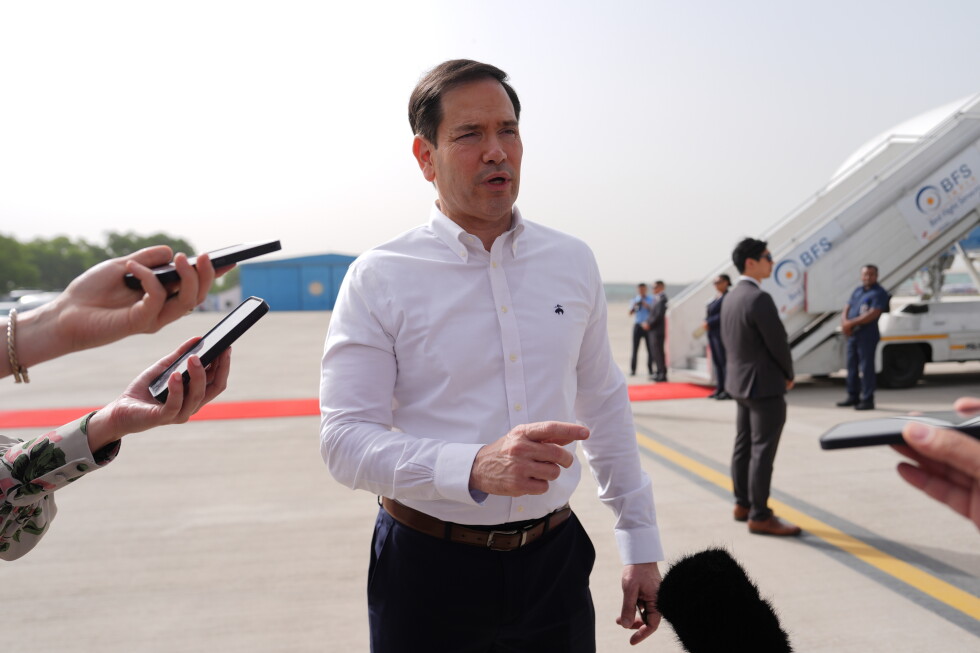
On his first official visit to India as U.S. Secretary of State, Marco Rubio has arrived in New Delhi with a clear mission: to repair frayed bilateral relations and reinforce long-standing strategic and economic partnerships between Washington and New Delhi, even as lingering trade disputes create friction between the two major Indo-Pacific powers.
During Sunday’s high-level talks, which included meetings with Indian Prime Minister Narendra Modi and Foreign Minister Subrahmanyam Jaishankar, Rubio outlined shared priorities for deepened collaboration across four key areas: trade, energy, defense, and maritime security. He reaffirmed that the two nations remain strategically aligned, and voiced public optimism that negotiators will be able to hash out a long-stalled comprehensive bilateral trade agreement in the near future. As a key diplomatic gesture, Rubio also delivered a formal invitation from U.S. President Donald Trump for Modi to make an official state visit to Washington later this year.
The roots of recent bilateral tension stretch back to new tariffs imposed by the Trump administration on a wide range of Indian exports, a move driven in large part by U.S. disapproval of India’s continued purchases of discounted Russian crude oil following the outbreak of the Ukraine war. The steep tariffs sparked outrage among Indian officials and eroded trust in Washington’s commitment to the relationship, raising questions about U.S. reliability as a long-term partner for New Delhi. While the two sides eventually reached an interim trade deal that rolled back some of the most punitive tariffs and expanded India’s purchases of American energy and other goods, negotiations on a broader, full-scale trade agreement have yet to reach a successful conclusion.
Despite these frictions, the United States has continued to view India as a critical geopolitical ally and a key counterweight to growing Chinese influence across the Indo-Pacific, leading to steady expansion of defense and technology cooperation in recent years. That regional focus will take center stage later in Rubio’s four-day trip, when he is set to join talks with foreign ministers from the other three Quadrilateral Security Dialogue member nations: Australia, India, and Japan. The Quad, an Indo-Pacific strategic alliance, has emerged as a central coordination platform for member states to advance cooperation on maritime security, resilient global supply chains, and aligned regional strategy, as China expands both its military footprint and economic clout across the region.
The alliance has repeatedly pushed back against Chinese activities in the South China Sea, accusing Beijing of aggressive militarization of disputed island territories. For its part, China has long framed the Quad as a deliberate effort to obstruct its peaceful rise and contain its growing regional influence. Recent trade tensions between the U.S. and India, paired with Trump’s high-profile recent visit to China, have sparked new scrutiny of the alliance’s future role and cohesion.
Praveen Donthi, a senior analyst with the International Crisis Group, noted that India’s growing global strategic weight is closely tied to its utility as a counterbalance to Chinese regional power. Any major shift in U.S. policy toward Beijing, he argued, would directly reshape New Delhi’s strategic value to Washington. “If the U.S. changes its approach towards China, it will diminish India’s importance,” Donthi explained.
Beyond geopolitics and trade, the ongoing conflict in Iran has added new layers of pressure to bilateral negotiations, particularly on energy security. The war has disrupted critical shipping lanes through the Strait of Hormuz, the main transit route for more than a third of India’s crude oil imports, stoking fears of prolonged supply disruptions and driving up global fuel prices. Rising energy costs have in turn placed new strain on India’s already fragile economy, making energy diversification a top policy priority for New Delhi.
Speaking after Sunday’s talks, Jaishankar affirmed that India will continue expanding its energy imports, including from the United States, while pursuing a deliberate strategy of diversifying supplier nations to keep domestic markets stable and fuel prices affordable for Indian consumers. He added that New Delhi supports open, unconstrained global energy markets as a core requirement for sustained global economic growth. During his meetings, Rubio echoed that push, emphasizing Washington’s desire to deepen energy cooperation and encouraging India to continue ramping up purchases of American oil and natural gas.
Alongside his packed schedule of official diplomatic engagements, Rubio has incorporated cultural and ceremonial stops into his four-day itinerary. He opened the trip in the eastern Indian city of Kolkata, where he visited the global headquarters of the Missionaries of Charity, the charitable organization founded by Mother Teresa. He also took part in a gala reception in New Delhi celebrating the 250th anniversary of U.S. independence. Before concluding his visit, Rubio is scheduled to travel to two of India’s most iconic tourist destinations: Agra, home to the Taj Mahal, and Jaipur, the capital of Rajasthan known for its historic forts, royal palaces, and vibrant cultural heritage.