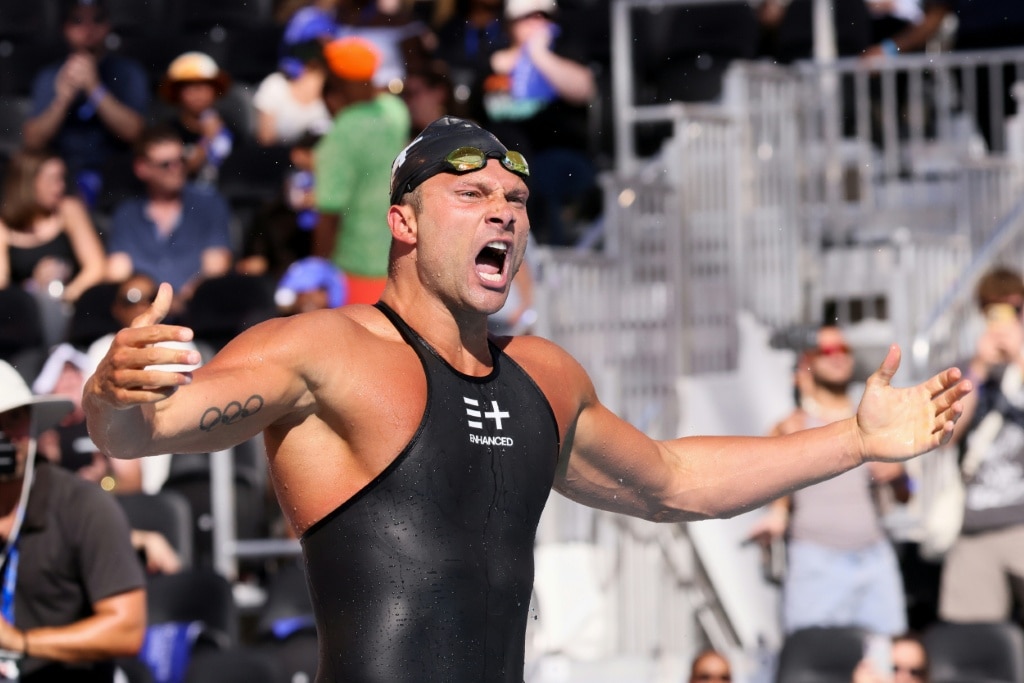
The inaugural edition of the controversial Enhanced Games, an event that openly permits athletes to use performance-enhancing substances banned from traditional elite competitions like the Olympics, kicked off Sunday in Las Vegas. Despite the allowances for banned drugs and technologically advanced swimsuits, participating athletes narrowly missed out on breaking existing official world records in early competition, leaving organizers and competitors just short of their high-stakes goal.
A total of 42 athletes across sprinting, swimming and weightlifting took part in the event, with the vast majority using stacks of testosterone, peptides, anabolic steroids and other substances blacklisted by global athletics governing bodies. These governing bodies have already roundly condemned the competition as dangerously reckless, and have confirmed they will never recognize any records set at the Enhanced Games.
Lured by lucrative prize purses — $1 million for any athlete who breaks an existing world record, and $250,000 for individual event gold — the field includes several former Olympic medalists, such as retired elite swimmers James Magnussen, Cody Miller and Ben Proud. In the most closely watched early swimming contest, the men’s 100-meter freestyle, Greek competitor Kristian Gkolomeev posted a time of 46.60 seconds, just 0.2 seconds behind Pan Zhanle’s current official world record of 46.40 seconds.
“It was very close to the world record. I really wanted to do it, but it’s OK,” Gkolomeev told reporters after the race. “I felt at the end I died a little bit, but I didn’t really train for the 100 this year, definitely I will take that.”
On the women’s side of the same event, Britain’s Emily Barclays took gold with a time of 24.09 seconds, approximately half a second off the standing world mark.
Enhanced Games co-founder Max Martin had predicted ahead of the competition that “quite a few” world records would fall unofficially, but the first half of the event did not live up to that projection. In the opening weightlifting contest, Beatriz Piron — who had reportedly surpassed the women’s snatch world record in training — attempted 100kg but came up short of the mark. For the men, Canada’s Boady Santavy and American Wesley Kitts attempted 183kg and 197kg respectively, and both failed, even after organizers broke standard rules to grant each an extra fourth attempt to hit the record.
“I hit a lot of PRs in training. Not 197 yet… Man, if I had about four more weeks (in training) I’d say I’d have had a good shot at it,” Kitts said after his attempt.
In a surprising upset, the men’s 50-meter backstroke was won by Hunter Armstrong, one of the small minority of competitors who chose not to use any performance-enhancing drugs, who beat two rivals who did use PEDs with a time of 24.21 seconds. American former Olympian Cody Miller, who won the men’s 50-meter breaststroke, said he was thrilled to cut seven-tenths of a second off his own personal best at age 34, though his 26.55 second time remained well off Adam Peaty’s 25.95 second world record.
Unlike traditional elite swimming competitions, the Enhanced Games permits competitors to wear the same full-body “supersuits” that caused a wave of record-breaking at the 2008 Beijing Olympics before being banned by global swimming governing bodies over concerns about unfair technological advantage.
Former 100-meter sprint world champion Fred Kerley, another clean competitor at the event, topped the men’s sprint heats with a 9.93 second run, just two-hundredths of a second ahead of “enhanced” athlete Emmanuel Matadi, who clocked 9.95 seconds.
The 2024 Enhanced Games is being held in a custom-built $50 million temporary arena constructed on the parking lot of a Las Vegas casino, which will be dismantled just hours after the final event wraps up. Blending elite sports, biohacking advocacy, political positioning and entertainment, the event counts high-profile backers including billionaire tech investor Peter Thiel and Donald Trump Jr., with iconic Las Vegas-based rock band The Killers scheduled to play the closing set after competition ends.
The competition has sparked widespread criticism from global health experts, who warn that the unregulated use of the performance-enhancing substances permitted at the Games carries major risks of “life-shortening and fatal consequences,” including permanent damage to the heart, liver and kidneys, since little definitive research exists on the long-term impacts of many of these drug combinations.
Enhanced Games officials have pushed back against these concerns, noting that all substances used by athletes are formally approved by the U.S. Food and Drug Administration, and that the event spared no expense to hire top-tier medical staff to monitor competitors. Chief medical officer Guido Pieles acknowledged that the health risks of the substances “clearly there” but argued they are “really manageable” with proper oversight.
Organizers have emphasized a commitment to transparency, publishing the overall percentage of athletes taking each category of performance-enhancing drug, with Martin saying “transparency is core to our DNA.” However, athletes confirmed that they are not required to publicly disclose the exact specific drug combinations each competitor is taking. Beyond the event itself, the parent company Enhanced sells many of the same substances used by its athletes directly to the general public.