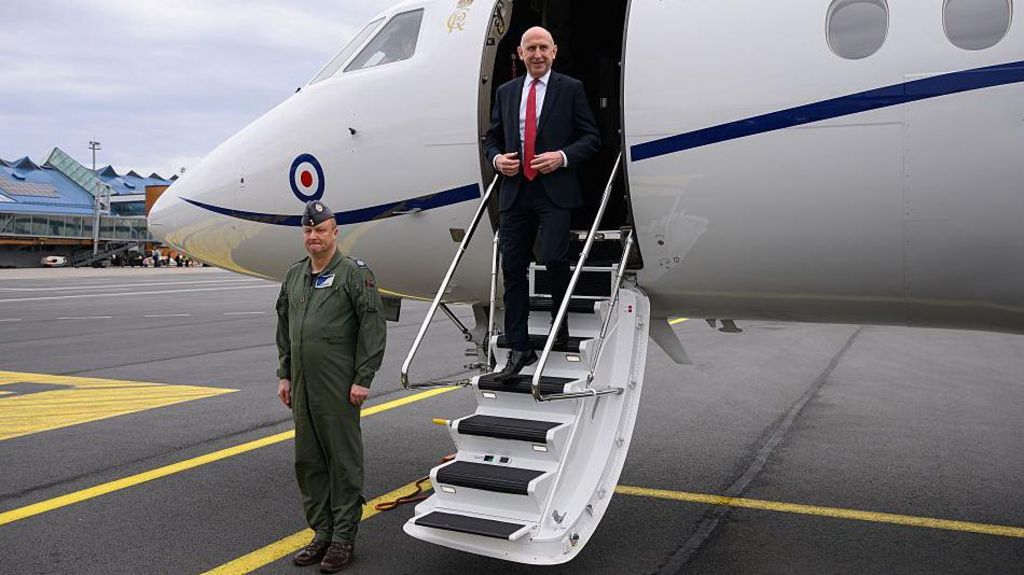
A Royal Air Force aircraft carrying UK Defence Secretary John Healey suffered a deliberate GPS signal jamming attack while flying near the Russian border earlier this week, in an incident that has further inflamed already fraught tensions between the West and Moscow.
The disruption occurred Thursday as Healey returned to the United Kingdom following a working visit to Estonia, where he met British troops deployed as part of a NATO military exercise close to the Russian frontier. The Times was the first outlet to break news of the incident, multiple defense sources familiar with the matter confirmed.
Intelligence assessments point to Russia as the perpetrator of the attack, according to initial reporting. The jamming disabled the aircraft’s primary GPS navigation system for the entire three-hour duration of the flight, forcing pilots to switch to backup alternative navigation technologies to complete their journey safely. Notably, this is not the first such incident recorded in the region: in 2024, another RAF jet transporting then-Defence Secretary Grant Shapps also experienced GPS jamming while operating near Russian territory.
At the time of writing, it remains unclear whether Healey was specifically targeted for the attack. The Times noted that the flight’s planned route was publicly visible on commercial aircraft tracking platforms prior to departure, leaving open the possibility that the jamming was part of broader, unspecified Russian activity along the border rather than an intentional strike against the UK’s top defense official. The UK Ministry of Defence has not yet released an official statement on the incident, and declined to comment when contacted by reporters.
The jamming incident comes just one day after new details emerged of a dangerous, separate air encounter between Russian and British military aircraft over the Black Sea last month. On that occasion, two Russian warplanes carried out repeated, aggressive interceptions of an RAF Rivet Joint surveillance aircraft in international airspace.
According to the UK Ministry of Defense, the interception was the most aggressive Russian action against British aircraft since 2022, when a Russian pilot fired an air-to-air missile near a British Rivet Joint in the same area in a widely condemned incident. Last month’s encounter saw a Russian Su-35 fighter approach the British surveillance jet close enough to trigger the RAF plane’s onboard emergency systems and knock out its autopilot. A second Russian Su-27 fighter conducted six dangerous low-altitude passes directly in front of the RAF aircraft, coming within just six meters of the plane’s nose at its closest point.
During his visit to Estonia earlier this week, Healey publicly addressed the Black Sea incident, praising the “outstanding professionalism” of the RAF crew that handled the unsafe interception, while condemning Russia’s “unacceptable” aggressive behavior in international airspace.
Estonia, a Baltic member of NATO, hosts a contingent of British troops as part of the alliance’s collective defense posture along its eastern flank, deployed in response to heightened security threats following Russia’s full-scale invasion of Ukraine in 2022. British service members are currently participating in large-scale NATO military exercises in the region designed to deter further Russian expansion, making the jamming incident a clear show of force amid ongoing standoff between Moscow and the Western alliance.