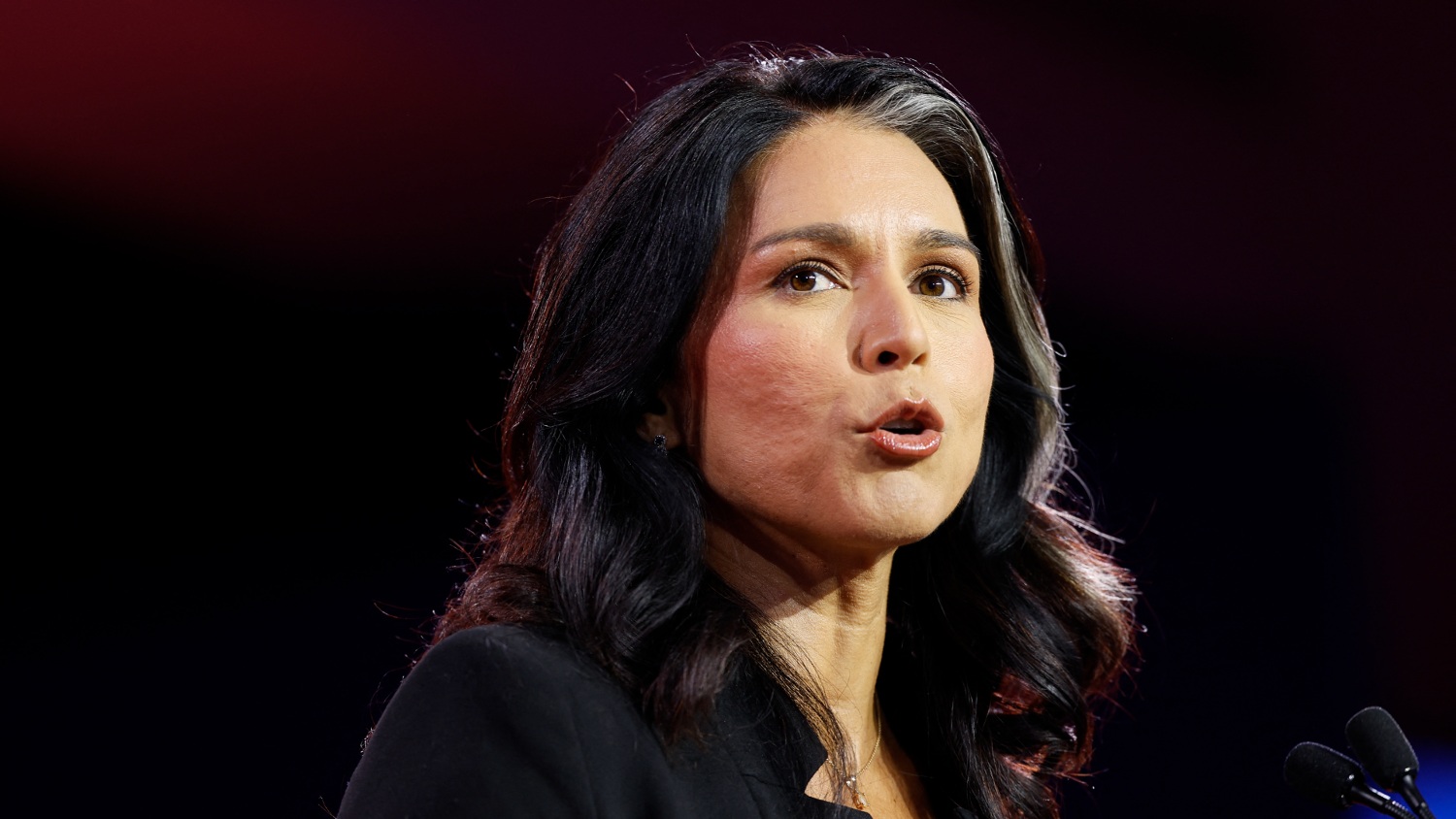
In a public letter posted to X Friday, former 2020 Democratic presidential candidate and current U.S. Director of National Intelligence Tulsi Gabbard announced she will resign from her post in June, after her husband Abraham received a diagnosis of an extremely rare subtype of bone cancer.
Addressed to President Donald Trump, the letter laid out Gabbard’s reasoning for stepping away from the nation’s top intelligence role: “I am deeply grateful for the trust you placed in me and for the opportunity to lead the Office of the Director of National Intelligence. My husband, Abraham, has recently been diagnosed with an extremely rare form of bone cancer. He faces major challenges in the coming weeks and months. At this time, I must step away from public service to be by his side and fully support him through this battle.”
Gabbard also expressed lasting gratitude to Trump for nominating her to the cabinet-level position, making no mention of ongoing tensions over the U.S.-Israeli war on Iran in her public statement.
Beyond the personal health crisis that Gabbard cites as the catalyst for her exit, her departure removes one of the last remaining prominent anti-interventionist, Iran war skeptics from the Trump White House. The vacancy comes two months after her close ally Joseph Kent, former director of the National Counterterrorism Centre, resigned over the administration’s shift toward war with Iran. In his March resignation statement, Kent said he could not “in good conscience” continue in the role, as the White House had “succumbed to pressure from Israel and its powerful American lobby” to launch military strikes.
News agency Reuters, however, has reported that Gabbard was effectively “forced out” by the White House, despite the official framing focused on family health. President Trump pushed back against any implicit suggestion of tension in his own X post acknowledging the resignation, praising Gabbard’s tenure: “Tulsi has done an incredible job, and we will miss her. She rightfully wanted to be with her husband and bring him back to good health.”
Policy analysts and major U.S. outlets including The Wall Street Journal note that Gabbard’s exit is unlikely to shift the Trump administration’s current policy direction on Iran or Israel, as the former congresswoman had already been largely sidelined from key war-related decision-making for months. Even during the U.S. military offensive in Venezuela earlier this year, Gabbard was vacationing at a beach in her home state of Hawaii, far from the White House Situation Room. Gabbard’s most high-profile break with administration policy came in March, when she submitted written testimony to the Senate Intelligence Committee confirming Iran had made “no efforts” to rebuild its uranium enrichment program after U.S. strikes on three Iranian nuclear facilities in June 2025. This assessment directly contradicted public claims from Trump, Secretary of State Marco Rubio, and special envoy Steve Witkoff, who have repeatedly claimed Iran was on the brink of developing a functional nuclear weapon. Notably, Gabbard never presented the testimony in person to Senate committee members.
For his part, Trump has maintained a long-running distrust of the established U.S. intelligence community, and in recent months his appointed CIA Director John Ratcliffe has emerged as the dominant figure in the administration’s national security apparatus, taking on high-profile foreign policy assignments including a recent visit to Cuba, where the Trump administration continues to enforce harsh, economically devastating sanctions and a decades-long blockade.
A veteran of two U.S. military deployments to the Middle East, Gabbard built her political profile around consistent anti-interventionist positions long before joining the Trump administration. She completed a 12-month combat tour in Iraq in 2004, followed by a 2009 deployment to Kuwait where she helped train local counterterrorism forces. She represented a Democratic congressional district in Hawaii from 2013 to 2021, where she was an early advocate for a full U.S. military withdrawal from Afghanistan, calling for a pullout as early as 2011. She has also repeatedly pushed for a full withdrawal of the roughly 900 U.S. troops currently stationed in northeastern Syria, and was a vocal critic of U.S. military backing for the Saudi-led coalition’s intervention in Yemen, co-sponsoring bipartisan legislation to block U.S. arms sales to Riyadh in 2019.
Gabbard’s political trajectory has shifted dramatically over the past decade: after running for the 2020 Democratic presidential nomination as a progressive ally of Senator Bernie Sanders, she later endorsed centrist Democratic President Joe Biden before formally switching allegiances to campaign for Donald Trump’s 2024 presidential comeback bid.