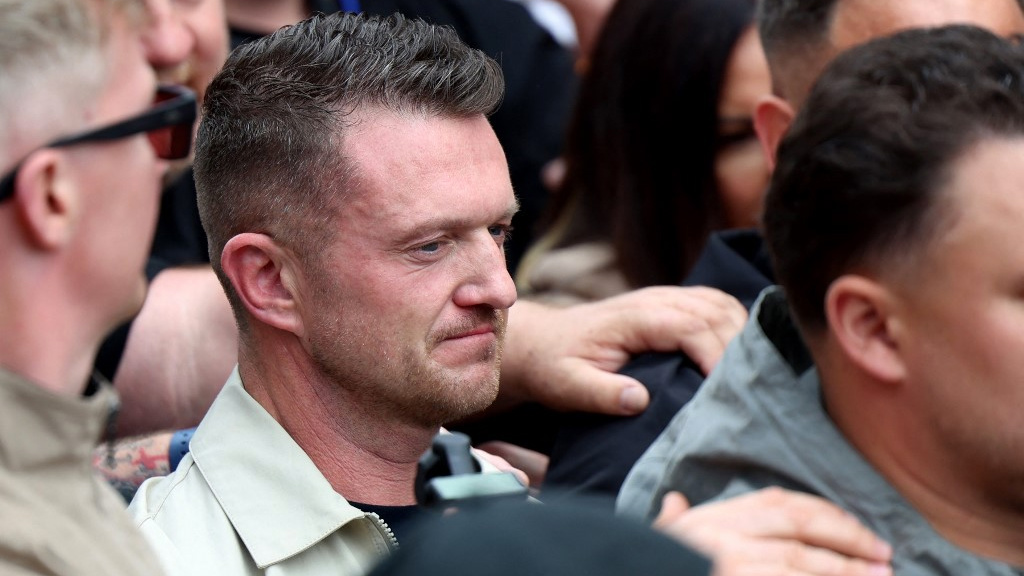
The Oxford Union, one of the world’s most famous and storied collegiate debating societies, finds itself at the center of yet another firestorm, this time over a decision that cuts straight to the heart of global conversations about free speech, religious scrutiny, and the line between hate speech and open debate. The flashpoint? A planned debate titled “This House believes the West is right to be suspicious of Islam”, featuring an invitation to far-right anti-Islam activist Tommy Robinson, whose real name is Stephen Yaxley-Lennon, a man with multiple criminal convictions including for assault, fraud, and contempt of court. What makes the controversy even more unexpected is that the invitation came from the union’s current president, 20-year-old Arwa Elrayess — a Muslim student of Palestinian origin.
Middle East Eye traveled to the University of Oxford this week to meet Elrayess in the union’s historic wood-panelled Gladstone Room, a space steeped in British political legacy. Named for former British prime minister and one-time union president William Gladstone, the room features soaring painted ceilings, shelves lined with centuries of national newspaper archives, and plush leather armchairs that once served as seating for the society’s smoking room in a more permissive era. The semi-circular cabinet table by the window, where Gladstone once met his ministers, is said to have been designed specifically so the former leader could look every minister directly in the eye to spot dishonesty — a detail Elrayess shared with a nod to the confrontational conversation ahead.
Robinson, a polarizing figure who has built his public profile on anti-Islam activism, recently drew 60,000 attendees to a London rally where he declared he would “stop Islam” if he gained power, called on supporters to “prepare for the Battle of Britain”, and demanded that many Muslims leave the United Kingdom. When asked if these comments qualified as hate speech, Elrayess did not mince words: “I think everything that was said was abhorrent.” But she remains unwavering in her commitment to holding the debate, a stance shaped directly by her own experience as a Muslim and Palestinian student at Oxford.
In her first year at the university, during the Israeli military campaign in Gaza that Elrayess refers to as genocide, she debated an Israeli soldier on the union floor. At the time, she had family still living in Gaza, making her one of the most personally invested participants in that room. She recalled that experience as deeply empowering: “I could not have thought of anything more vindicating than to be able to stand up there and be given equal weight, and to be able to give my views. People came up to me from all different backgrounds and said, ‘thank you so much for getting to say the things that I wanted to say, but I don’t think we ever had the opportunity.’”
That experience shaped Elrayess’s core philosophy on inviting controversial figures: inviting a speaker does not grant them moral legitimacy, it simply acknowledges that their views hold enough public influence to require direct scrutiny. “What we are saying is that their views are influential and consequential enough that they deserve to be scrutinized,” she explained. She added that she wants to challenge the harmful perception that Muslims seek to avoid scrutiny of their faith: “I wanted to prove that it is within a Muslim’s term, that I was willing to have this conversation. I’m not afraid to have my faith scrutinised because I know I can defend it. I’m not afraid to hear this rhetoric because I know what I think about it, and I want to be able to give other Muslim speakers or other Muslim students the same opportunity I had when I first came to Oxford, to be able to look someone in the eye who’s done so much harm to your communities and tell them exactly why they’re wrong.”
Elrayess also pushed back against claims of hypocrisy leveled by Roshan Salih, editor of British Muslim news site 5 Pillars, who has called for her resignation over the unresolved 2024 controversy surrounding Palestinian writer Susan Abulhawa. Last year, Abulhawa’s speech criticizing Israel was deleted and edited from the Oxford Union’s YouTube channel, a decision Elrayess — who was not president at the time — has openly condemned as censorship. She told Middle East Eye that she is working behind the scenes to restore the unedited full speech to the platform before her term ends: “I cannot imagine leaving my term without that video going back up.”
The decision to invite Robinson has drawn fierce condemnation from across the British political and religious establishment. Labour MP and former cabinet minister Anneliese Dodds, whose constituency covers Oxford East, said this week that “The hatred promoted by Stephen Yaxley-Lennon, also known as Tommy Robinson, has no place in our great city.” The Bishop of Oxford Dr Steven Croft and Imam Monawar Hussain released a joint statement saying they were “disturbed and saddened by the event”, arguing that union leadership “have a duty of care to the many thousands of Muslims, Jews and others of different faiths in the city.”
Robinson is already persona non grata across most major British institutions: the National Union of Students maintains an official de-platforming policy for him, right-wing media outlet GB News has never extended an invitation for him to appear, and the right-wing Reform UK party has stated he is not welcome within its ranks. Large-scale protests are planned for the day of the debate, scheduled just over a week from now, and security concerns have led many to predict the event will be cancelled entirely. Multiple scheduled speakers have already withdrawn from the debate, with independent MP Adnan Hussain confirming his withdrawal last week over Robinson’s involvement. Some speakers have even threatened to pull out of all future union events in protest.
Contrary to widespread claims of Muslim opposition to the invitation, however, Elrayess says many Muslim students have privately expressed their support. A poll conducted by 5 Pillars — the same outlet whose editor called for her resignation — found that a majority of its readers also backed holding the debate. Elrayess argues that hiding controversial views from public debate does not make them disappear: “It’s not that these issues will go away if Robinson can’t speak at the union. The real danger is when these conversations are having nobody there to confront them or scrutinise them.” If Robinson attempts to violate British free speech laws during the event, she added, the debate will be immediately halted and he will be removed from the chamber, under the union’s strict existing rules.
This controversy is only the latest in a 200-year history of the Oxford Union sparking national and global outcry over its commitment to open debate. Founded in 1823 by a group of students rebelling against university censorship, the society has long served as a training ground for future British political leaders and a magnet for contentious conversations. In 1933, it passed a motion declaring “This House would not in any circumstances fight for King and Country”, drawing fierce condemnation from Winston Churchill, who called the resolution “abject, squalid, shameless” and “nauseating”. In 1964, civil rights leader Malcolm X spoke on the union floor in defense of extremism in the name of liberty; former U.S. president Richard Nixon spoke there four years after his resignation over the Watergate scandal; O.J. Simpson drew global headlines when he addressed the union shortly after his acquittal on murder charges; and the British government once banned broadcasts of a speech by Sinn Fein leader Gerry Adams. Just last year, the union drew widespread condemnation from conservative media after members voted overwhelmingly to declare Israel an “apartheid state responsible for genocide”.
The core question at the heart of this debate is not new: when does a view become so dangerous that it deserves to be de-platformed entirely? The argument for barring extreme voices was famously laid out by philosopher Bertrand Russell in 1962, when he rebuffed an invitation to debate British fascist leader Oswald Mosley. “It is always difficult to decide on how to respond to people whose ethos is so alien and, in fact, repellent to one’s own,” Russell wrote. “Nothing fruitful or sincere could ever emerge from association between us.”
But the Oxford Union has long stood by the opposite principle, a legacy that former British Prime Minister Harold Macmillan once summed up by calling the institution “the last bastion of free speech in the western world.” Whether the Robinson debate goes ahead as planned or is cancelled due to pressure and security concerns, the controversy itself carries on the union’s long tradition of forcing the world to confront the hardest questions about free speech, power, and the price of open dialogue. It is a debate that will continue to rage, both inside the union’s historic chambers and far beyond the walls of Oxford’s university.