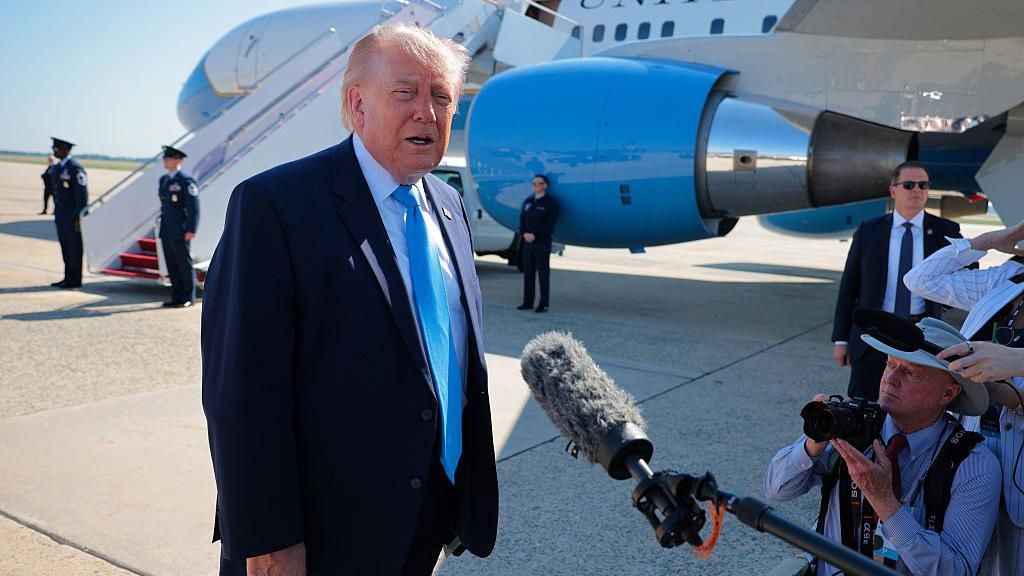
In a move that upends nearly half a century of U.S. diplomatic protocol, former and current U.S. President Donald Trump has confirmed he intends to hold direct talks with Taiwanese leader Lai Ching-te regarding a proposed $14 billion arms package to the self-governing island, a step that threatens to roil already delicate relations between Washington and Beijing.
No sitting U.S. president has spoken directly with a Taiwanese leader since 1979, when the United States formally cut diplomatic ties with Taipei to recognize the People’s Republic of China as the sole legitimate government of China. Beijing has consistently claimed Taiwan as an inalienable part of its territory, and has repeatedly refused to rule out the use of military force to assert its control over the island. Since Lai took office in 2024, he has overseen one of the most aggressive pushes in recent years to bolster Taiwan’s defensive capabilities amid growing Chinese military pressure.
Washington’s long-standing policy on Taiwan has been rooted in deliberate ambiguity: the 1979 Taiwan Relations Act legally commits the U.S. to provide Taiwan with defensive arms, but successive administrations have worked to balance this commitment with the need to preserve stable diplomatic and economic ties with Beijing. When pressed by reporters on Wednesday whether he planned to speak with Lai before finalizing a decision on the arms deal, which reportedly includes advanced air-defense missile systems and anti-drone technology, Trump offered a straightforward response: “I’ll speak to him. I speak to everybody.. we’ll work on that, the Taiwan problem.”
The announcement comes just one week after Trump wrapped up a two-day summit with Chinese President Xi Jinping in Beijing, where Trump himself described his personal relationship with Xi as “amazing.” During that summit, Beijing made clear that the Taiwan issue remains the most sensitive and consequential flashpoint in bilateral relations, with Xi warning outright that mishandling the question could lead to open conflict between the two global powers.
Trump has so far declined to take a formal position on whether the $14 billion arms package will move forward, telling reporters aboard Air Force One on the return trip from Beijing that he would “make a determination over the next fairly short period.” He reiterated this week that he had not made any binding commitments to either side on the issue, while acknowledging that Xi holds very strong views on Taiwan’s status. “Xi felt ‘very strongly’ about Taiwan. I made no commitment either way,” he told reporters last week.
In an additional break from long-standing U.S. policy, Trump revealed he had discussed the proposed arms sale “in great detail” with Xi during their Beijing meeting. That revelation contradicts a 1982 U.S. diplomatic commitment to Taiwan that Washington would not consult Beijing on arms sales to the island. When pressed on this decades-old pledge, Trump brushed it off, saying the 1980s were “a long way” away.
This is not the first time Trump has broken with long-standing diplomatic norms around Taiwan. As president-elect in 2016, he held a controversial call with then-Taiwanese leader Tsai Ing-wen, which drew a formal diplomatic complaint from Beijing.
Since the Trump-Xi summit, Lai has doubled down on his position, issuing public statements describing Taiwan as a “sovereign, independent democratic country” and insisting that cross-strait peace will not be “sacrificed or traded away.” He has also framed U.S. arms sales as a “key factor in maintaining regional peace and stability.” Under Lai’s leadership, Taiwan has significantly increased its defense budget to counter growing Chinese military activity near the island. Today, most Taiwanese residents support maintaining the current status quo, which sees the island operate as a de facto independent state without formal declaration of independence or unification with mainland China, though a majority identify as separate from China.
Beijing has already signaled its displeasure with the Trump administration’s trajectory, with multiple sources confirming that China has delayed approval for a planned visit by Elbridge Colby, the Pentagon’s top policy official, until Trump makes a final decision on the arms deal. The $14 billion proposal follows a $11 billion arms sale approved by the U.S. last December, one of the largest ever to Taiwan, which also sparked fierce condemnation from Beijing.