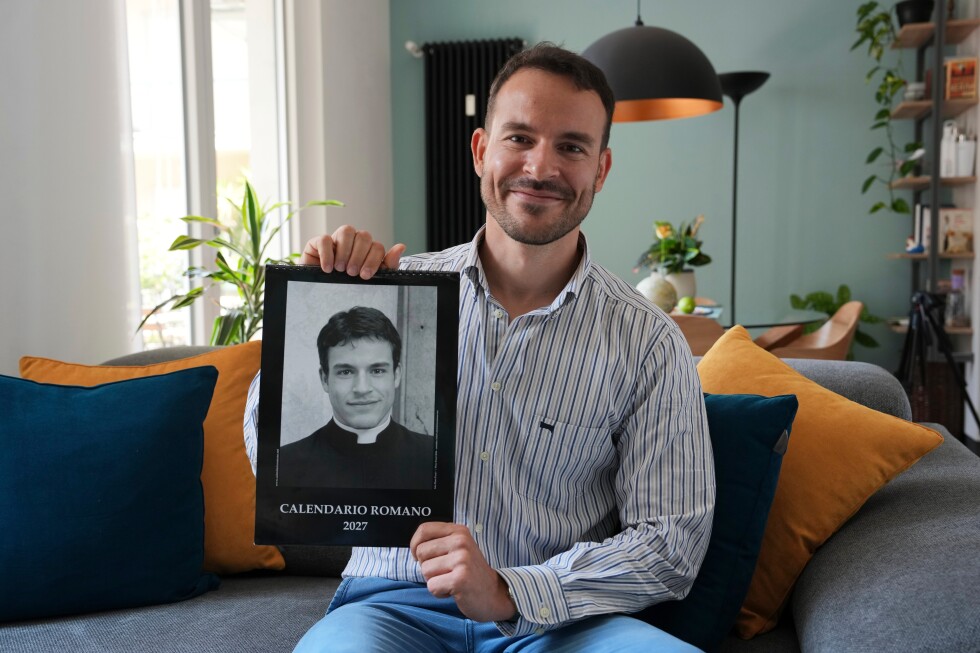
For nearly a quarter century, a striking black-and-white calendar showcasing close-up portraits of handsome young men in priestly collars has held its place as a quirky staple souvenir for visitors to Rome. But a recent bombshell report from leading Italian daily La Repubblica has pulled back the curtain on a decades-long open secret: the overwhelming majority of the men featured in the popular publication are not men of the cloth at all.
The face most closely associated with the calendar, officially titled *Calendario Romano*, belongs to Giovanni Galizia, a 39-year-old flight attendant for a Spanish airline who posed for his iconic cover shot at just 17 years old. Speaking to The Associated Press from his home in Verona earlier this week, Galizia recalled that the 1990s shoot in his native Palermo was nothing more than a casual joke arranged by mutual friends who connected him to the calendar’s creator, photographer Piero Pazzi. The enigmatic Mona Lisa-like smile that has graced countless covers for 23 of the calendar’s 26 years? It was just the awkward grin of a teenager embarrassed by his friends laughing off-camera at his costume.
“It was the smile of an embarrassed kid, because I saw all my friends in front of me laughing out loud because I was dressed like I was a priest,” Galizia explained. The one-off gig left no impact on his life until this week, when La Repubblica’s exposé turned the little-known secret into national news across Italy.
Pazzi, the photographer behind the project, is no stranger to quirky creative ventures: he has previously produced calendars of Venetian gondoliers and founded cat history museums in Budapest and Montenegro. His *Calendario Romano* relies heavily on recycled portraits year after year, with 12 total images featured per edition. Galizia told the AP he only knows one other model featured in the calendar, a French man who also has no ordination. Pazzi acknowledged that only around one-third of the models in the already-released 2027 edition are actual practicing priests, though he declined to share further details.
Both Galizia and Pazzi push back against widespread descriptions of the project as a “sexy priest calendar,” framing it instead as a deliberate artistic exploration of the tension between the sacred and the secular. Galizia argues that modern audiences too often conflate beauty with sensuality in an overly sexualized cultural landscape, noting that the project follows a long tradition of actors and models portraying clergy in film and television without deception. “Of course, it winks a bit at the dynamic between the sacred and the profane, because it is clear that seeing a world that is distant and in some ways so lofty as the ecclesiastical world, with such a fresh-faced young man, creates a kind of dissonance,” he said. Still, he adds, he takes the “sexy” label as a compliment: “because managing to be sexy in a priest’s collar is no small feat.”
The calendar has no official affiliation with the Vatican, which declined to comment for this story, and the project is produced entirely independent of the Holy See, though it does include a page of informational text about the Vatican for tourists. It retails for roughly 8 euros ($9.30) in souvenir shops clustered around Vatican City and Rome’s historic center, where one shop clerk told the AP it sells a handful of copies per day, with total annual sales estimated in the thousands. Pazzi collects royalties for the work, while Galizia — who signed a release form for his photo decades ago — has never sought or received payment for his repeatedly used portrait.
Surprisingly, the project has earned the casual approval of at least one working priest. Father Domenico, a South Korean priest visiting near the Vatican this week, told the AP the calendar is already well known among young people in his home country, who embrace it as lighthearted humor. “They often think priests are stiff and distant,” he explained. “But looking at this calendar, they think priests are more familiar, and priests can be funny. I think in Korea this calendar is very famous, and it is OK.”
For Galizia, the sudden national attention decades after his accidental modeling gig remains just another unexpected joke. The only time his connection to the calendar ever came up before this week was when his cousins gifted a copy to their grandmother, and the whole family spent the moment “dying laughing.” He has never even been recognized on the street for his most famous portrait — until now.