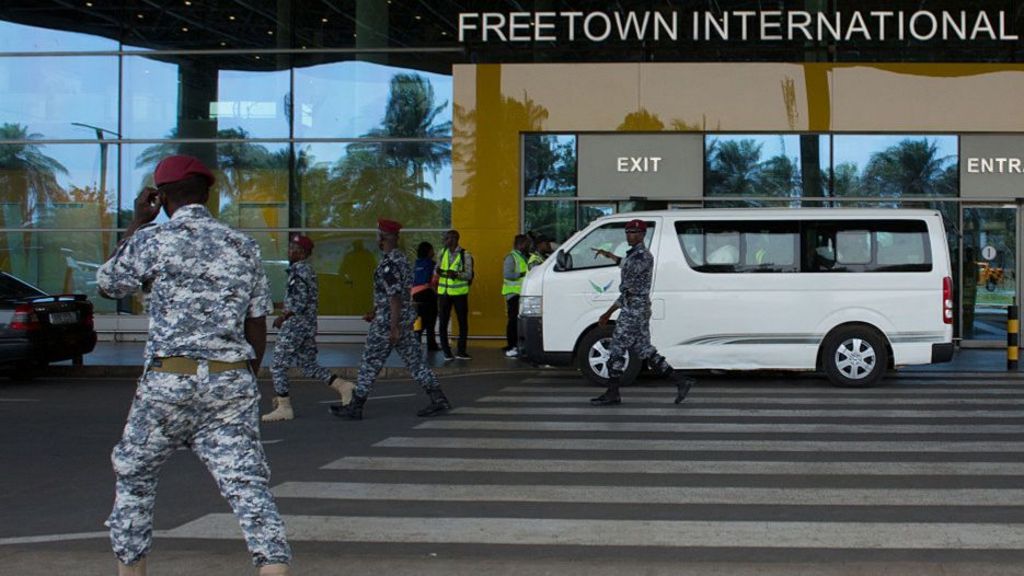
As U.S. President Donald Trump escalates his nationwide crackdown on unauthorized immigration, Sierra Leone has become the newest African nation to accept deported migrants sent from American territory. A chartered Boeing flight carrying nine West African migrants touched down at Freetown International Airport, located just outside Sierra Leone’s capital, on Wednesday morning, in a move that spotlights the expanding scope of the Trump administration’s third-country deportation policy.
Witnesses from the BBC confirmed the details of the arrival: the group of seven men and two women were visibly dejected upon landing, with one individual physically resisting removal from the aircraft before being forced off by officials. Official breakdowns of the group show five of the deportees are from Ghana, two are from Guinea, and one each hails from Nigeria and Senegal. After exiting the terminal, the group was escorted away from the airport in a marked white van to temporary housing facilities run by private contractor Kenvah Solutions.
Weeks ahead of the arrival, Sierra Leone’s Foreign Minister Timothy Musa Kabba confirmed to Reuters that the country had struck an agreement with Washington to accept up to 300 deportees annually. Under the terms of the deal, however, only migrants who hold citizenship from member states of the Economic Community of West African States (ECOWAS), West Africa’s regional economic and political bloc, are eligible to be accepted into the country. ECOWAS free movement rules allow citizens of any member nation to reside in another member state for up to 90 days without a visa, but Kenvah Solutions has stated the deportees will only be permitted to stay at its temporary facilities for a maximum of two weeks, leaving the long-term residency status of the group unclear.
This deportation operation is part of a broader policy launched shortly after Trump took office for a second term in January 2025. Dozens of migrants have already been sent to so-called “third countries” – nations where the deportees did not reside before moving to the United States. To date, the U.S. has already processed third-country deportations to multiple African countries, including the Democratic Republic of Congo, Ghana, South Sudan, and Eswatini. Unlike Sierra Leone and Ghana, which have restricted acceptance to ECOWAS citizens, these other nations have received deportees from regions outside Africa, including Colombia, Cuba, Mexico, and Vietnam.
The financial and human cost of this policy has come under increasing scrutiny from lawmakers and human rights groups. A minority report from the U.S. Senate Foreign Relations Committee estimates that, as of January 2026, the Trump administration has likely spent more than $40 million on third-country deportation operations, though the full total expenditure remains undisclosed. Sierra Leonean authorities have not publicly disclosed any financial compensation or policy concessions they received in exchange for agreeing to accept the deportees.
Human rights advocates have repeatedly condemned the practice, arguing that it violates core international human rights standards and exposes already vulnerable migrants to unnecessary harm. In September last year, Human Rights Watch issued an open call for African nations to reject what it described as “opaque deals,” arguing the agreements are deliberately structured to weaponize human suffering for political and diplomatic gain. Ghana, which has also agreed to accept U.S. deportees, has echoed Sierra Leone’s policy of only accepting ECOWAS citizens, with President John Mahama noting in September that free movement rules already allow West African nationals to enter Ghana without visa requirements.