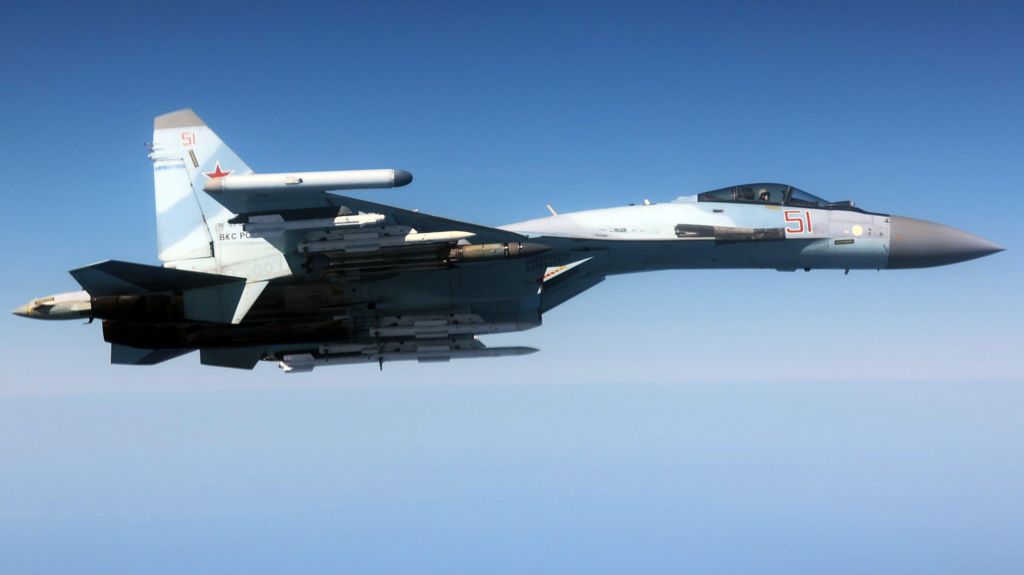
In an incident that marks the most aggressive Russian aerial action against a British military aircraft since 2022, two Russian fighter jets carried out repeated, high-risk intercepts of an unarmed Royal Air Force (RAF) surveillance plane over the Black Sea last month, the United Kingdom’s Ministry of Defence (MoD) has confirmed.
The close-proximity encounters forced the RAF RC-135W Rivet Joint aircraft into a dangerous situation: one Russian Su-35 fighter closed in so rapidly that it triggered the spy plane’s onboard emergency safety systems and forced its autopilot to disengage, leaving the crew to manually regain control of the aircraft. A second Russian jet, a Su-27, conducted six separate low-altitude passes directly in front of the RAF aircraft, coming within just six meters (19 feet) of the plane’s nose.
UK Defence Secretary John Healey has publicly condemned the intercepts as “unacceptable”, while praising the RAF crew for what he called their “outstanding professionalism” in navigating the life-threatening encounter without incident. The MoD emphasized that this encounter represents the gravest escalation in Russian aerial aggression against NATO-aligned aircraft in the Black Sea region since September 2022, when a Russian pilot fired two air-to-air missiles at an RAF Rivet Joint operating in the same international airspace.
Officials confirmed that the RAF spy plane was carrying out a routine, pre-planned international flight when the interception occurred, as part of NATO’s ongoing mission to reinforce security along the alliance’s eastern flank. Healey stressed that the reckless actions of the Russian pilots created a clear and unnecessary risk of catastrophic aerial accident, with the potential to rapidly escalate tensions between Russia and the NATO alliance.
“This incident is another example of dangerous and unacceptable behaviour by Russian pilots, towards an unarmed aircraft operating in international airspace,” Healey said in a statement. “These actions create a serious risk of accidents and potential escalation. This incident will not deter the UK’s commitment to defend Nato, our allies and our interests from Russian aggression.”
Both the MoD and the UK Foreign Office have formally contacted the Russian embassy in London to protest the encounter and demand condemnation of the pilots’ actions. The MoD noted that the intercept comes amid a broader pattern of growing Russian aggression near critical European infrastructure, pointing to recent increased Russian submarine activity around undersea British energy and communications cables in the North Sea.
The 2022 missile incident, which Russia initially tried to blame on an accidental technical malfunction, has since been confirmed by three senior Western defence sources to have been a deliberate, if misordered, attack. The sources told the BBC that the Russian pilot launched the two missiles after receiving an unclear command from a Russian ground control station; the first missile missed the RAF aircraft, contradicting Moscow’s original claims of a system malfunction. At the time, the UK publicly accepted Russia’s explanation to avoid immediate escalation.
The RAF’s RC-135W Rivet Joint, operated by the service’s No. 51 Squadron from its base in Lincolnshire, is a specialized signals intelligence platform. According to RAF official documentation, the aircraft is fitted with cutting-edge sensor technology designed to intercept and analyze electromagnetic signals across a wide spectrum, delivering real-time strategic and tactical intelligence to NATO and UK military command.