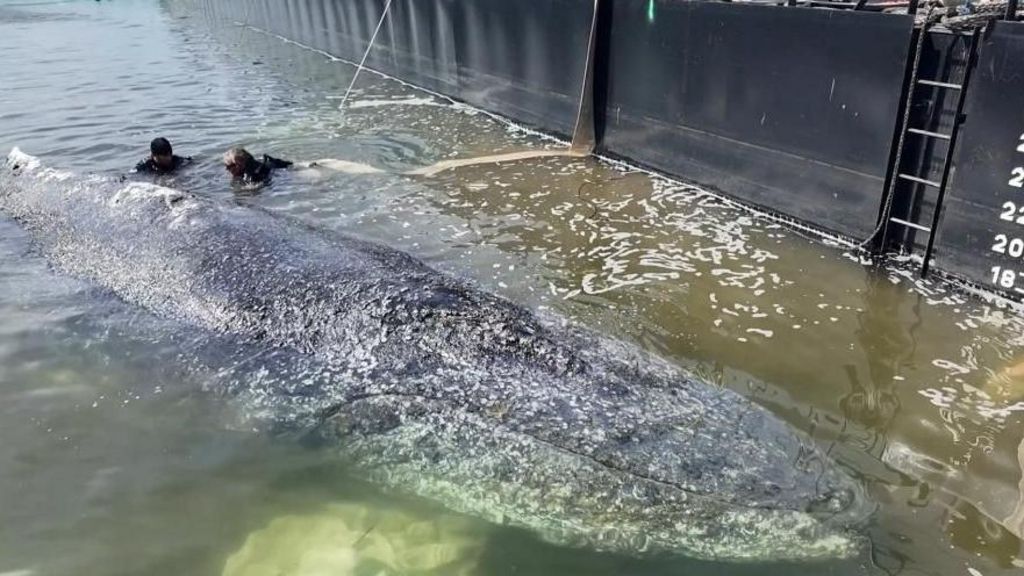
A months-long high-profile rescue effort for a stranded humpback whale has come to a somber end, with the animal’s decomposing carcass now washing ashore on Denmark’s Anholt Island — leaving local officials scrambling to plan a safe removal while the small coastal community navigates unexpected public attention and public health risks.
The story of the whale, which captured widespread public interest across Germany after it first became stranded on the Baltic Sea coast in early March, began when the mammal got tangled in fishing gear near Lübeck Bay. First spotted stuck at Timmendorfer Beach — the location that gave the whale its popular media nicknames, “Timmy” and “Hope” — the weak animal managed to swim further east along the German coast before becoming re-stranded off the island of Poel weeks later.
Two private German entrepreneurs launched a private rescue bid to save the humpback, moving the animal onto a barge in late April to ferry it out to open water. The team released the whale into the North Sea roughly 70 kilometers from Denmark’s northern tip, far from the Kattegat Strait where it ultimately washed up. German wildlife experts had warned from the start that the whale was severely underweight and unlikely to survive, and authorities had already abandoned hope of the animal’s survival by early April.
Last weekend, just two weeks after that attempted rescue release, the whale’s carcass was discovered beached just a few meters off Anholt’s coastline. Environmental officials confirmed the body was indeed the rescued humpback after locating a GPS tracking tag that had been attached to the animal during the rescue operation. To this day, it remains unclear how the dead whale drifted from its release location off northern Denmark to Anholt, off the East Jutland coast.
As decomposition progresses, the carcass has swollen with trapped built-up gas, sparking public fears that the massive animal could explode. Danish environmental officials have announced plans to remove the carcass from the island, while also warning local residents to stay far away from the remains to avoid potential infection risks. No official timeline or detailed plan for the removal has been released as of Wednesday, with the agency only confirming it is working on a strategy that will allow for a full post-mortem examination and the collection of valuable tissue samples for scientific research.
Local reactions to the beached carcass have been mixed. One anonymous Anholt resident, speaking to reporters, noted the body is currently 20 to 30 meters from the shore and continues to drift along the beach, adding that while some locals are unnerved by the risk of an explosion, she sees it as a natural process and holds no personal fears. Many islanders have also expressed bemusement at the ongoing international attention the dead whale has drawn, with curious German tourists already traveling to the small island to catch a glimpse of the animal and follow new developments in the saga.