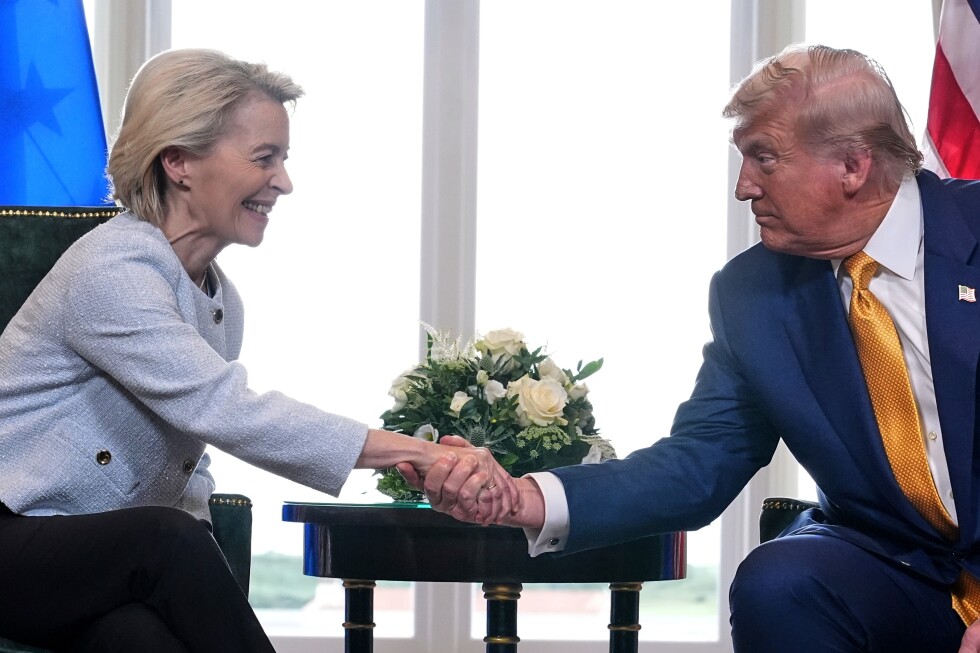
BRUSSELS – After marathon late-night negotiations to resolve bitter internal divisions, the European Union has formally signed off on a landmark tariff agreement with the United States that caps duties on most EU exports at 15%, narrowly averting a full-scale transatlantic trade war that was set to trigger ahead of President Donald Trump’s July 4 deadline.
The path to final approval was far from smooth, with heated clashes between lawmakers and bloc leaders threatening to derail the hard-won agreement that governs more than $1 trillion in annual transatlantic goods and services trade between two of the world’s largest economic powers, both currently grappling with economic spillover from the ongoing conflict in Iran.
The framework for the deal was first laid out 12 months prior, when European Commission President Ursula von der Leyen met Trump at his Turnberry golf resort in Scotland to strike an initial handshake agreement, capping months of tense bargaining that followed the Trump administration’s sweeping global tariff offensive. That initial agreement sparked months of further technical negotiations between Washington and Brussels, even as European criticism of the deal surged after Trump made an unexpected public threat to seize control of Greenland, a self-governing Danish territory. Trump has since walked back that threat, at least temporarily.
Following intense trilogue negotiations between the European Parliament, European Council, and European Commission that stretched into an “intensive night” of five hours of talks, the deal secured final EU approval. European trade chief Maroš Šefčovič announced the breakthrough after negotiations concluded, noting that once formally adopted by the full parliament in the coming weeks, the agreement “will reinforce stability in EU-U.S. trade and open the door even wider to constructive cooperation on many issues of strategic importance.”
In a social media statement confirming the outcome, the EU executive branch reaffirmed its commitment to the deal, writing “A deal is a deal, and the EU honours its commitments.”
Under the terms of the agreement, most European exports to the U.S. will be subject to a maximum 15% tariff, while U.S. industrial goods entering the EU will see tariffs eliminated entirely. While the arrangement raises the average tariff rate on covered goods from the previous 4.8%, creating added costs for consumers and businesses on both sides of the Atlantic, analysts credit the new framework with delivering long-term policy certainty that helped Europe avoid a projected recession in 2023.
Amid skyrocketing energy and commodity prices driven by the prolonged closure of the Strait of Hormuz amid Middle East tensions, and persistent high inflation and interest rates on both sides of the Atlantic, supporters of the deal argue that resolving long-running transatlantic trade tensions is a critical step toward shoring up global economic stability. The American Chamber of Commerce in Brussels shared that view in a post-approval statement, saying it was “relieved” to see the EU reach internal consensus. “The trilogue agreement is a sign that the EU is honouring its commitments under the deal,” the group said, adding that the approval will let both sides “move beyond tariffs” to address pressing shared challenges such as critical supply chain resilience.
European lawmakers successfully pushed to add binding safeguard provisions to the final text that will allow the bloc to take swift retaliatory action if the U.S. backtracks on its commitments under the deal, according to Bernard Lange, chair of the European Parliament’s trade committee. “If there is something going wrong, of course, we are self-confident to act on that,” Lange said.
Even with the deal now cleared through all EU internal processes, significant uncertainty remains about its future, amid growing concerns in Europe that the White House lacks clear legal authority to uphold the agreement. A series of recent U.S. court rulings have undermined the legal basis Trump used to impose the original tariffs in question. This year, the U.S. Supreme Court struck down the legal authority Trump relied on to enact the tariffs, forcing the administration to find alternative legal justifications for existing duties and move forward with new levies to replace lost tariff revenue. Just months ago, a U.S. federal court ruled that Trump had exceeded the tariff authority granted to the presidency by Congress, ruling that the administration’s new replacement tariffs were “invalid” and “unauthorized by law.”
That legal cloud also hangs over long-threatened new tariffs on EU passenger and commercial vehicles that Trump has teased on social media, where he has also accused the EU of failing to uphold its end of the deal without providing specific evidence of non-compliance.
With the EU having completed its domestic approval process, the ball is now in Washington’s court to respond, Lange said. “That’s, of course, a big question mark. I have not my crystal ball here with me,” he added.