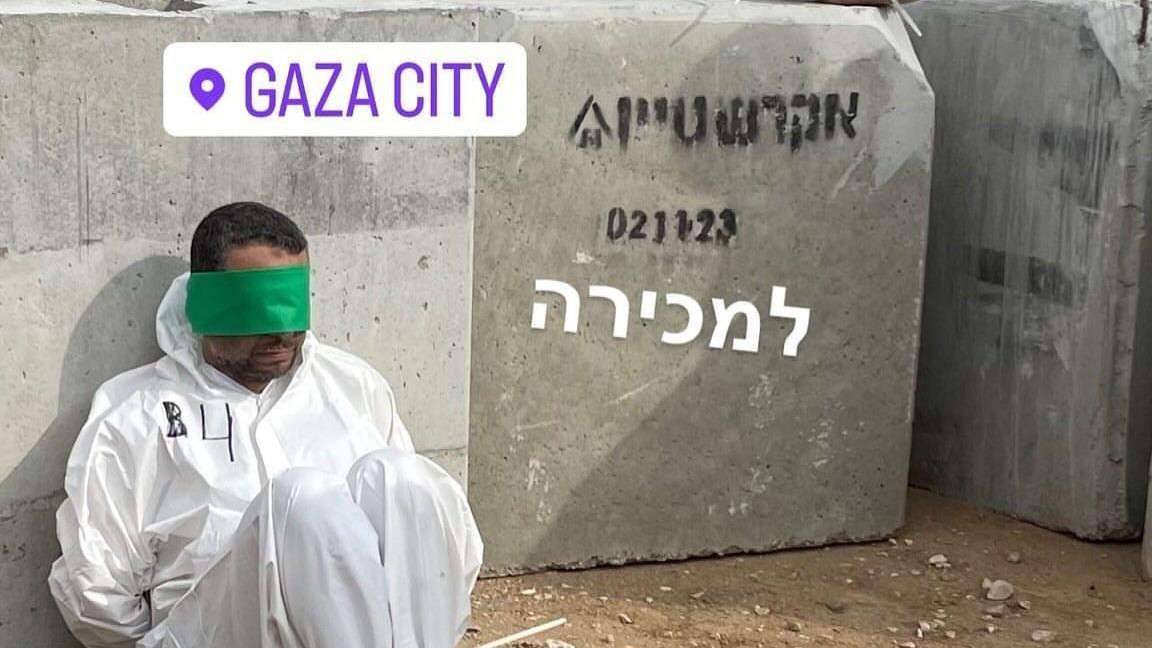
Nearly 18 months after a 41-year-old Palestinian man with a chronic mental health condition vanished from his home in Gaza, a disturbing deleted social media post from an Israeli soldier has given his family the first clue to his fate — and left them with no clear answers about his whereabouts.
On November 18 of last year, Israeli soldier Harel Amshika shared a nine-image photo carousel to his personal Instagram account, paired with reflective text about his combat deployment in the Gaza Strip.
His years of frontline service “passed quickly, but left a big mark,” Amshika wrote. “Being a warrior in such a time is a privilege… Gratitude for sleepless nights… And a very long war. To friends who became family. To experiences that I never thought I would have, for better or worse.”
Amshika went on to express gratitude to his unit, the Shaked Battalion, which operates under the Israeli military’s Givati Brigade. He also honored fallen soldiers he had served with, specifically highlighting combat medic Ido Zano in his account biography.
Among the photos in the carousel was one particularly graphic image: a Palestinian man, clad in a full white hazmat suit with “B4” handwritten in black marker below his right shoulder, sits bound and blindfolded against a concrete block. The man has no shoes, with both his hands and ankles restrained. A green cloth or tape covers his eyes. Just above him, the lower half of a second bound man, whose hands and feet are secured with plastic zip ties, is visible on a neighboring block.
Over the image, Amshika overlaid a short, chilling caption: “For sale”.
Both the post and Amshika’s original Instagram account have since been taken down, though the soldier has created a new account with a nearly identical username and a one-line biography: “Just for fun”. Archived copies of the post and screengrabs of the dehumanizing photograph have nonetheless spread widely across social media platforms.
According to a new report from the Global Legal Action Network (GLAN), a Gaza-based Palestinian woman named Zahra Shorrab recognized the bound man in the circulated image as her son, Mohammed Shorrab. She confirmed the identification through distinct features including his hands, hair, and feet.
Mohammed, 41, requires ongoing care from his family for his mental health condition. He disappeared on August 20, 2024, after leaving his home to attend evening prayers; his family never saw him again after he stepped out.
For nearly a year and a half, his relatives searched for any trace of Mohammed, with no success. It was only when Zahra encountered the Israeli soldier’s “for sale” post that the family gained any information about what may have happened to him.
In an interview with journalist Ali Alasmer, Zahra Shorrab spoke out about the pain and outrage her family has endured. “Have the Palestinian people become so cheap that they are put up for sale? What is happening to us is cruel… It is unbearable that they are scattering us like this and that a Palestinian is being offered for sale,” she said.
“Do human beings no longer have any worth?” Shorrab asked. “We are human beings. We are people… How can they reduce him to something worthless like that?”
After the identification was confirmed, GLAN partnered with Hamoked, an Israeli human rights organization that provides free legal assistance to Palestinians living under Israeli occupation, to pursue answers on the family’s behalf.
On February 26, Hamoked submitted an official written inquiry to the Israel Prison Service, requesting information about Mohammed’s location and status.
The Israel Prison Service replied that after a full review of its detainee records, no evidence could be found that Mohammed Shorrab had ever been held in any of its facilities.
Yet as GLAN points out, the basic facts of the case remain unambiguous: the photograph exists, the soldier who took it has been publicly named, his military unit has been identified, and the brigade was confirmed to be operating in the area where Mohammed disappeared at the time he went missing.
Middle East Eye reached out to the Israel Defense Forces (IDF) with a series of questions about the case, covering both Mohammed Shorrab’s disappearance and Harel Amshika’s social media post.
In an official response, an IDF spokesperson stated: “Based on the examinations conducted thus far, no individual by the name Muhammad Rabee Saed Shorrab was found to be currently held, or to have been held during the war, in an IDF detention facility.
“Regarding the image presented, it is not possible to identify the individual depicted with certainty. The image was taken over two years ago, and the individuals involved have since been discharged and are no longer serving in the military. The image has been removed. Procedures regarding conduct toward detainees were reinforced to the forces throughout the war.”
Middle East Eye also specifically asked whether any disciplinary action had been opened against Amshika in connection with the post. As of the time of this reporting, the IDF has not responded to that question.
The revelation of the photograph comes as United Nations special rapporteurs released a new report this week documenting widespread allegations of torture and cruel treatment of Palestinian detainees. The report includes verified testimony describing abuses ranging from “repeated and serious physical assaults, setting dogs on detainees” to “handcuffing and blindfolding for extended periods, shackling to beds and feeding through straws.”
The UN investigation also documented “the prolonged deprivation of food, sleep deprivation, water and medical attention, prolonged exposure to the cold, being forced to kneel on gravel, deliberate humiliation, blackmailing, electric shocks, being burnt with cigarettes, and being given hallucinogenic pills”, as well as “enforced disappearance and arbitrary detention of essential healthcare workers in Gaza.”
This report is part of Middle East Eye’s independent, on-the-ground coverage of conflict and human rights issues across the Middle East and North Africa.