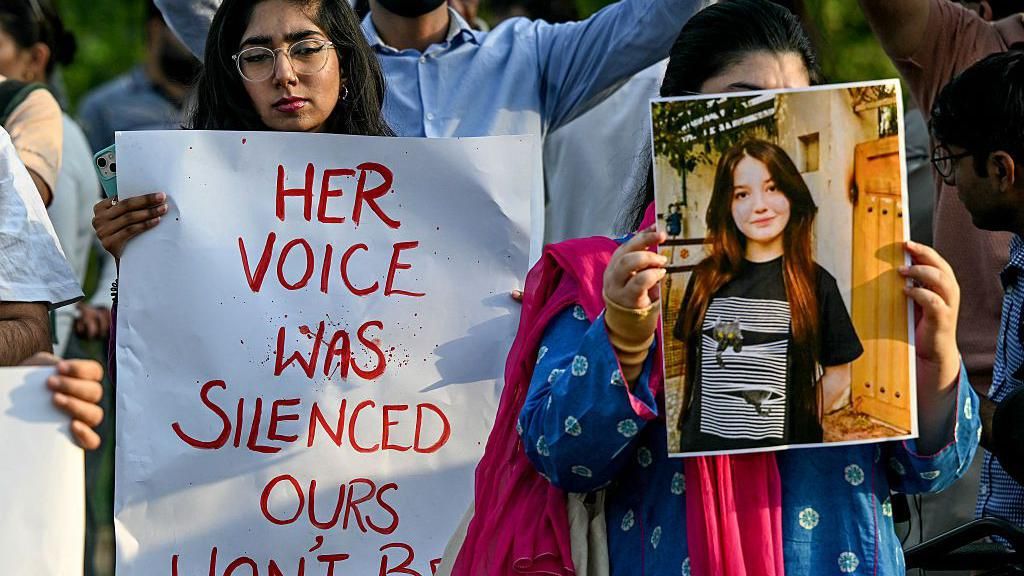
A shocking case of gender-based violence that roiled Pakistani public discourse has reached a landmark verdict, with an Islamabad court handing down a death sentence to 23-year-old Umar Hayat for the brutal murder of 17-year-old TikTok star Sana Yousaf. The killing, which took place in June of the previous year, followed a pattern of predatory behavior that ended in a devastating act of violence after Yousaf repeatedly rejected Hayat’s romantic advances.
Investigative accounts from local Pakistani media outline how Hayat, who confessed to the killing in July, developed an unhealthy, one-sided obsession with Yousaf following casual online interactions. Days before the attack, he traveled to Islamabad, where Yousaf lived with her family, to greet her on her birthday. When Yousaf refused to meet him, Hayat forced his way into her family home. A confrontation between the two quickly escalated, ending with Hayat shooting Yousaf dead.
At the time of her death, Yousaf had built a massive online following: more than one million followers on TikTok and an additional half a million on Instagram. Fans adored her approachable, light-hearted content, which ranged from testing viral fashion trends and lip-syncing to popular songs to candid clips of her spending time with friends.
Following the verdict, Yousaf’s father, Syed Yousaf Hassan, told local media that the court’s ruling serves as “a lesson for all such criminals in society”. In addition to the death sentence, the court ordered Hayat to pay 2.5 million Pakistani rupees, equivalent to roughly $9,000, in compensation to Yousaf’s grieving family.
The investigation into Yousaf’s murder was a wide-ranging effort: law enforcement officers carried out raids across Islamabad and the neighboring province of Punjab, reviewing footage from a total of 113 CCTV cameras to piece together the timeline of the attack.
While the murder sparked widespread national outrage, it also exposed deep-seated misogyny within segments of Pakistani society. A small but vocal group of mostly male internet users launched a backlash against Yousaf, attacking her work as a social media influencer on religious grounds. Some even demanded that her family remove all of her existing content from TikTok and Instagram, claiming the posts amounted to “sinful” behavior.
Digital rights and women’s rights advocates have pushed back against this dangerous narrative. Usama Khilji, director of digital rights organization Bolo Bhi, noted that the unfair criticism of Yousaf reflects entrenched bias against women creating content online. Prominent human rights activist Farzana Bari labeled the reaction to Yousaf’s murder explicitly misogynistic and patriarchal, pointing out that Yousaf was targeted simply for exercising her right to self-expression. Bari emphasized that the case serves as a stark reminder that social media has become an increasingly dangerous space for female content creators in Pakistan, where systemic gender-based violence continues to threaten women’s safety and autonomy.
Activists also emphasize that Yousaf’s killing is not an isolated incident, but part of a long-standing, widespread pattern of violence against women across Pakistan that demands systemic policy and cultural change.