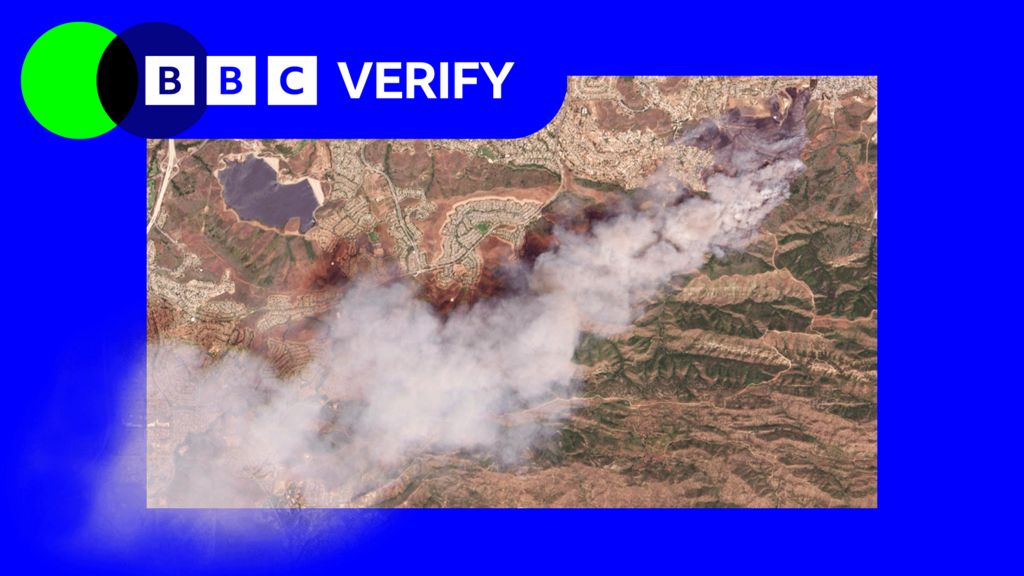
Two massive, entirely uncontained wildfires are tearing across Southern California, with satellite imagery from NASA laying bare the alarming scope of the blazes that have forced tens of thousands of residents to flee their homes. The first, named the Sandy Fire, sparked early Monday morning near Simi Valley, a city located just northwest of Los Angeles, according to California Governor Gavin Newsom.
Local satellite captures taken shortly after noon on Monday show a thick, towering plume of dark smoke billowing thousands of feet into the atmosphere just south of the city limits. As of Tuesday morning, firefighting operations are in full swing: 750 frontline firefighters are backed by specialized night-flying water-dropping helicopters, which allow crews to target dangerous hotspots even after the sun sets, a critical capability that slows the fire’s spread when ground crews can no longer operate.
Initial investigation into the cause of the Sandy Fire points to a mechanical accident, local law enforcement confirmed. The Simi Valley Police Department received reports that a person operating a tractor struck a rock, creating a spark that ignited dry vegetation and quickly grew into the raging inferno now sprawling across 1,364 acres (550 hectares) of land. As of Tuesday, no portion of the fire has been brought under containment, and data from NASA’s Fire Information for Resource Management System (FIRMS) shows active burn hotspots shifted steadily southward overnight into Tuesday.
The mass evacuation order issued for the region covers more than 10,000 homes across Simi Valley and its adjacent communities, with an additional 3,500 homes placed under mandatory evacuation warning that extends into neighboring Los Angeles County. Los Angeles Mayor Karen Bass stressed that city officials do not currently forecast the blaze will reach Los Angeles proper, but warnings were issued as a proactive precaution “out of an abundance of caution.” A spokesperson for the California Department of Forestry and Fire Protection noted that unseasonably strong high winds on Monday morning fanned the fire’s rapid spread, though wind speeds dropped significantly later in the day, giving crews a small window of opportunity to gain ground.
In response to the ongoing emergency, the Simi Valley Unified School District canceled all classes across every campus in the district for Tuesday, as multiple schools were being used as emergency evacuation shelters for displaced residents. This outbreak of wildfire comes just 16 months after a devastating series of fast-moving blazes ripped through the Los Angeles area in January 2025, killing roughly 30 people and destroying more than 10,000 structures, a disaster that left a lasting mark on the region’s emergency preparedness frameworks.
A second, far larger wildfire is also burning uncontained dozens of miles off the Southern California coast on Santa Rosa Island, part of the protected Channel Islands National Park. US National Park Service officials confirmed the fire has already charred 14,600 acres (6,000 hectares) of the island, with satellite imagery confirming the blaze has pushed northeast over the weekend and is now spreading deeper into the island’s interior.
First reported to authorities on Friday, the Santa Rosa Island fire remained 0% contained as of Monday evening. At least 70 firefighters alongside trained park rangers have been deployed to battle the remote blaze, working under challenging conditions with limited access to the island’s rugged terrain. In a separate operation linked to the fire, the US Coast Guard confirmed it successfully rescued a 67-year-old man who was stranded along the island’s shoreline, though details on the man’s condition have not yet been released.
Santa Rosa Island is the second-largest of the five Channel Islands located off Southern California’s coast. It is almost entirely uninhabited by permanent human residents, but it hosts one of the most unique and biodiverse ecosystems in the continental United States, home to dozens of rare and endemic plant and animal species found nowhere else on Earth. Conservation experts are already sounding alarms about the potential long-term impact of the massive burn on the island’s fragile native habitats.