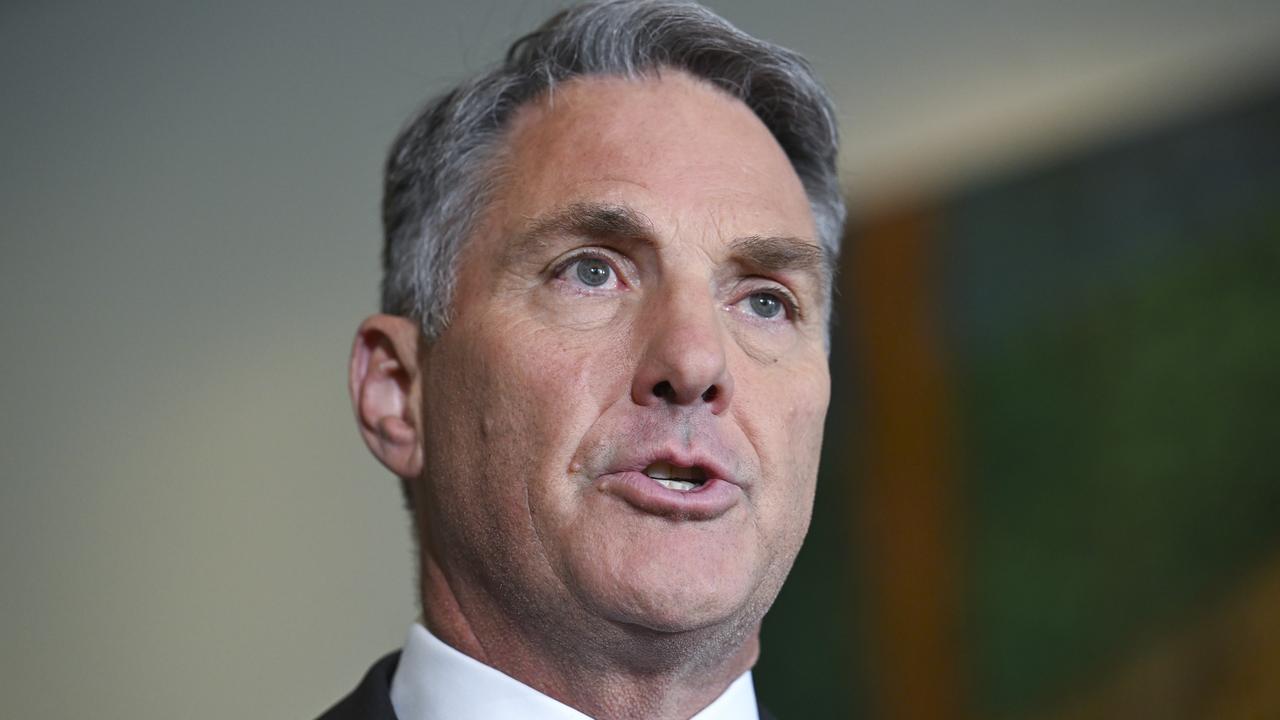
A sharp political clash over Australia’s national defence policy has erupted after Defence Minister Richard Marles launched a scathing attack on the former Liberal-National Coalition government, accusing it of neglecting critical planning for the nation’s ageing Collins-class submarine fleet and leaving a dangerous capability gap that the current Albanese Labor government is now forced to address. The confrontation came during a major policy address delivered by Marles at the Lowy Institute on Tuesday, where he positioned the Albanese government as the true steward of Australian national defence while dismantling the long-held public perception that conservative parties are the more competent actors on security issues.
At the center of the dispute is the government’s scaled-back, reworked approach to the A$11 billion life-of-type extension (LOTE) program for Australia’s six Collins-class conventionally powered submarines, which are set to remain in service until the delivery of nuclear-powered submarines secured under the trilateral AUKUS security pact with the United States and the United Kingdom. Following an independent defense review, the Albanese administration has abandoned the original full fleet overhaul plan inherited from the Coalition, instead adopting a flexible, conditions-based strategy that cuts back unnecessary engineering overhauls, reduces scheduling risks, and focuses upgrades exclusively on high-priority capabilities including core weapons systems and combat infrastructure.
The oldest of the fleet, HMAS Farncomb – launched almost 30 years ago – will be the first vessel to enter the LOTE program later this month, with work split between shipyards at Osborne in South Australia and Henderson in Western Australia, carried out by the Australian Submarine Corporation (ASC). The work will retain and restore the submarine’s core base components while modernizing critical combat and weapons systems. Upgrades to the fleet’s optronics systems were previously shelved by the current government to align with the tailored, risk-mitigated approach. Marles also confirmed the revised program will accelerate modernization work on HMAS Rankin, the newest submarine in the Collins-class fleet.
“This approach will reduce engineering risk by sustaining existing systems where appropriate, while continuing to upgrade critical capabilities that keep our fleet operationally effective,” Marles said in his address. “It will ensure our Collins-class submarines remain a potent, highly capable undersea deterrent for Australia today and for years to come.”
Beyond the submarine program, Marles used the speech to outline the government’s broader defence agenda, highlighting progress on accelerating the delivery of new Mogami-class frigates and major investments in Ghost Bat and Ghost Shark, two domestically developed autonomous defense vehicles. He pushed back aggressively against decades of Conservative branding on defence, arguing that Labor has always been Australia’s natural party of national defence, pointing to the legacy of former Labor prime ministers including Chris Watson, Andrew Fisher, John Curtin, and Gough Whitlam in building Australia’s independent defence capacity and national sovereignty.
“Labor’s historical focus on defence comes from the fact that our armed forces, national security, and defence capability sit at the very heart of Australian national sovereignty,” Marles said. “The character of any nation is defined in large part by what it is able to do militarily. Sovereignty is the foundation of nationhood, of the idea of Australia itself – and Labor has always been the party of the Australian project.”
He went on to criticize the conservative vision of Australian federation, noting that original conservative leaders sought only to unite six British colonies into a single British entity focused on free trade, with little interest in advancing an independent Australian national identity. Turning to the Coalition’s nine years in office under prime ministers Tony Abbott, Malcolm Turnbull, and Scott Morrison, Marles called the previous government “the worst defence government in Australia’s history”, pointing to its failure to address the rapid expansion of Chinese naval capabilities in the Indo-Pacific. He added that the current government maintains “serious concerns” over recent Chinese actions against Philippine civilian and government vessels in the South China Sea.
“For decades, the Liberals have enjoyed a huge brand advantage when it comes to defence policy,” Marles said. “But the gap between perception and reality is sometimes a chasm. All leaders face the danger of believing their own publicity – and in defence, that has made the Liberals fundamentally lazy.”
On the future submarine program, Marles reiterated that the previous government’s mismanagement had left a critical capability gap for Australia’s most important maritime military platform. “By this point, careful, long-range planning for extending the life of the Collins-class fleet should have been well underway,” he said. “Unfortunately for Australia, the Liberals failed to prepare and implement a thoughtful, coherent LOTE plan for the submarines.”
The debate comes as global security uncertainty intensifies following the outbreak of conflict in the Middle East, which Marles said has placed new, urgent focus on Australia’s defence capabilities, national resilience, and sovereign independence. In 2024, the Collins-class fleet was officially listed as a “Product of Concern” by the federal government, triggering increased direct ministerial oversight of the upgrade program to address delays and capability risks.