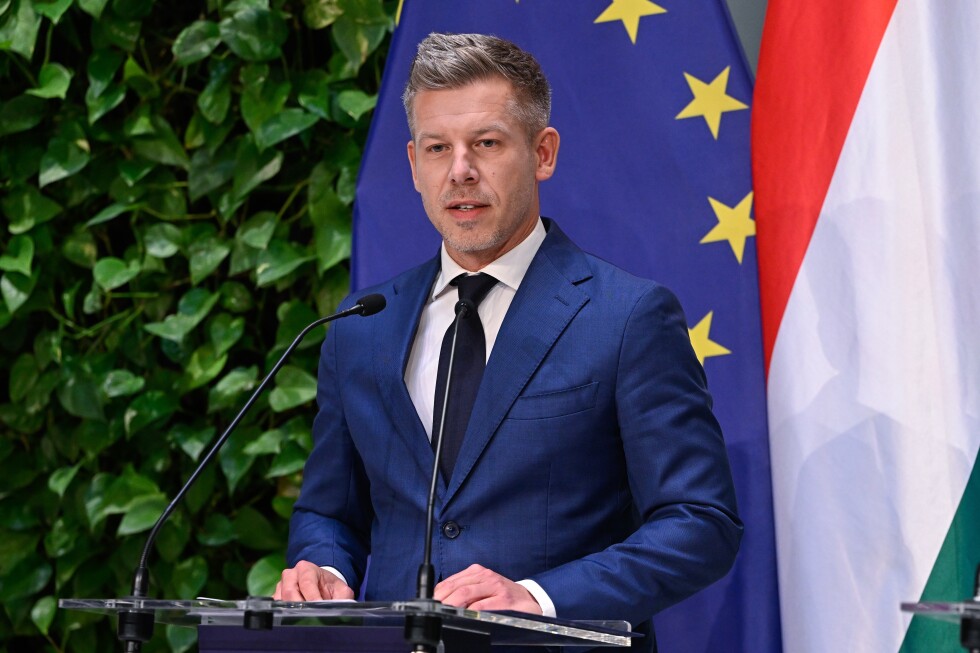
Fresh off a historic political upset that ended 16 years of Viktor Orbán’s nationalist-populist rule, Hungary’s new center-right Prime Minister Péter Magyar is traveling to Poland this week to draw lessons from Warsaw’s own recent experience undoing authoritarian-leaning governance. The trip comes as Magyar’s Tisza party sets out to dismantle the political and economic infrastructure Orbán built during his more than a decade and a half in power, a mission that has sparked widespread optimism across Europe.
Magyar’s landslide election victory last month — which delivered Tisza a two-thirds parliamentary supermajority, an unprecedented result in Hungary’s post-Communist era — has drawn consistent comparisons to Poland’s 2023 general election, where Donald Tusk’s center-right coalition ousted the national-conservative Law and Justice (PiS) party after eight years in power. Like Tusk, Magyar has made restoring eroded democratic institutions, holding corrupt former officials accountable, and rolling back executive overreach his top policy priorities.
Magyar’s diplomatic itinerary kicked off with a flight to the southern Polish city of Kraków on Tuesday, followed by an overland journey by train to Warsaw, and a final leg to the Baltic coastal city of Gdańsk. Since being sworn in on May 9, the new prime minister has moved quickly to consolidate his mandate, demanding that dozens of senior officials appointed by Orbán’s administration step aside, and threatening to remove remaining holdouts via constitutional amendment — a power Tisza’s supermajority makes fully achievable.
Topping Magyar’s target list are key institutional leaders he has labeled “Orbán’s puppets”: ceremonial but constitutionally powerful President Tamás Sulyok, Hungary’s attorney general, and the heads of both the Constitutional Court and Supreme Court. All are appointees of the previous government, and many retain their seats through long terms that extend years into the future; Sulyok’s term runs until 2029, while Constitutional Court head Péter Polt, a widely acknowledged Fidesz loyalist, will remain in office until 2037.
Warsaw-based Center for Eastern Studies analyst Andrzej Sadecki notes that while retaining control of key state institutions by former regime allies is the same core challenge Tusk faced after taking power in Poland, Magyar holds a critical advantage his Polish counterpart did not. “The situation is much easier for Magyar because he has a constitutional majority. This makes it much easier for him to introduce deep changes,” Sadecki told the Associated Press. Unlike Tusk, who had to negotiate as head of a fragile coalition government, Magyar’s Tisza party won an absolute 53% of the national vote, securing enough seats to pass constitutional amendments without cross-party support. Sadecki framed the election outcome as far more than a routine change of government, calling it “a watershed moment” for Hungarian democracy.
One of Magyar’s first policy pushes mirrors Tusk’s early actions in Poland: overhauling a state-controlled media ecosystem that operated as a partisan mouthpiece for the previous ruling government. For 16 years, Orbán built an expansive, state-aligned media network that consistently amplified Fidesz’s messaging while defaming, discrediting, and intimidating political opposition. In the wake of his election victory, Magyar slammed Orbán-era public broadcasters as “a factory of lies,” announcing he would suspend all news programming until the outlet can be restructured to meet objective journalism standards.
Tusk’s government took an almost identical approach less than a month after taking office, overhauling the primetime newscast on Poland’s state television network and replacing senior leadership at all public media outlets. That move drew legal criticism even from some liberal groups, with the Warsaw-based Helsinki Foundation for Human Rights noting that the rapid restructuring “raises serious legal doubts.” But József Péter Martin, executive director of Transparency International Hungary, argues the systemic failure of Hungarian public media under Orbán justifies a full restructuring — and that the process can be completed within the bounds of the rule of law.
Restoring full judicial independence, by contrast, is shaping up to be one of Magyar’s most difficult long-term challenges, mirroring ongoing struggles faced by Tusk’s administration in Poland. During PiS’s eight years in power, the party overhauled Poland’s court system by appointing loyalist judges to higher courts, punishing dissident judges with disciplinary action, and stacking the Constitutional Court with ideological allies who could block unfavorable legislation through prolonged constitutional review. Tusk’s efforts to reverse these changes have been repeatedly blocked by two successive PiS-aligned Polish presidents, and full judicial independence has yet to be restored.
In Hungary, similar structural barriers stand in Magyar’s way. Despite repeated calls for his resignation, Orbán ally President Sulyok has publicly stated he has no intention of stepping down early. Martin argues that while rank-and-file Hungarian judges and prosecutors largely uphold their professional duties, replacing the senior leadership of the constitutional and supreme courts is critical to restoring public trust in judicial impartiality. Critically, Martin added that these posts should not be filled with Tisza loyalists, which would simply replace one partisan capture with another, but rather with independent figures fully committed to upholding the Hungarian constitution and public interest.
The new Hungarian government also faces pressure from voters to hold former Orbán administration officials accountable for alleged corruption and abuse of power — nearly 3.4 million Hungarians cast ballots for Tisza, with many naming accountability as a top priority. In Poland, prosecutors have already opened multiple corruption investigations against former PiS officials, including former Justice Minister Zbigniew Ziobro, who stands accused of diverting public funds intended for violence victims for personal and political gain. Prosecution of Ziobro stalled after he was granted asylum in Orbán’s Hungary earlier this year, though he has since claimed to have relocated to the United States, where Polish authorities are seeking his extradition.
To meet voter expectations for accountability, Magyar has pledged to launch a new specialized body, the National Asset Recovery and Protection Office, tasked with investigating and recouping public funds allegedly misappropriated during Orbán’s tenure. Martin emphasized that restoring the rule of law and independent judiciary is the “initial and most essential step” to enabling successful prosecution of past abuses, adding that Magyar’s campaign pledge to join the European Public Prosecutor’s Office would be a major step forward. “If all this is done, then I think there is a good chance that the corrupt perpetrators of the former regime, under an independent judiciary, can be held accountable,” Martin said. The report was contributed to by AP correspondent Ciobanu, reporting from Warsaw, Poland.