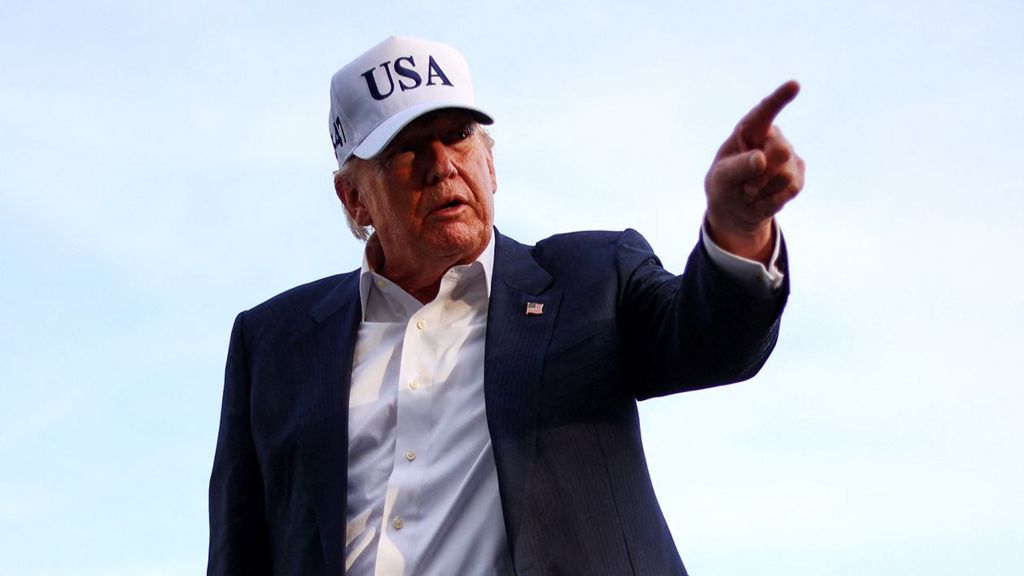
Weeks after his high-profile meeting with Chinese President Xi Jinping in Beijing, former and current U.S. President Donald Trump has delivered an unprecedented public warning to Taiwan against moving toward formal independence, triggering immediate reactions from Taipei and sparking widespread debate over the future of U.S. policy in the Indo-Pacific.
In an interview with Fox News that aired Friday, Trump made his stance clear: “I’m not looking to have somebody go independent. And, you know, we’re supposed to travel 9,500 miles to fight a war. I’m not looking for that. I want them to cool down. I want China to cool down.” These remarks mark the most direct public pressure a sitting U.S. president has ever placed on Taiwan regarding its sovereignty status, leading to a quick response from Taipei.
Taiwanese officials reiterated their long-held position that the island sees no need for a formal declaration of independence, a stance that aligns with mainstream public sentiment on the self-governing island. To understand the stakes of this exchange, it is necessary to contextualize the decades-long historical and geopolitical backdrop of the Taiwan issue.
Following the 1949 conclusion of China’s civil war, the defeated Kuomintang government relocated to Taiwan, while the Chinese Communist Party established control over the mainland. Beijing has claimed the island as an inalienable part of its territory ever since, and Taiwan independence has stood as the most sensitive red line for Chinese leadership. Since President Xi Jinping took office, Beijing has ramped up its efforts to suppress perceived separatist activity, framing unification with Taiwan as an “unstoppable” historical priority. In recent years, this pressure has translated into regular military drills near the island, diplomatic campaigns to cut Taiwan’s global recognition, and persistent greyzone incursions into Taiwan’s airspace and territorial waters.
During his recent summit with Trump, Xi emphasized that the Taiwan question is the single most critical issue shaping U.S.-China relations, warning that mishandling the topic could lead to direct conflict. For decades, global observers have warned that any Chinese military move against Taiwan would likely draw in the U.S., which is legally bound by the 1979 Taiwan Relations Act to provide the island with defensive military capabilities. Under China’s 2005 Anti-Secession Law, Beijing retains the right to use “non-peaceful means” to assert its territorial claims if Taiwan formally declares independence or all options for peaceful unification are exhausted, making any move toward formal independence a potential trigger for regional war.
Today, most Taiwan residents, who live under a thriving democratic system distinct from mainland China’s increasingly authoritarian rule, support maintaining the status quo—neither formal independence nor unification with Beijing. This position is reflected in the official policy of the Democratic Progressive Party (DPP), which has governed Taiwan since 2016. Current President Lai Ching-te, like his predecessor Tsai Ing-wen, has argued that Taiwan already functions as an independent sovereign state, so no formal declaration is necessary—a carefully calibrated approach designed to assert Taiwanese autonomy without crossing Beijing’s explicit red line. A formal declaration of independence would also require constitutional amendment approved by Taiwan’s legislature and a majority public vote in a referendum, making it logistically difficult for any administration to pursue even if it wanted to. Even so, Beijing remains deeply suspicious of the DPP, which historically advocated for formal sovereignty, and has repeatedly labeled Lai a dangerous separatist, accusing his administration of hijacking public opinion to push an independence agenda and building up military capabilities for confrontation. Lai has pushed back on these claims, noting that military strengthening is only a defensive measure in response to growing Chinese pressure.
Trump’s recent comments have upended long-standing expectations around U.S. policy on Taiwan. No U.S. administration has ever explicitly supported Taiwanese independence, and for decades Washington has maintained a carefully calibrated “strategic ambiguity” policy, neither confirming nor denying whether it would intervene militarily to defend the island. This policy emerged after 1979, when the U.S. severed formal diplomatic ties with Taiwan to establish relations with Beijing, acknowledging the one-China principle, while passing the Taiwan Relations Act to enshrine U.S. commitments to Taiwan’s defense. The act authorizes ongoing arms sales to Taiwan to support its self-defense capabilities.
Trump’s remarks have left analysts divided. During his summit, Trump noted that Xi “doesn’t want a movement for independence” in Taiwan, adding that he “heard him out” but did not offer a formal response. While Trump later stressed that “nothing’s changed” in U.S. policy and expressed openness to speaking directly with Lai— a move that would almost certainly draw fierce condemnation from Beijing, as it did when Trump spoke with a Taiwanese president early in his first term—many observers see his warning to Taiwan as an unusual break from past U.S. framing. Ryan Hass, a senior analyst at the Brookings Institution, argues that Trump’s “visible sympathy for Xi’s framing on Taiwan will embolden Beijing to increase pressure on Taipei, and elevated the risk of confrontation.”
All eyes are now turning to a pending $14 billion U.S. arms package for Taiwan, which follows an $11 billion weapons sale approved in December. After the Beijing summit, Trump declined to commit to finalizing the new package, telling Fox News the decision “depends on China” and that the proposal “is a very good negotiating chip for us frankly.” He later added that he would make a decision “over the next fairly short period.” This is not the first time a U.S. president has shaken up long-standing Taiwan policy rhetoric: former President Joe Biden twice publicly stated the U.S. would defend Taiwan if attacked, appearing to move away from strategic ambiguity, only for his administration to walk back the comments and clarify that official policy had not changed. For decades, U.S. policy on Taiwan has remained fundamentally consistent despite shifts in rhetoric. Now, regional and global powers are closely watching Trump’s next moves to see if the long-standing U.S. balancing act on the Taiwan issue is finally shifting.