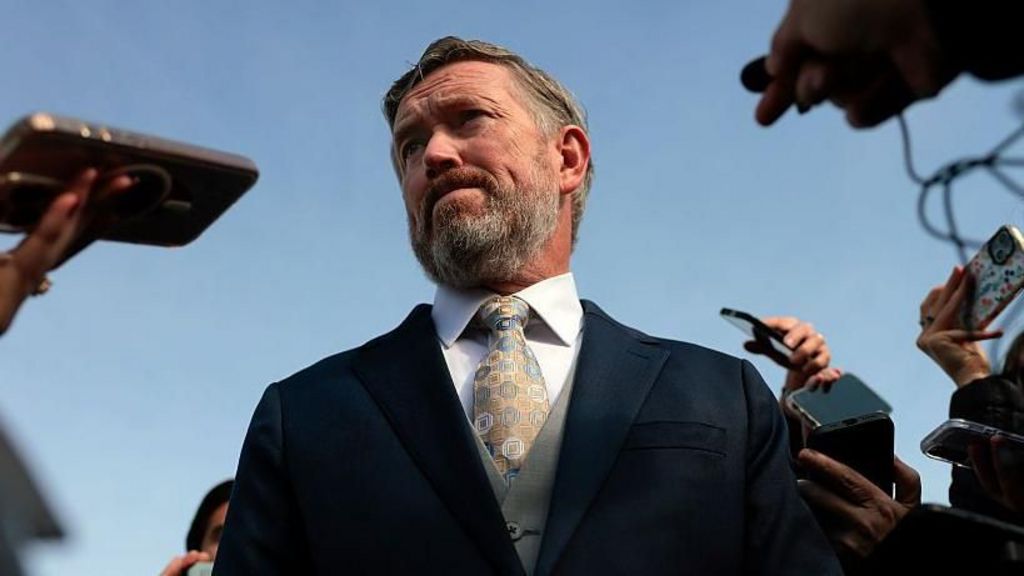
As voters head to the polls for Kentucky’s 4th Congressional District Republican primary on Tuesday, the nation is watching one of the most explosive intraparty showdowns of the 2026 election cycle: a test of whether sitting Congressman Thomas Massie can defy former president Donald Trump and hold onto his seat. The contest has become a defining referendum on Trump’s unchallenged grip over the modern Republican Party, with national consequences for any other GOP lawmakers considering breaking with the party’s leader.
The conflict between Massie and Trump stems from the Kentucky congressman’s repeated breaks with the White House on high-profile issues core to Trump’s agenda. Massie voted against Trump’s landmark 2025 tax and spending package, arguing it added trillions of dollars to the national debt; he backed efforts to roll back Trump’s tariffs on Canada; he supported measures to curtail Trump’s military operations in the Caribbean targeting suspected drug trafficking vessels and the ongoing U.S. military deployment in Iran. Most notably, Massie joined a bipartisan coalition that successfully pressured Trump’s own Department of Justice to release the full, unredacted files on deceased convicted sex offender Jeffrey Epstein, a move that infuriated the president.
Trump’s response has been unrelenting. He has branded Massie with a barrage of vicious insults, calling him a “moron,” “lowlife,” “loser” and “major sleazebag,” even attacking other Republican politicians who dare to stand with the Kentuckian. When Colorado Congresswoman Lauren Boebert campaigned alongside Massie earlier this month, Trump called her “weak-minded” and “dumb” on his Truth Social platform, threatening to yank his endorsement of her re-election bid – a threat that carried little practical weight, as Colorado’s primary filing deadline had already passed, but sent a clear warning to any would-be dissenters. By March, Trump had handpicked his own challenger to unseat Massie: retired Navy Special Forces veteran Ed Gallrein, who has centered his entire campaign on being the president’s preferred candidate.
The race has deepened divides within Kentucky’s local GOP, with officials and voters split sharply over Massie’s brand of uncompromising libertarian small-government conservatism. To his supporters, Massie is a principled lawmaker who keeps his word even when it costs him politically. “He’s one of the most consistent congressmen,” said Rex Morgan, a attendee of a Massie meet-and-greet in Shelbyville. “Even if it were to cost him his job, he will not go back on his word.” But to critics within the party, Massie’s intransigence is nothing more than political grandstanding, designed to grab media attention at the expense of the GOP’s broader agenda. With Republicans holding only a razor-thin majority in the House during Trump’s second term, Massie’s breaks have repeatedly delayed or derailed the president’s legislative priorities. “It’s not that you have to agree on every single issue, but at a certain point you’ve got to look at the big picture and say, how can we move this ball forward?” said Allen Volz, vice-chair of the Boone County Republican Party.
Massie has walked a careful line to court the district’s deeply pro-Trump electorate – Trump won Kentucky’s 4th District by 35 points over Kamala Harris in the 2024 presidential election. He emphasizes that he has voted with the Trump administration 90% of the time, framing his occasional breaks as pushes to hold the Republican Party accountable to its small-government promises. “The problem we have is not that I’m voting against the Republican Party up there, it’s that the Republican Party up there is sometimes voting against Republican people back home. That’s the 10% of the time,” Massie explained at his Shelbyville event. He argues that his opposition to bloated spending packages improves final legislation, noting “the negotiation starts when one person says no. And if nobody says no, then you get the whole standing pile of crap.”
By contrast, Gallrein’s campaign strategy has been straightforward: he leans entirely on Trump’s endorsement, printing it on yard signs, featuring it front-and-center on his website and social media, and making it the core of every ad buy. The former Navy SEAL, who owns a farm and events venue in Shelbyville, has run an unusually low-profile campaign: he has skipped nearly all primary debates, holds small, unannounced events, and declines almost all national media requests. “At the end of the day, Gallrein’s best argument is that Trump wants him,” said Trey Grayson, a former Kentucky secretary of state and Republican strategist. “I think their theory is there are enough folks for whom that’s enough that you get to 51%.”
The race has attracted a raucous cast of national supporters on both sides, and has become the most expensive House primary in U.S. history, with total spending surpassing $32 million. Most of the outside money opposing Massie comes from three high-profile billionaires: Las Vegas casino magnate Miriam Adelson, and hedge fund managers Paul Singer and John Paulson, whose funding has been funneled through a pro-Trump super PAC called Kentucky MAGA and pro-Israel lobbying group AIPAC, which opposes Massie’s criticism of U.S. military aid to Israel. Anti-Massie ads have flooded local airwaves, including one controversial spot that used artificial intelligence to generate fake images of Massie with progressive Democratic lawmakers Alexandria Ocasio-Cortez and Ilhan Omar, falsely framing the trio as a threat to Trump’s agenda. Massie has fought back, outraising his opponent in large part thanks to a national grassroots donor base energized by his push for the Epstein files, and has run ads framing Gallrein as a puppet of wealthy special interests.
As election day arrives, recent polling shows the race is a statistical dead heat. Political analysts note that Kentucky’s 4th District has demographic features that could work in Massie’s favor: it includes large swathes of more affluent, educated suburban voters around Louisville and Cincinnati, a demographic that is less reliably pro-Trump than the lower-income rural voters that have formed the core of the president’s recent base. Trump’s sagging national approval ratings, dragged down by rising gas prices and divisions within the GOP over his ongoing military campaign in Iran, also bolster Massie’s non-interventionist foreign policy brand. A Massie win would send shockwaves through the Republican Party, proving that it is possible for a sitting GOP lawmaker to break with Trump and survive. “A single house member going against the president of the US and prevailing?” said Grayson. “That’s a tell that maybe you can stand up and get away with it.” A loss for Massie, however, would cement Trump’s control over the party, sending a clear message that dissent from the president’s agenda will not be tolerated.