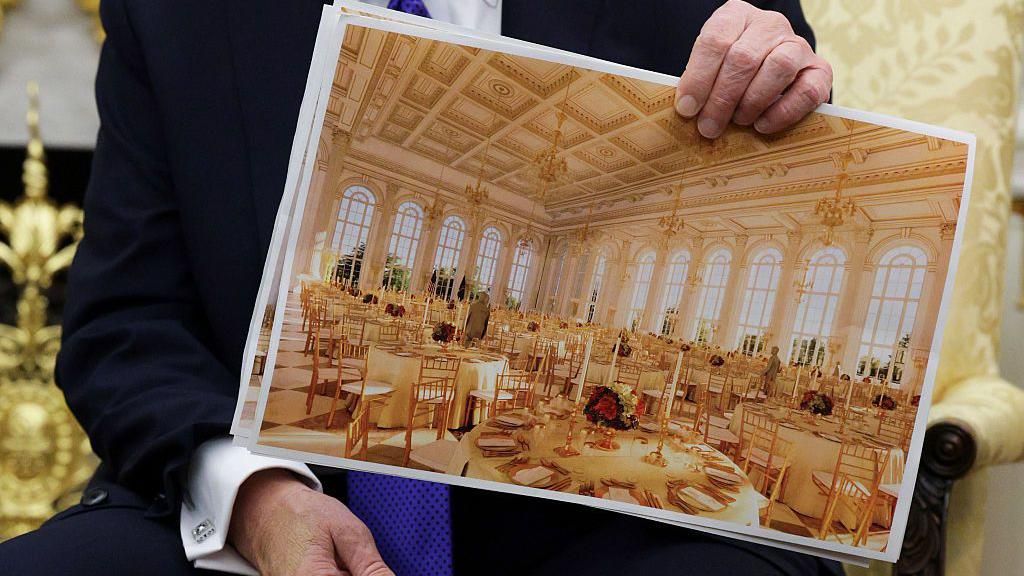
In a high-stakes legislative win for congressional Democrats, the Senate’s nonpartisan rule-keeper has struck down a provision that would have allocated $1 billion in taxpayer funds for security upgrades tied to former President Donald Trump’s controversial White House East Wing overhaul, which includes a planned $400 million ballroom. The ruling delivered a major early blow to Republican efforts to advance the spending provision through the budget reconciliation process, a procedural tool that allows budget-related bills to move forward with a simple majority and avoid the Senate filibuster. The provision was tucked into a larger omnibus spending package that would fund immigration agencies under the Department of Homeland Security.
The ruling came from Senate Parliamentarian Elizabeth MacDonough, the respected procedural referee who has overseen Senate rules compliance since 2012. On Saturday, Democrats confirmed that MacDonough had deemed the security funding provision out of order, finding it violated the Byrd Rule — a longstanding Senate regulation that bars extraneous, non-budgetary provisions from being included in reconciliation legislation. MacDonough determined the funding covered activities that fall outside the jurisdiction of the Senate Judiciary Committee, which has oversight over the package, and failed to meet the Byrd Rule’s requirements for provisions included in reconciliation.
Republicans originally pushed for the taxpayer-funded security upgrades after a late April shooting at a Trump gala event that the former president attended. The incident prompted the Trump administration to accelerate timelines for the ballroom project, which was already underway after construction crews demolished the historic East Wing last October to clear space for the new facility, which Trump has billed as “the finest ballroom of its kind, anywhere in the world”.
Following the ruling, Trump has confirmed that private donors will cover the $400 million cost of the ballroom itself, but Republicans had sought to draw on public funds to cover Secret Service security upgrades for the renovated space. Democrats had forcefully pushed back against the public funding allocation, arguing that taxpayer money should not be used to fund a personal vanity project for the former president.
“Republicans tried to make taxpayers foot the bill for Trump’s billion-dollar ballroom. Senate Democrats fought back — and blew up their first attempt,” Senate Minority Leader Chuck Schumer wrote in a post on social media platform X Saturday. “Now Republicans say they’re going back to the drawing board to try again. And Senate Democrats will be ready to stop them again. Americans don’t want a ballroom. They don’t need a ballroom. And they sure as hell should not be forced to pay for one.”
Oregon Senator Jeff Merkley, the ranking Democratic member of the committee overseeing the package, warned that Republicans are expected to revise the legislation to appease Trump and resubmit the provision, adding that Democrats are fully prepared to challenge any new attempt to include the funding.
Ryan Wrasse, a spokesperson for Senate Majority Leader John Thune, pushed back on suggestions the maneuver was irregular, noting that revisions to provisions during reconciliation are common. “Redraft. Refine. Resubmit. None of this is abnormal during a Byrd process,” Wrasse wrote on X.
The ballroom project has sparked controversy from its inception, with preservation advocates pushing back aggressively against the demolition of the historic East Wing. The National Trust for Preservation filed a lawsuit against the Trump administration to halt construction, arguing that the teardown and renovations violate federal law because they were carried out without formal congressional approval. While a federal appeals court ruled in April that construction could continue on both the underground and above-ground portions of the project, legal challenges remain ongoing.
The ballroom project is part of a broader slate of changes Trump has pushed for in Washington D.C. during his second term, rooted in his background as a real estate developer. The former president has already added gold decorative finishes to the Oval Office, replaced part of the White House Rose Garden with a patio modeled after the one at his Mar-a-Lago resort in Florida, renamed multiple prominent D.C. institutions including the Kennedy Center and United States Institute of Peace to include his name, and unveiled plans for a 250-foot triumphal arch near Arlington National Cemetery.