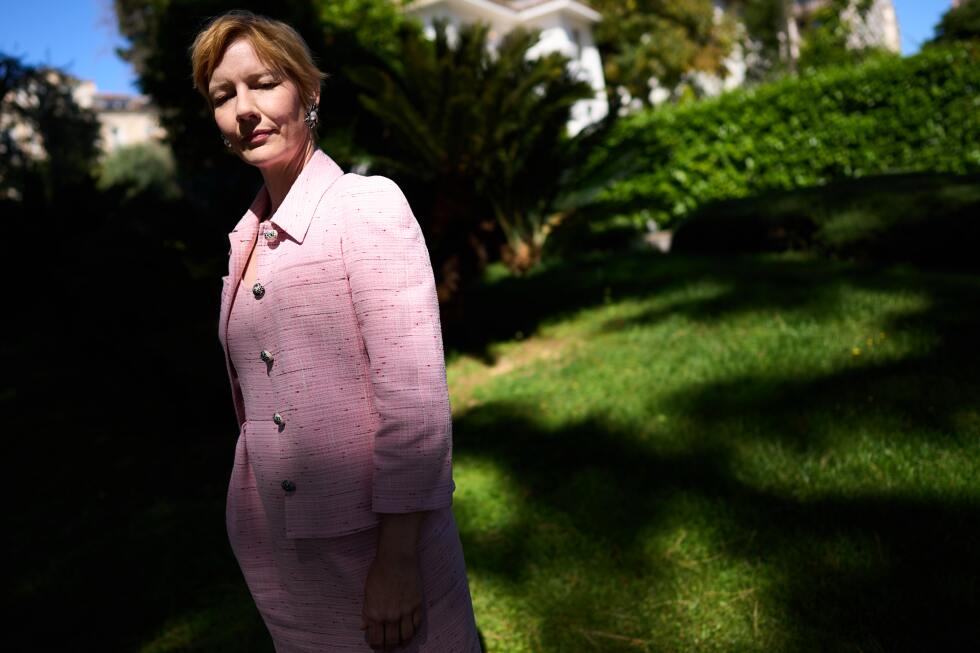
CANNES, France — For acclaimed German actress Sandra Hüller, unbridled emotional outbursts are not her default performance style, nor her preferred mode of being. Soft-spoken and drawn to quiet reserve, Hüller often builds her most riveting on-screen intensity through stillness, through the quiet power of simply watching a scene unfold. But when her character does finally break into rage, grief, or even unexpected joy — like her viral karaoke scene in this year’s box office hit — the result is nothing short of spectacular.
“It’s not something I particularly enjoy doing,” Hüller shared in a candid interview in a sun-dappled Cannes garden, pausing to take a drag from a cigarette before reflecting further. “I’m actually more drawn to characters who don’t erupt constantly. To be honest, people who lash out all the time can be pretty draining, right? I much prefer observing others to being the center of attention myself. When you deliver a big, explosive performance, all eyes are on you — I think that’s probably the root of my preference. Don’t worry, I won’t drag you into playing therapist today to unpack all that,” she said with a warm laugh.
This year, audiences and critics alike are getting the full, breathtaking scope of Hüller’s talent, with four wildly diverse new releases showcasing every corner of her range. The most anticipated of these projects is *Fatherland*, the latest feature from award-winning Polish filmmaker Paweł Pawlikowski, the visionary behind Oscar-winning works *Ida* and *Cold War*, which premiered in competition for the Palme d’Or at the 2026 Cannes Film Festival.
Within days of its first screening, *Fatherland* — set for a global release later this year via Mubi — has emerged as one of the festival’s most widely praised standout entries and an early frontrunner for the festival’s top prize. Staying true to Pawlikowski’s signature aesthetic, the film is shot in elegant, stark black-and-white, clocks in at a tight 82 minutes, and hums with the unprocessed grief and fractured identity of post-World War II Europe.
Hüller stars as Erika Mann, daughter of iconic German author Thomas Mann, played by Hanns Zischler. In 1949, the pair return to their divided homeland for a cross-country road trip, moving seamlessly between the U.S.-administered West Germany and Soviet-controlled East Germany. Their old country has ceased to exist, leaving them caught between two opposing new worlds — what Thomas Mann dubs the choice between “Mickey Mouse or Stalin.”
For Hüller, who was born in former East Germany, *Fatherland* comes on the heels of her chilling, Oscar-nominated turn in Jonathan Glazer’s *The Zone of Interest*, which was set on the grounds of the Auschwitz concentration camp. While her *Zone of Interest* character was complicit in Nazi atrocities, Erika in *Fatherland* is a vehement anti-Nazi, forced to live among former collaborators who refuse to reckon with their actions.
“Portraying emptiness is an enormous challenge, and I think tackling that is a really big deal,” Hüller explained. “We talk about this period constantly in German history classes, but I never got a real sense of what it actually felt like to live it. We have thousands of photos of women clearing rubble from the streets, because most men were dead or imprisoned after the war. But that feeling of waking up and no longer recognizing the country you were born into — that’s something we rarely connect with.”
*Fatherland* is far from Hüller’s first iconic turn at Cannes. The festival has already hosted two of her most celebrated career performances: the 2016 critically adored comedy *Toni Erdmann*, and 2023’s Palme d’Or-winning *Anatomy of a Fall*. What makes 2026 unique is the sheer volume of high-profile, diverse work coming from the actress, a career streak most performers only dream of.
Earlier this year, Hüller took home the Berlin Film Festival’s Silver Bear for Best Leading Performance for *Rose*, a meditative exploration of gender set in the aftermath of the Thirty Years’ War. In the spring’s blockbuster hit *Project Hail Mary*, she co-starred opposite Ryan Gosling, who encouraged her to lean into the spontaneous energy of what became the film’s most beloved scene: a raw karaoke performance of Harry Styles’ “Sign of the Times.” She will also appear in Oscar-winning director Alejandro G. Iñárritu’s highly anticipated upcoming feature *Digger*, set for release later in 2026.
“I’m almost 50 now, and I feel incredibly lucky to be having this run of experiences right now,” Hüller said. “For a lot of my peers at this age, work slows down, or it feels like the end of the road. That’s not the case for me, and I don’t take that for granted.”
Just as Erika is torn between two competing worlds in *Fatherland*, Hüller currently moves seamlessly between European art house cinema and major Hollywood blockbusters, thriving in both spaces. “I’ve just been looking at every project that comes my way and asking myself if I can say yes, if I’m ready to take it on,” she explained. “So many new experiences are coming my way that I’ve never had before — I’d be so stupid to turn them down. It’s not about chasing success, really. It’s about growing as a person and an artist, getting to know new spaces so you can move more freely through the world. That brings me so much joy. It’s dangerous, it’s way outside of my comfort zone, but it’s worth it.”
Despite this unprecedented career high, success has come with a trade-off for Hüller, who identifies first and foremost as a theater actor. She is eager to return to the grassroots theater collective where she honed her craft early in her career; she still directs productions with the group, but her widespread fame makes it impossible for her to step back into an ensemble role without drawing unwanted attention.
“I miss theater like a heartbroken person misses someone they love,” she said, her eyes filling with tears as she spoke. “Even talking about it right now, I can’t hold back the tears.”
Pawlikowski, known for his stripped-back, minimalist filmmaking style, occasionally adds spontaneous moments to his meticulously crafted shots. During filming, he came up with a last-minute scene where Erika, who has grown quietly skeptical of her father’s cautious optimism for a new, united Germany, finally confronts him in a shouting match.
“I told her, ‘Listen, if the scene doesn’t work, I won’t put it in the final cut — just give it your best shot,’ and she was brilliant,” Pawlikowski recalled in an interview at Cannes. “That’s the luxury of working with an actress who can do anything. I just watched her and thought, how did she pull that off? It was even better than what I’d imagined.”
Hüller didn’t expect Pawlikowski’s unique directorial approach to reshape her acting process, but it did. Pawlikowski’s framing leaves an enormous amount of empty space for performances to breathe, and Hüller had to learn how to occupy that space without falling into stillness that reads as lifeless on camera.
“It all comes down to presence, awareness, and focus, and having a rich inner life that isn’t necessarily visible on the outside,” she said. “But audiences can feel it, somehow. The more precise that inner movement is, the better it works within Pawlikowski’s very precise, carefully constructed frames. That’s a lesson I had to learn through making this film, and it’s one I’ll carry with me for the rest of my career.”